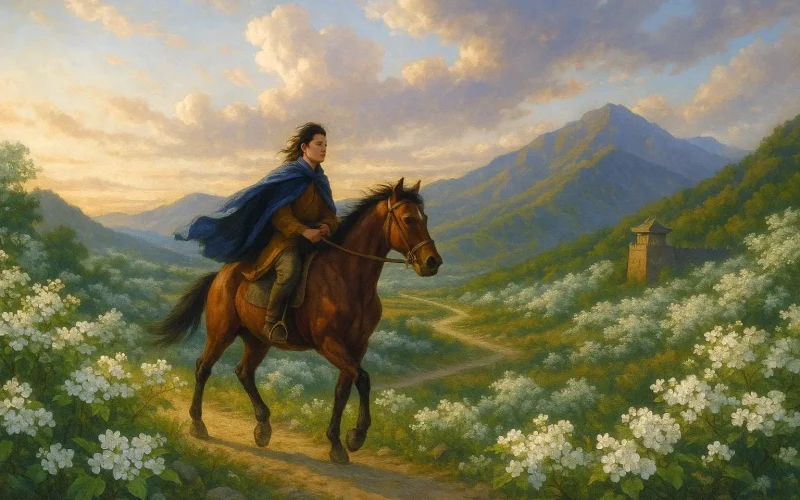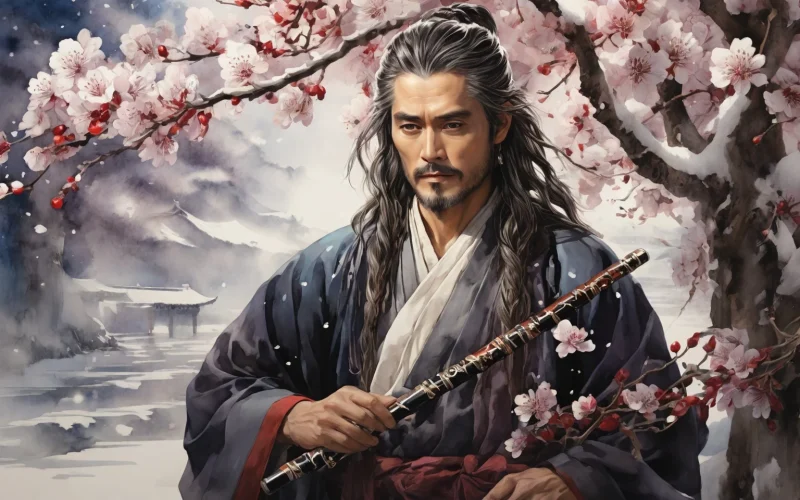



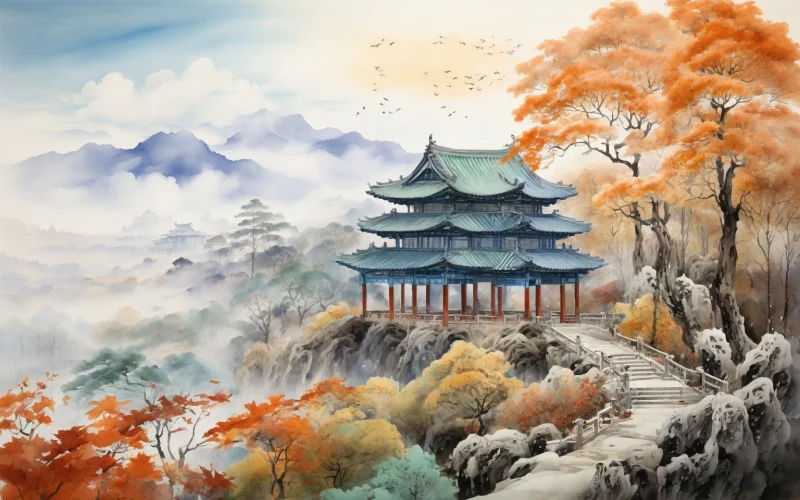
The tower overlooks frosty trees;
Speckless is the mirror-like sky.
The South Mountain and autumn bre
Vie to be more sublime and high.
Original Poem
「长安秋望」
杜牧
楼倚霜树外,镜天无一毫。
南山与秋色,气势两相高。
Interpretation
This poem was likely composed around 850 AD during Du Mu's later years while residing in Chang'an, representing a paradigm of his scenic quatrains. Having experienced years of provincial postings, the poet had finally returned to the empire's center, serving in positions such as Assistant Director in the Ministry of Personnel. By this period, Du Mu's political fervor had cooled, and he turned instead to contemplate nature and the cosmos with a clearer, more discerning gaze. The unique value of Autumn View from Chang'an lies in its complete departure from the conventional tradition of lamenting autumn, reconstructing the aesthetic essence of the season from an unprecedented and elevated perspective. The pristine clarity of "mirror-like sky without a trace" and the majestic grandeur of "their vigor vies in height" are not only rare strokes of robust power in late Tang poetry but also resonate with the refinement and sublimation of the poet's inner world after navigating the vicissitudes of an official career.
First Couplet: 楼倚霜树外,镜天无一毫。
Lóu yǐ shuāng shù wài, jìng tiān wú yī háo.
The tower leans beyond frost-touched trees; A mirror-sky, without a trace of haze.
Explication: "The tower leans beyond frost-touched trees" establishes the poem's lofty vantage point through the spatial relationship between architecture and flora. The word "leans" is masterful: it depicts the tower as if actively nestling against the trees while subtly implying a tension between human construction and natural creation. The frost-touched trees of autumn, with their mottled colors and sturdy branches, form a solid foundation for the high tower. The following line, "A mirror-sky, without a trace of haze," accomplishes a visual leap from earth to firmament. The metaphor "mirror-sky" describes not only the autumn sky's clarity but also endows it with a sentient, reflective quality—it mirrors not just scenery but the viewer's state of mind. The absolute assertion "without a trace" creates a purity akin to a vacuum, reserving vast space for the eruption of vigor in the subsequent lines.
Final Couplet: 南山与秋色,气势两相高。
Nánshān yǔ qiūsè, qìshì liǎng xiāng gāo.
South Mountain and autumn's hue, in view— Their vigor vies in height, those splendid two.
This couplet represents the pinnacle of the poetic practice of using concrete imagery to convey abstract concepts in Chinese poetics. The poet places the tangible South Mountain alongside the intangible essence of autumn's hues, allowing them to engage in a dialogue at the level of "vigor." The word "vies" is particularly crucial: it denotes not a one-sided contrast but a dynamic of mutual stimulation and affirmation. South Mountain appears more precipitous because it is measured against autumn's expanse, while autumn's hues gain tangible form and grandeur through their association with the mountain's solid presence. This dynamic process of "vying in height" utterly animates the scene, elevating a static landscape into a spiritual vista brimming with vital tension. In Du Mu's rendition, autumn is no longer merely a symbol of decay but a presence of immense vitality, standing shoulder-to-shoulder with the eternal landmark of South Mountain.
Holistic Appreciation
This is a work that rewrites the philosophy of time through a poetics of space. By meticulously constructing a vertical space—tower above trees, sky above tower, South Mountain and autumn's hue above all—Du Mu achieves a spiritual purification of autumn through physical elevation. The poem's four lines form a perfect visual chain: vantage point (tower) → background (mirror-sky) → distant view (South Mountain) → artistic conception (autumn's hue), each layer receding further and rising higher.
The poem's core revolution lies in its abstraction of "autumn's hue." Traditional autumn poems often convey emotion through specific imagery (fallen leaves, returning geese, withered lotuses). Du Mu, however, makes "autumn's hue" itself the subject of aesthetic appreciation, divorcing it from concrete carriers and having it contend in vigor directly with South Mountain. This technique of reifying the spirit of a season lifts the poem beyond the level of scene-specific emotion into metaphysical contemplation of nature's essence. Autumn's hue is no longer an attribute of scenery but becomes a personified force of nature, possessing independent dignity comparable to a mountain.
Noteworthy is the use of the word "vigor." Against the backdrop of a late Tang poetic style increasingly tending toward delicacy, Du Mu's use of "vigor" as the poem's linchpin undoubtedly carries the significance of a literary counter-current. This vigor stems from South Mountain's geological form, from the clear, crisp air of autumn, and equally from the outward projection of the poet's inner spirit. When he writes "vies in height," he is essentially declaring that the human heart can indeed stand as tall as mountains and as expansive as autumn's breadth. This is a final echo of the High Tang spirit within the late Tang, and Du Mu's ultimate affirmation of the scholar-official's spiritual stature.
Artistic Merits
- Vertical Aesthetics of Spatial Construction: From frost-touched trees (ground level) to tower (human-made level) to mirror-sky (cosmic level) and finally to South Mountain (natural landmark level), the poem establishes a clear vertical structure. This design of progressively ascending space faithfully reflects Chang'an's geographical feature (South Mountain lying to the south) while serving as a metaphor for continuously rising spiritual realms.
- Poetic Wisdom in Shifting Between Concrete and Abstract: Placing the concrete "South Mountain" alongside the abstract "autumn's hue" allows the physical mountain to provide a visual anchor for the intangible autumn quality, while the autumn hue, in turn, infuses the mountain with seasonal spirit. This technique of mutual substantiation and enhancement between concrete and abstract expands the expressive boundaries of classical poetry.
- The Ultimate Practice of an Aesthetic of Purity: The absolute purity of "without a trace," the perfect reflection of "mirror-sky," and the monochromatic filter of "frost-touched trees" collectively create a consummate visual experience of purity. Through this refinement of a complex world, Du Mu created one of the purest autumnal visions in the history of Chinese poetry.
Insights
This work demonstrates a transcendent mode of observation: when we view the world from a sufficiently lofty spiritual vantage point, all things can reveal their most essential and majestic forms. Du Mu does not succumb to the traditional sentiment of lamenting autumn. Instead, he ascends a high tower, gazes toward South Mountain, and allows autumn's hue to unfold its grand scale between heaven and earth. The lesson for the modern reader is this: perspective determines realm—much of the "bleakness" and "decay" that troubles us may simply be because we do not stand high enough or see far enough.
The imagery of "their vigor vies in height" reveals an ideal spiritual relationship between humanity and nature: it is not humans sighing at nature's greatness and feeling insignificant, but the human spirit capable of engaging in equal dialogue with natural grandeur, each stimulating the other. South Mountain is lofty, autumn's hue is vast, yet the poet's heart is ample enough to encompass it all, even to stand as its equal. This reminds us: true spiritual freedom lies in facing the cosmos as a subject, not forever remaining a passive admirer or mourner.
Ultimately, this poem offers a methodology for opening the infinite within limitation. Situated within the declining momentum of the late Tang and the confined space of Chang'an, Du Mu could, through a single glance at an autumn scene, construct a spiritual universe of such loftiness and grandeur. It proves one point: external limitations can never confine the flight of the spirit; if the mind is sufficiently clear and lofty, even within a tiny room one can witness the magnificent sight of South Mountain and autumn's hue vying in height. In this sense, Autumn View from Chang'an is not merely a scenic poem but a revelation on how to transcend one's era and circumstances and maintain spiritual majesty.
Poem translator
Xu Yuanchong (许渊冲)
About the poet
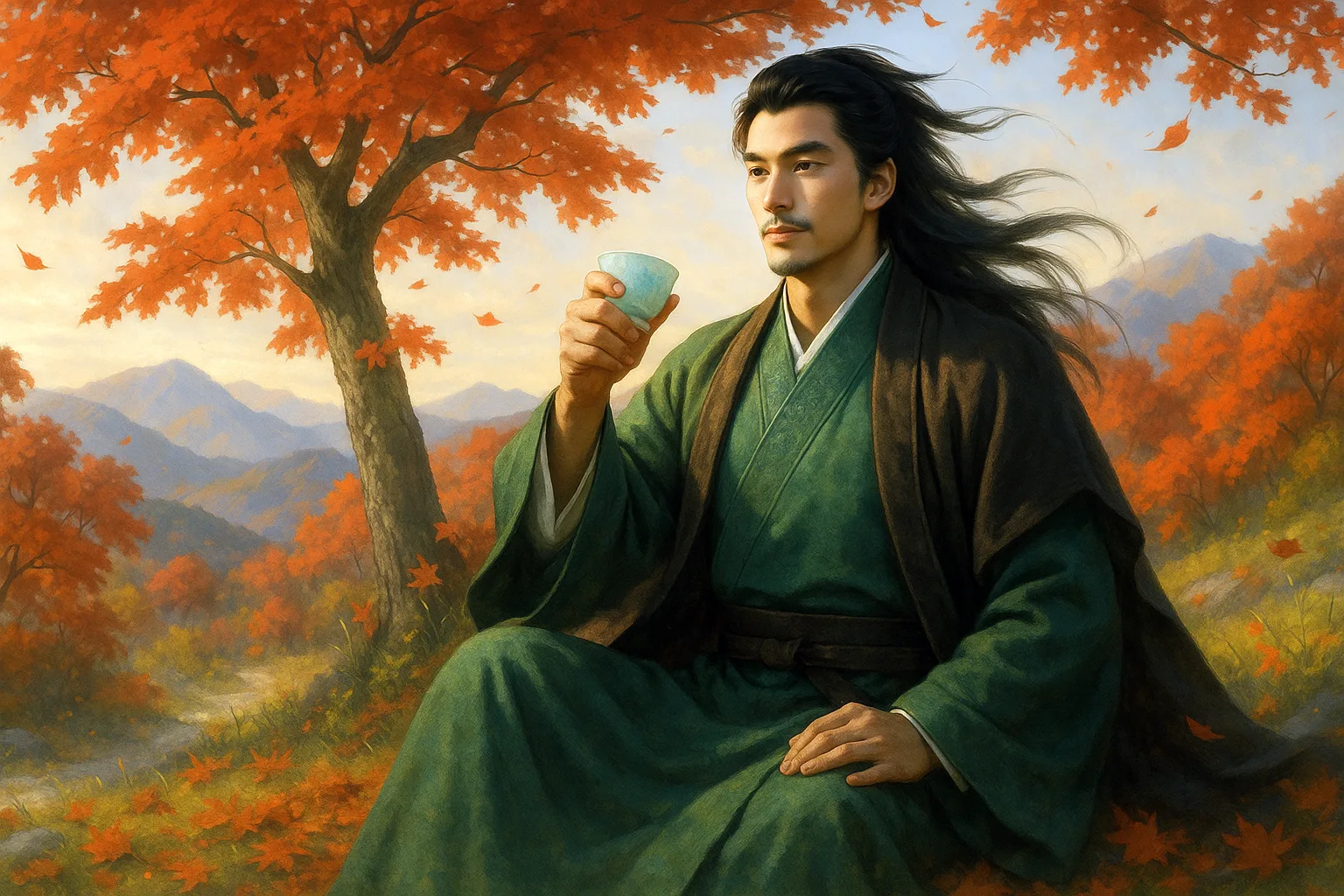
Du Mu (杜牧), 803-853 AD, was a native of Xi'an, Shaanxi Province. Among the poets of the Late Tang Dynasty, he was one of those who had his own characteristics, and later people called Li Shangyin and Du Mu as "Little Li and Du". His poems are bright and colorful.