


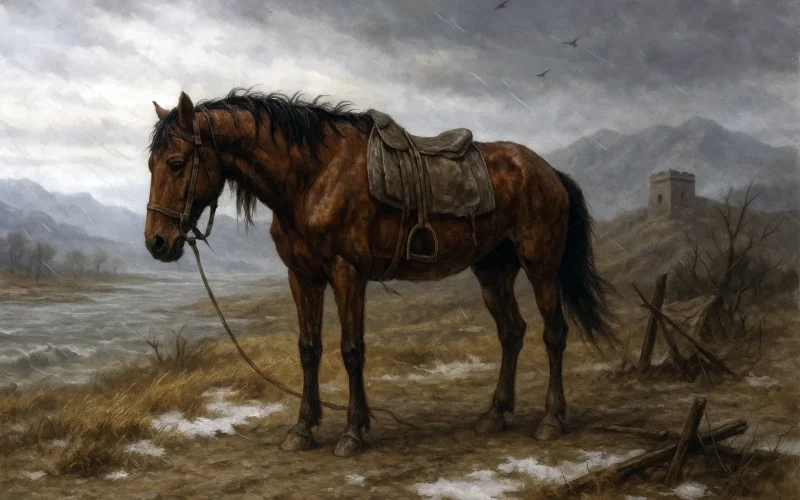
I've ridden you for long, my horse,
On the cold frontier deep in snow.
In dust you've grown old and weak,
Sick at the year's end, it grieves me so.

Are you different from other steeds?
You're gentle and good even now.
Though humble, your love is deep;
I'm moved and sigh with furrowed brow.
Original Poem
「病马」
杜甫
乘尔亦已久,天寒关塞深。
尘中老尽力,岁晚病伤心。
毛骨岂殊众?驯良犹至今。
物微意不浅,感动一沉吟。
Interpretation
This work was composed during Du Fu's later years of wandering in southwestern China, likely between 760-768 CE while he resided in Chengdu and Kuizhou. By this time, the poet had endured the turmoil of war, displacement, poverty, and illness. His own circumstances formed a profound parallel with the fate of an aging, ailing horse. Du Fu wrote many poems about horses, often using steeds as symbols of heroic aspiration, but this poem, "The Sick Horse," strikes a unique path by turning his gaze toward an ordinary, weakened, yet steadfast laborer. It is no longer a symbol of heroic ambition but a profound elegy for all those lives that have toiled silently under the weight of fate, only to be forgotten in the end. It represents a radiant flash of Du Fu's compassionate heart focusing on the minute and the marginalized.
First Couplet: “乘尔亦已久,天寒关塞深。”
Chéng ěr yì yǐ jiǔ, tiān hán guān sài shēn.
Long have I ridden you, through years grown old; / Through bitter cold, through passes deep, our story's told.
The opening reads like a dialogue with an old friend, its tone measured yet heavy with the passage of time. "Long have I ridden you" speaks of accumulated years and shared experience. "Through bitter cold, through passes deep" condenses countless arduous journeys into six highly visual words. This horse's life completely overlaps with the poet's own wanderings; it is not merely a mount but a witness and fellow bearer of the turbulent years and bitter travels.
Second Couplet: “尘中老尽力,岁晚病伤心。”
Chén zhōng lǎo jìn lì, suì wǎn bìng shāng xīn.
In dust and toil, your strength spent, worn and old; / Year's end brings sickness—grievous to behold.
This couplet addresses the central theme of the "sick horse," intensifying the emotional weight. "In dust and toil" linked with "your strength spent" writes of a lifetime of exhausting labor—this "strength" is the total vital force expended for survival and duty. "Year's end" marks the stage of life, "sickness" is the present state, and "grievous to behold" is the powerful projection of the poet's own feeling. The poet grieves for the horse, but is he not also grieving for himself and for all lives worn down to sickness and decay? Here, the sorrow of the object and the self merges into one.
Third Couplet: “毛骨岂殊众?驯良犹至今。”
Máo gǔ qǐ shū zhòng? Xùn liáng yóu zhì jīn.
In hide and bone, what sets you from the rest? / Your gentle, faithful nature stands the test.
The focus turns from external form to inner character. With the seemingly plain phrase "what sets you from the rest?" the poet emphasizes the horse's ordinariness, yet with the resolute "stands the test" he highlights the nobility of its nature. Here, "gentle, faithful" transcends simple obedience, rising to a quality of loyalty, resilience, and gentleness maintained even through hardship. This praises the horse, but even more, it is Du Fu's tribute to a certain spirit of character—one that does not lose its virtue due to commonness, nor alter its nature due to hardship.
Fourth Couplet: “物微意不浅,感动一沉吟。”
Wù wēi yì bù qiǎn, gǎndòng yī chén yín.
A creature slight, yet rich in deep intent; / Moved, I ponder what your life has meant.
The juxtaposition of "a creature slight" with "rich in deep intent" creates a powerful contrast, marking the moment where the poem's spirit achieves its ascent. Within a conventional, worldly value system, an old and sick horse holds no significance; yet, in the poet's emotional and ethical universe, the "intent" borne from a lifetime of devotion carries immense weight. The phrase "Moved, I ponder" describes a state where emotion, having peaked, turns inward toward contemplation. Within this ponder resides compassion, respect, a sorrow that reflects back upon oneself, and, more profoundly, a meditation on life's value that transcends utilitarian measure.
Holistic Appreciation
This work represents the ultimate embodiment of the "state where object and self become one" in Du Fu's poetry describing objects. The entire poem displays no technical flourish, only plain narration and a deep flow of feeling, yet it achieves a deeply moving artistic effect.
Its brilliance lies in a "doubling of identity": superficially, the poet is the horse's master, observer, and sympathizer; in essence, poet and horse are a community of shared fate, fellow bearers of hardship. Every word describing the horse—"long," "worn," "sickness," "gentle, faithful"—is simultaneously a portrayal of the poet's own situation and state of mind. This technique of describing the object being to describe the person, of pitying the object being to pity the self, gives the poem an exceptionally profound emotional foundation.
Even more profound is how, through this "sick horse," Du Fu erects a "monument to the ordinary." He praises not a steed that conquers territories, but a humble horse that bears burdens over long distances; not a hero of glorious achievement, but an ordinary life that has given its all. This discovery and reverence for the "deep intent" within the "slight creature" reflects the vast, all-embracing compassion of Du Fu's heart and is central to his poetic spirit.
Artistic Merits
- A Torrent of Feeling within Plain Description: The poem employs language almost as plain as speech, like recounting daily matters. Yet, through the subtle use of particles like "long have," "stands the test," "what," and "ponder," it contains boundless emotion and deep feeling, reaching the artistic realm where "utmost plainness reveals the most vibrant color."
- Layered Progression and Circular Structure: The poem moves from recounting shared hardships of the past (first couplet), to depicting the present state of decline and illness (second couplet), to recognizing the creature's enduring nature (third couplet), and finally resolving into a moment of shared feeling and philosophical reflection (fourth couplet). Emotion flows from the quietude of common memory, gradually ascending to a climax of compassion, before settling into a profound, contemplative silence. This progression creates a complete, resonant emotional movement.
- Subtle Use of Contrast: The past hardships of "bitter cold… passes deep" contrast with the present desolation of "year's end brings sickness." The physical ordinariness of "hide and bone… what sets you from the rest?" contrasts with the spiritual nobility of "gentle, faithful nature stands the test." Through these contrasts, the poem's tension and theme are reinforced.
- Personification and Ethical Elevation in Object Poetry: The poet completely abandons the traditional approach of treating the horse as a tool or symbol. Instead, he respects and dialogues with it as a subject with a complete life history and moral character, granting object poetry an unprecedented ethical depth and humanistic brilliance.
Insights
The most precious insight this work offers concerns "how to regard and evaluate life." In a world that venerates success, strength, and conspicuous value, Du Fu turns a gaze both deeply affectionate and solemn upon a sick, weak, old horse of no extraordinary appearance ("hide and bone… what sets you from the rest?"). He teaches us that the value of a life is never determined by its external utility, strength, or status, but by the character it displays in the process ("gentle, faithful"), by the "intent" of its wholehearted giving, and by the dignity and care it inherently deserves as a life.
It compels us to reflect: in our own time, are we too enthralled by the glory of the champion "steed," while overlooking countless ordinary contributors akin to the "sick horse"? Can we, like Du Fu, perceive the "profound meaning" within a "seemingly insignificant being" and be moved to "contemplate" its worth? This heartfelt compassion and respect for the weak, the overburdened, and the fallen constitute the essential force that counters societal apathy and fosters a more compassionate world.
Therefore, "The Sick Horse" is not merely a poem lamenting personal circumstance; it is a great piece on the ethics of life. It reminds us that true human kindness begins with a profound understanding and care for every life that seems insignificant. Du Fu's "ponder" traverses the centuries, remaining a gentle, persistent inquiry to the conscience of every era.
Poem translator
Xu Yuanchong (许渊冲)
About the poet

Du Fu (杜甫), 712 - 770 AD, was a great poet of the Tang Dynasty, known as the "Sage of Poetry". Born into a declining bureaucratic family, Du Fu had a rough life, and his turbulent and dislocated life made him keenly aware of the plight of the masses. Therefore, his poems were always closely related to the current affairs, reflecting the social life of that era in a more comprehensive way, with profound thoughts and a broad realm. In his poetic art, he was able to combine many styles, forming a unique style of "profound and thick", and becoming a great realist poet in the history of China.