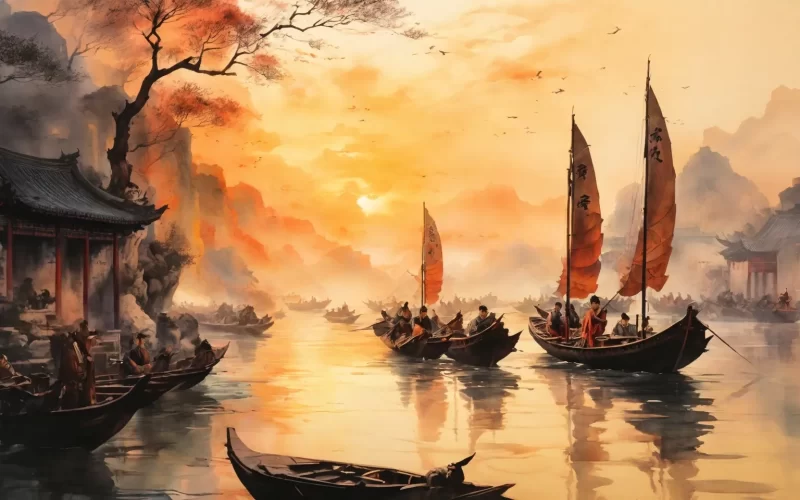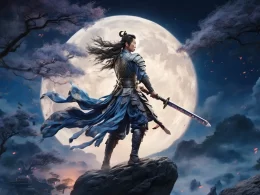



The war-chariots rattle,
The war-horses whinny.
Each man of you has a bow and a quiver at his belt.
Father, mother, son, wife, stare at you going,
Till dust shall have buried the bridge beyond Changan.
They run with you, crying, they tug at your sleeves,
And the sound of their sorrow goes up to the clouds;
And every time a bystander asks you a question,
You can only say to him that you have to go.

...We remember others at fifteen sent north to guard the river
And at forty sent west to cultivate the campfarms.
The mayor wound their turbans for them when they started out.
With their turbaned hair white now, they are still at the border,
At the border where the blood of men spills like the sea --
And still the heart of Emperor Wu is beating for war.

...Do you know that, east of China's mountains, in two hundred districts
And in thousands of villages, nothing grows but weeds,
And though strong women have bent to the ploughing,
East and west the furrows all are broken down?

...Men of China are able to face the stiffest battle,
But their officers drive them like chickens and dogs.
Whatever is asked of them,
Dare they complain?
For example, this winter
Held west of the gate,
Challenged for taxes,
How could they pay?
...We have learned that to have a son is bad luck-
It is very much better to have a daughter
Who can marry and live in the house of a neighbour,
While under the sod we bury our boys.

...Go to the Blue Sea, look along the shore
At all the old white bones forsaken --
New ghosts are wailing there now with the old,
Loudest in the dark sky of a stormy day.
Original Poem
「兵车行」
杜甫
车辚辚,马萧萧,行人弓箭各在腰。
耶娘妻子走相送,尘埃不见咸阳桥。
牵衣顿足拦道哭,哭声直上干云霄。
道旁过者问行人,行人但云点行频。
或从十五北防河,便至四十西营田。
去时里正与裹头,归来头白还戍边。
边亭流血成海水,武皇开边意未已。
君不闻,汉家山东二百州,
千村万落生荆杞?
纵有健妇把锄犁,禾生陇亩无东西。
况复秦兵耐苦战,被驱不异犬与鸡。
长者虽有问,役夫敢申恨;
且如今年冬,未休关西卒。
县官急索租,租税从何出?
信知生男恶,反是生女好;
生女犹得嫁比邻,生男埋没随百草。
君不见,青海头,古来白骨无人收?
新鬼烦冤旧鬼哭,天阴雨湿声啾啾。
Interpretation
This poem was composed in 751 AD, during the Tianbao era of Emperor Xuanzong, a time when the Tang dynasty's expansionist campaigns were at their most brutal. That year, Tang forces suffered heavy casualties in successive wars against Nanzhao and the Khitans, and in fierce battles with Tibetan forces in the Qinghai region. To replenish its armies, the court forcibly conscripted men from Guanzhong and as far away as Henan and Hebei. The relentless conscription, the vast distances involved, and the savagery of the warfare emptied villages and left fields abandoned. Although Du Fu had not yet lived through the An Lushan Rebellion, he had already perceived with keen insight the profound social crisis festering beneath the dynasty's golden age. The poem is not based on a single, specific battle, but is a powerful work of artistic synthesis, in which the poet blends observation and hearsay to create a representative, essential truth. Using a fictional yet archetypal scene of conscripts departing, it exposes the bleeding wound beneath the Tang empire's splendid robes, standing as one of his earliest epic works to directly indict contemporary ills and give voice to the people's suffering.
First Section:车辚辚,马萧萧,行人弓箭各在腰。耶娘妻子走相送,尘埃不见咸阳桥。牵衣顿足拦道哭,哭声直上干云霄。
Chē lín lín, mǎ xiāo xiāo, xíngrén gōngjiàn gè zài yāo. Yé niáng qīzǐ zǒu xiāng sòng, chén'āi bùjiàn Xiányáng qiáo. Qiān yī dùn zú lán dào kū, kūshēng zhí shàng gān yúnxiāo.
War chariots rumble, battle steeds whinny, and the conscripted soldiers, with bows and arrows at their waists, are about to embark on a long journey. Their parents, wives, and children come running to see them off; the churning dust clouds blot out the Xianyang Bridge. Kin cling desperately to their clothes, stamp their feet, block the road, and weep. Their sorrowful cries shoot straight up to the highest heavens, shaking heaven and earth.
With brushstrokes akin to a cinematic lens, the poet opens with a送别 scene of soul-shaking power. The auditory depiction, "Chariots rumble, rumble; horses neigh, neigh," instantly immerses the reader in a tense, tragic narrative atmosphere. Then, the four successive actions—"Clutching clothes, stamping feet, blocking the road, they cry"—precisely capture the most instinctive behaviors of despair, pushing the agony of a life-and-death parting to its extreme. The exaggerated contrast between the visual obscurity of "Dust clouds rise and swallow up the Xianyang Bridge" and the auditory penetration of "Their wailing soars straight up and pierces through the sky" jointly constructs a space of suffering shrouded in悲愤 and dust.
Second Section:道旁过者问行人,行人但云点行频。或从十五北防河,便至四十西营田。去时里正与裹头,归来头白还戍边。边庭流血成海水,武皇开边意未已。君不闻,汉家山东二百州,千村万落生荆杞?纵有健妇把锄犁,禾生陇亩无东西。况复秦兵耐苦战,被驱不异犬与鸡。
Dào páng guòzhě wèn xíngrén, xíngrén dàn yún diǎn xíng pín. Huò cóng shíwǔ běi fáng hé, biàn zhì sìshí xī yíngtián. Qù shí lǐzhèng yǔ guǒ tóu, guīlái tóu bái hái shù biān. Biān tíng liúxuè chéng hǎishuǐ, Wǔ huáng kāi biān yì wèi yǐ. Jūn bù wén, Hàn jiā Shāndōng èrbǎi zhōu, qiān cūn wàn luò shēng jīng qǐ? Zòng yǒu jiàn fù bǎ chú lí, hé shēng lǒng mǔ wú dōngxī. Kuàng fù Qín bīng nài kǔzhàn, bèi qū bù yì quǎn yǔ jī.
A passerby on the roadside asks these soldiers, who can only reply helplessly: "Conscription is simply too frequent." Some were sent north to guard the Yellow River at fifteen, and by forty are transferred west to farm garrison fields. When they first left, they were so young the village head had to help them tie their head-cloths; they return white-haired, only to be sent back to garrison the frontier. Blood flows like a sea on the border battlegrounds, yet the Emperor's ambition to expand the territory never ceases. Have you not heard? In the two hundred-plus prefectures east of Mount Hua, thousands upon thousands of villages lie in waste, overgrown with brambles and thorns. Even if strong women struggle to grasp the plough and hoe, the crops in the fields grow sparse and disorderly, yielding little. Moreover, though we soldiers from Guanzhong can endure bitter warfare, we are driven about by the authorities no differently than chickens or dogs, devoid of all dignity.
This section, through the voice of the "conscript," unfolds a tearful indictment against the war machine. The poet uses temporal contrasts—"fifteen" versus "forty," "the headman wrapped their hair-cloths" (departing) versus "white-haired… sent to garrison" (returning)—to reveal how the conscription system mercilessly devours individual lives. Then, the focus shifts from personal plight to a social panorama: the causal link between "The border's blood now flows in seas" and "the Martial Emperor's will… is unfulfilled" points directly at the ruler's ambition. "A thousand, ten thousand villages where thorns and scrub now grow" presents the war's devastating destruction of agricultural productivity. Finally, the line "Are herded forth no differently than chickens or dogs" uses a shocking simile to lay bare the soldiers' inhuman treatment by those in power, deepening the poem from a description of phenomena to a revelation of their本质.
Third Section:长者虽有问,役夫敢申恨?且如今年冬,未休关西卒。县官急索租,租税从何出?信知生男恶,反是生女好。生女犹得嫁比邻,生男埋没随百草。君不见,青海头,古来白骨无人收。新鬼烦冤旧鬼哭,天阴雨湿声啾啾。
Zhǎngzhě suī yǒu wèn, yìfū gǎn shēn hèn? Qiě rú jīnnián dōng, wèi xiū Guānxī zú. Xiànguān jí suǒ zū, zūshuì cóng hé chū? Xìn zhī shēng nán è, fǎn shì shēng nǚ hǎo. Shēng nǚ yóu dé jià bǐlín, shēng nán máimò suí bǎi cǎo. Jūn bù jiàn, Qīnghǎi tóu, gǔ lái báigǔ wú rén shōu. Xīn guǐ fányuān jiù guǐ kū, tiān yīn yǔ shī shēng jiū jiū.
Even if an elder like you asks with concern, how dare we who serve pour out the hatred in our hearts? Just look at this past winter—the order to conscript soldiers from west of the pass has not stopped. The magistrate still urgently presses for rent and taxes, but with the fields all laid waste, where are they to come from? Now people truly understand that bearing a son is a calamity, while bearing a daughter is better. A daughter can still marry a neighbor and stay near her parents; a son can only die in battle, his bones lost amidst the wild grasses. Have you not seen? By the shores of Qinghai Lake, since ancient times, piles of white bones lie uncollected and unburied. The new ghosts, full of resentment, and the old ghosts wail in sorrow; whenever the sky is overcast and rainy, the desolate sound of their "jiū-jiū" weeping is carried from that place.
This section pushes the critique to its climax and extends it into a transcendent, spectral world. The rhetorical question, "How can a soldier dare to speak of all the pain inside?" reveals the fear and silence under oppression, more poignant than any direct lament. Following the pointed inquiry, "how can the levy be made?" the poet delivers the poem's most subversive line: "to bear a son is a curse; / Far better is a daughter." This inversion of traditional ethics is the ultimate indictment of how war mutilates human nature and destroys the most fundamental human bonds. Finally, the poet's gaze shifts from the human world to the realm of ghosts. The "White bones" by "Qinghai's shore" and the wailing of the "new ghosts" and "old ghosts," amplified by the atmosphere of "gloomy sky and drizzling rain," create an eternal, desolate意境. The evil of war poisons not only the living but makes heaven and earth grieve, and history itself seem to weep.
Holistic Appreciation
This poem is the foundational work of Du Fu's realist poetry, marking the great shift in his style from personal lyricism to "pleading on behalf of the people." Using a conscript's departure as its narrative starting point and structured around the dialogue between a "passer-by" and a "conscript," the poem peels back layer after layer to reveal the threefold calamity unleashed by the "Martial Emperor's" expansionist policy: 1) the devastation of individual life (lifelong garrison duty), 2) the collapse of the social economy (a thousand villages overgrown with thorns), and 3) the distortion of human emotion and ethics (better to bear a girl, not a boy). The poem's conclusion stretches present suffering into the spectral wailing of ghosts. Using surreal, bleak imagery, it imbues the anti-war theme with a timeless, shocking power. Here, Du Fu displays not only deep compassion but also the penetrating insight of a historian and the profound, philosophical concern for ultimate human suffering.
Artistic Merits
- Perfect Fusion of Narrative and Dialogue: It employs a progressive structure of "scene depiction - traveler's question and conscript's reply - inner monologue - spectral lament," preserving the vivid narrative quality of Music Bureau (yuefu) poetry while incorporating the deep reflection of literati verse.
- Unity of Typification and Conciseness: The "conscript" represents countless drafted men; "east of Mount Hua, two hundred districts" is the epitome of the vast afflicted region. By distilling the most universal details, the poet achieves the artistic effect of "using one to stand for ten."
- Congruence of Linguistic Rhythm and Emotional Tension: The lines vary in length, from urgent three-character phrases to somber nine- or ten-character lines. The rhythm rises and falls with the emotion, especially the onomatopoeic reduplicative "'jiū-jiū' wail" at the end, which chills the reader to the soul.
- Critical Edge and Poetic Profundity: The poem's critique points directly at the "Martial Emperor"—bold and sharp. Yet this critique is fully integrated into concrete, tangible imagery and a sentiment of compassionate grief for the people, achieving a unity of political incisiveness and poetic aesthetics.
Insights
Transcending the smoke and flames of a millennium, this work's value extends far beyond recording the hardship of ancient conscription. It reveals that any "grand enterprise" based on expansionist ambition and neglect of the people's welfare, regardless of its glorious appearance, will ultimately exact a terrible price in blood, desolation, and the alienation of human nature. Using his poetic brush as a mirror, Du Fu illuminates not only the hidden pain of the High Tang but a fundamental misgovernance that all eras should guard against. The lament, "better to bear a girl, not a boy," is the most thorough negation of war—when a policy forces people to fear the birth of life and inverts the most basic ethical values, its legitimacy has utterly collapsed. Thus, this poem becomes an eternal warning: true civilizational progress is never built upon the sacrifice of individuals "herded forth no differently than chickens or dogs in flight," nor does it use "white bones lie strewn in heaps, with none to bury them" as a footnote for development.
Poem translator
Kiang Kanghu
About the poet
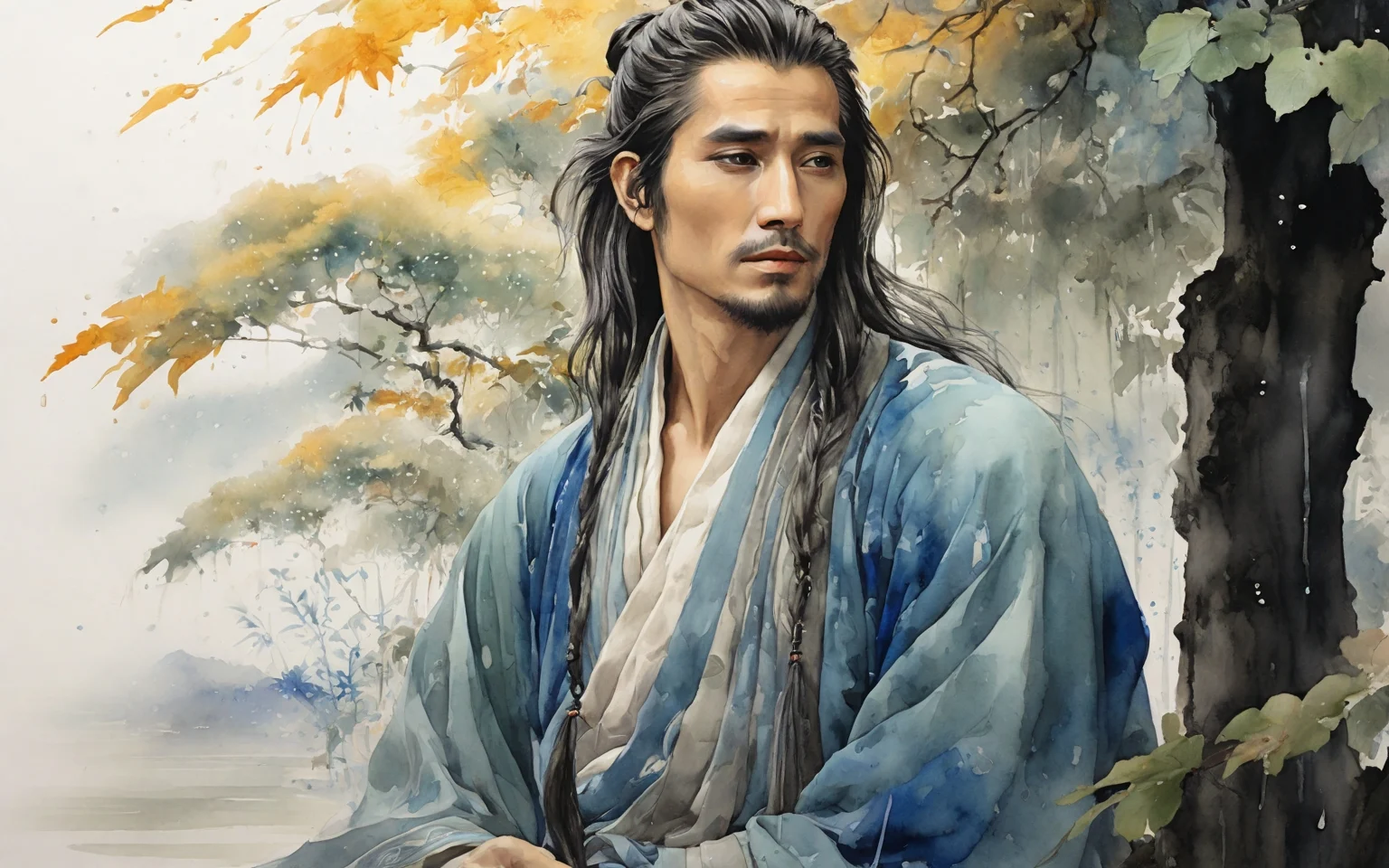
Du Fu (杜甫), 712 - 770 AD, was a great poet of the Tang Dynasty, known as the "Sage of Poetry". Born into a declining bureaucratic family, Du Fu had a rough life, and his turbulent and dislocated life made him keenly aware of the plight of the masses. Therefore, his poems were always closely related to the current affairs, reflecting the social life of that era in a more comprehensive way, with profound thoughts and a broad realm. In his poetic art, he was able to combine many styles, forming a unique style of "profound and thick", and becoming a great realist poet in the history of China.