


Where the sun has entered the western hills,
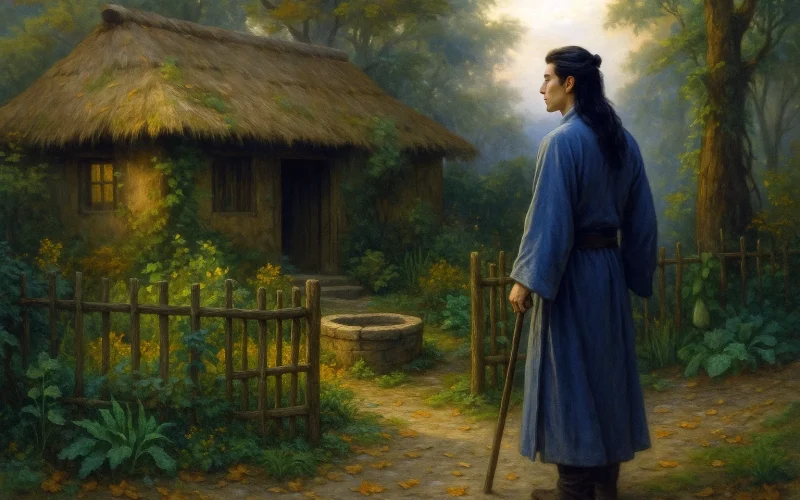
I look for a monk in his little straw hut;
But only the fallen leaves are at home,
And I turn through chilling levels of cloud.

I hear a stone gong in the dusk,
I lean full-weight on my sl ender staff...
How within this world, within this grain of dust,
Can there be any room for the passions of men?
Original Poem
「北青萝」
李商隐
残阳西入崦,茅屋访孤僧。
落叶人何在,寒云路几层。
独敲初夜磬,闲倚一枝藤。
世界微尘里,吾宁爱与憎!
Interpretation
This poem is a quintessential example of Li Shangyin's later Chan-inspired verse, likely composed around 857 AD during his retirement in Zhengzhou, after a lifetime of career disappointments and personal losses. By this period, his engagement with Buddhist thought had deepened from mere literary allusion to a profound fusion with his life's philosophy. The depicted journey to visit a monk becomes, through poetry, an inward pilgrimage of the spirit.
The title's "North Among Green Vines" likely denotes a northern hillside thickly cloaked in vines—a dwelling place for recluses. This imagery intrinsically evokes withdrawal from secular life and secluded existence. Having borne witness to the collapse of his political aspirations and endured profound personal loss, Li Shangyin turned to Buddhist teachings in search of solace. The enduring significance of this poem lies not in its exposition of abstract doctrine, but in its mapping of a complete transformation of consciousness—from the agitation of worldly concerns to spiritual lucidity—through the tangible, narrative act of "visiting."
First Couplet: 残阳西入崦,茅屋访孤僧。
Cán yáng xī rù yān, máo wū fǎng gū sēng.
The waning sun dips west behind the ridge's line;
To a thatched hut I come, this solitary monk to find.
Explication: The opening lines establish the poem's spiritual direction with precise setting. "The waning sun dips west" not only marks the hour but metaphorically suggests life's late stage, its light fading. The verb "to find" implies a deliberate quest, not a casual encounter. "Solitary" hints at a shared existential solitude between seeker and sought. The "thatched hut," contrasted with the ornate settings of Li's earlier poetry, marks a definitive shift in the landscape of his spiritual search.
Second Couplet: 落叶人何在,寒云路几层。
Luò yè rén hé zài, hán yún lù jǐ céng.
Through drifting leaves—where is the man I seek?
Beneath chill clouds—how many winding paths, how steep?
Explication: This couplet creates a twofold disorientation through its questioning form. "Through drifting leaves—where is the man?" questions both the monk's location and the poet's own place in existence. "Beneath chill clouds—how many winding paths…" metaphors the search as an arduous spiritual ascent, visualized through obstructing clouds and convoluted trails. The "drifting leaves" and "chill clouds" paint the autumn mountain scene while evoking life's transience and mental obscurity.
Third Couplet: 独敲初夜磬,闲倚一枝藤。
Dú qiāo chū yè qìng, xián yǐ yī zhī téng.
Alone, he strikes the stone-chime as first night descends;
At ease, he leans on a single vine-staff, and the quiet extends.
Explication: The poet finally "finds" the monk, not through description or dialogue, but through two emblematic gestures rich in Chan significance. "Alone, he strikes the stone-chime" merges sound (the clear chime) with time (night's beginning), creating a solemn resonance that pierces the silence. "At ease, he leans on a single vine-staff" captures the monk's serene unity with nature in a posture of effortless being. These images are powerful for showing how meaning is realized through minimalist action within simplicity.
Fourth Couplet: 世界微尘里,吾宁爱与憎!
Shìjiè wēichén lǐ, wú níng ài yǔ zēng!
The boundless world contained within a mote of dust…
Why, then, should love or hate unsettle my mind's trust?
Explication: The finale leaps from the particular to a cosmic perspective. The image of the world in a dust mote draws from Buddhist cosmology (e.g., the Diamond Sutra) and reflects a profound sense of life's minute scale. The key is the word "Why, then" (ning)—it signifies not denial but active relinquishment born of conscious choice. This preserves the dignity of the will, framing transcendence as a lucid decision, not passive resignation.
Holistic Appreciation
This is a poem of awakening, structured as an ascent and imbued with the clarity of a polished mirror. It follows the linear progression—"setting out," "seeking the path," "encountering," "apprehending"—yet within this frame accomplishes a profound inner transformation.
The first three couplets construct a gradually purified sensory field: the colored light of the "waning sun" gives way to the muted tones of "drifting leaves" and "chill clouds," then to the pure sound of the "chime" and the simple line of the "vine-staff." This refinement of perception mirrors the mind's journey from agitation to peace. Only when the senses are stripped of clutter can the insight of the final coupleet emerge.
Li Shangyin's mastery is shown by having the monk teach through silent being rather than spoken doctrine. The reader, alongside the poet, comprehends through observation. The epiphany feels earned because the preceding imagery has built the necessary contemplative momentum.
Artistic Merits
- Sensory Gradation Toward Essence: The imagery progresses from color ("waning sun") to monochrome ("leaves," "clouds") to pure sound and line ("chime," "vine-staff"). This aesthetic journey from the complex to the simple mirrors the Chan pursuit of essence beyond form.
- Psychological Cartography Through Space: Horizontal movement ("dips west"), vertical implication ("winding paths"), and cosmic scale ("mote of dust") map the three-dimensional journey of the seeking mind. Space becomes an externalization of inner state.
- Narrative Structure for Epiphany: The three-couplet buildup of journey and encounter creates narrative tension resolved in the fourth's insight. This grants philosophical realization an organic, experiential foundation, avoiding abstract preaching.
Insights
The poem reveals that profound understanding often requires a departure from one's usual setting and a simplification of sensory input. Leaving the mundane world for the mountain and paring down perception are not escapes but prerequisites for depth. In an age of constant stimulation, consciously creating such "simplified" time and space becomes crucial.
The image of the monk striking the chime "as first night descends" is particularly resonant. It suggests that the most penetrating insights often arise during the "early night" of common consciousness, when the chatter of the world subsides. Maintaining such moments of independent, quiet awareness is more vital than mere accumulation of knowledge.
Ultimately, the poem redefines "visiting": we seek not just a person or a place, but access—through deliberate journey and altered state—to a deeper self obscured by daily routine. The realization "Why, then, should love or hate…" gains its power from being lived, not merely learned. It reminds us that essential truths must often be embodied through experience to transform from concept into conviction.
Poem translator
Kiang Kanghu
About the poet
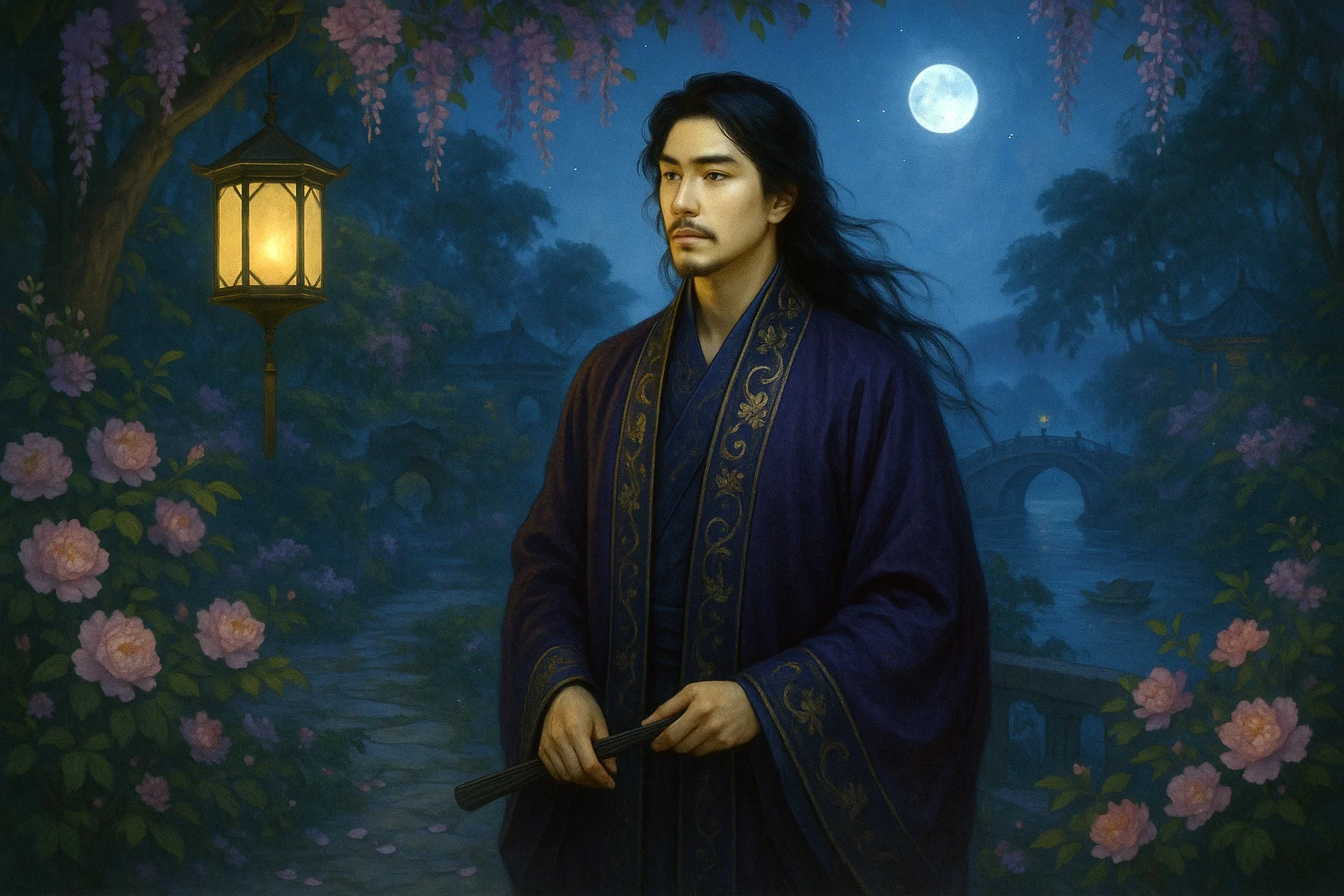
Li Shangyin (李商隐), 813 - 858 AD, was a great poet of the late Tang Dynasty. His poems were on a par with those of Du Mu, and he was known as "Little Li Du". Li Shangyin was a native of Qinyang, Jiaozuo City, Henan Province. When he was a teenager, he lost his father at the age of nine, and was called "Zheshui East and West, half a century of wandering".