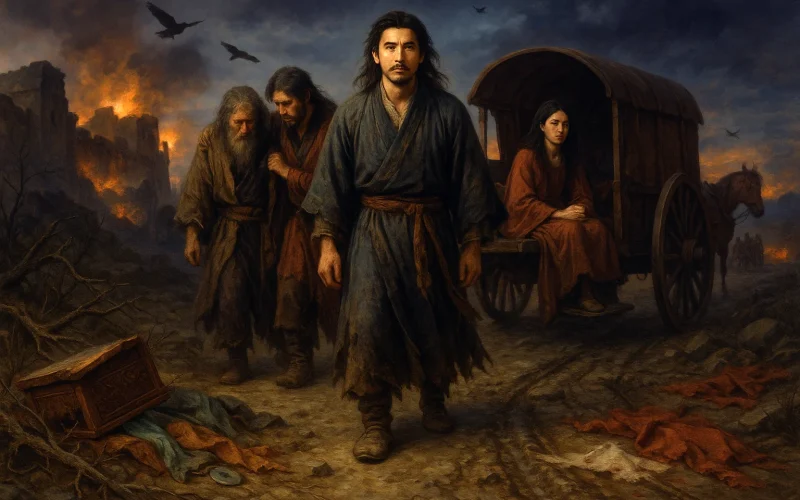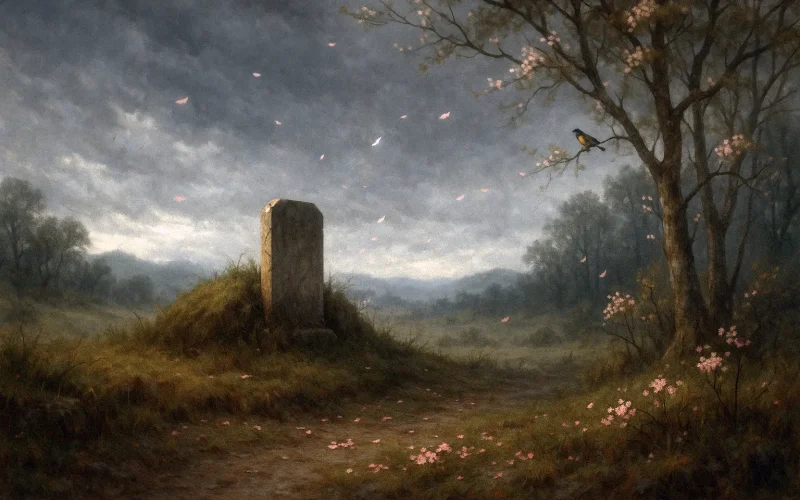




The Three Kingdoms, divided, have been bound by his greatness.
The Eight-Sided Fortress is founded on his fame;

Beside the changing river, it stands stony as his grief
That he never conquered the Kingdom of Wu.
Original Poem
「八阵图」
杜甫
功盖三分国,名成八阵图。
江流石不转,遗恨失吞吴。
Interpretation
This poem was composed in 766 CE, shortly after Du Fu's arrival in Kuizhou. Having endured the turmoil of war and a life of displacement, the poet spent his later years drifting through the southwestern regions. In Kuizhou, he beheld with his own eyes the legendary remains of the Stone Fortress, said to have been arrayed by Zhuge Liang. Confronting the stone piles standing immutable amidst the river's flow, Du Fu not only reflected upon Zhuge Liang's lifetime of devoted service—"bending his back to the task until death"—but also fused the historical fate of the Shu-Han kingdom, its strategic triumphs and failures, with his own personal sorrows. In just twenty characters, he completed a lyric of historical reflection that is as condensed as a historian's thesis and as profound as a funeral dirge.
First Couplet: “功盖三分国,名成八阵图。”
Gōng gài sān fēn guó, míng chéng Bā Zhèn Tú.
His merit towers o'er the Tripartite Realm's design; / His fame, by this Eightfold Fortress made, stands firm for all time.
The opening employs the authoritative, judgmental tone of a historian to deliver the highest possible assessment of Zhuge Liang's life's work. The two characters “功盖” (His merit towers o'er) carry immense declarative weight, asserting that his strategizing and planning, which established the tripartite division of the realm, were without equal. “三分国” (the Tripartite Realm's design) paints with the broad brush of temporal and spatial grandeur, while “名成八阵图” (his fame, by this Eightfold Fortress made) focuses on a specific, extraordinary, and enduring symbolic object. The Stone Fortress is both proof of his military genius and, transcending mere utility, a spiritual totem of his wisdom and loyalty. The two lines—one abstract and vast, the other concrete and singular—work in concert to forge the monumental, awe-inspiring image of Zhuge Liang as a statesman for the ages.
Second Couplet: “江流石不转,遗恨失吞吴。”
Jiāng liú shí bù zhuǎn, yí hèn shī tūn Wú.
The river flows, the stones endure, unmoved and fast; / Regret lives on—the move not made, the chance that could not last.
Here, the poetic focus turns sharply, pivoting from praise to a profound lament on history. The first line, “江流石不转” (The river flows, the stones endure), is a powerful, concentrated depiction of the actual scene: despite years flowing past like the river, these stone piles remain steadfast and unmoved. This vision is imbued with multiple layers of symbolism—it is the incarnation of Zhuge Liang's sincere, unwavering, and indelible spirit, and also an eternal witness to both his achievements and his regrets. The second line, “遗恨失吞吴” (Regret lives on—the move not made), is the poetic and thematic heart of the entire piece and the subject of endless scholarly debate. The word “失” (not made) can be interpreted as "a strategic error in," subtly alluding to Liu Bei's fatal mistake in rashly attacking Wu to satisfy a personal grievance. It can also mean "failure to accomplish," referring to the ultimate collapse of Zhuge Liang's central strategy from Longzhong: to "ally with Wu in the east and resist Wei in the north." Whichever interpretation one follows, it points to that irreversible turning point in the historical process and the eternal flaw of ideals shattered.
Holistic Appreciation
This five-character quatrain represents the pinnacle of Du Fu's historical and reflective poetry, showcasing his superb skill in “using poetry as history” and “incorporating discursive commentary into verse.” The structure is precise and the conception profound: the first two lines stand like a monument, establishing the tone with summative praise; the last two lines are like a stone cast into a deep pool, stirring infinite reverberations with concrete imagery and profound historical argument. The poet cleverly uses the “Stone Fortress”—a physical relic that condenses wisdom, achievement, and legend—as a fulcrum. On one end, it leverages a lament for Zhuge Liang's personal talent and fate; on the other, it leverages deep reflection on the Shu-Han regime, and indeed on the conflict between ideal and reality in all historical rises and falls. In just twenty characters, it perfectly spans the distance from the concrete to the abstract, from history to philosophy, and from praise to sorrowful lament.
Artistic Merits
- Highly Condensed, Epic Technique: Using only four lines, it summarizes the core achievements of Zhuge Liang's life (dividing the realm), the symbol of his talent (the Stone Fortress), the quality of his spirit (the unmoving stones), and the pivotal point of his historical tragedy (the move not made against Wu), possessing the concision and depth of historical discourse.
- Symbolic and Polysemous Imagery: The “Stone Fortress” and the “unmoved stones” are not merely natural and historical relics but eternal symbols of Zhuge Liang's undying spirit and enduring regret. The line “Regret lives on—the move not made” is rich in connotation, pointing to different levels of historical judgment, providing readers with broad interpretive space.
- Art of Contrast and Reversal: The “fame achieved” of the first two lines and the “regret” of the last two form a great emotional contrast. The ceaseless flow of the “river” and the steadfastness of the “stones” constitute a contrast of natural forces, together intensifying the tragic tension of historical deeds that endure while ideals ultimately turn to illusion.
- Concluding with Imagery, Leaving a Desolate Resonance: The poem ends by merging immense historical regret into the eternal natural scene of “The river flows, the stones endure.” This elevates the specific historical lament into a universal, desolate artistic conception concerning time, achievement, and fate, where the words end but the meaning is endless.
Insights
This work reveals Du Fu's profound insight, as a “poet-historian,” into the historical process: An individual's extraordinary talent and steadfast effort (towering merit, unmoving stones) may still prove unable to reverse an overall decline in the face of complex historical forces (including strategic errors, flaws of character, the vagaries of fortune). This capture of the tension between necessity and contingency, between ideal and reality in history, possesses timeless value for reflection.
Simultaneously, the “regret” in the poem is not only Zhuge Liang's but also Du Fu's. The poet borrows the wine of antiquity to pour out his own pent-up feelings. Zhuge Liang's life of “bending his back to the task until death” yet leaving his ambitions unfulfilled is undoubtedly a psychological reflection of Du Fu's own life—clinging to the ideal of “making his sovereign surpass the sage-kings” yet ending up drifting and destitute, with his aspirations come to naught. This small poem thus becomes a bridge connecting history and the present, the hearts of ancients and moderns.
It teaches us that the highest form of respect when facing historical relics or figures is not merely to praise their successes but to understand their dilemmas and regrets, and to gain from them wisdom about choice, responsibility, and limitation. Those stones standing firm in the river's flow seem to tell later generations: The steadfastness of spirit and the incompleteness of a mission can simultaneously become the most profound and most moving part of a civilization's memory.
Poem translator
Kiang Kanghu
About the poet

Du Fu (杜甫), 712 - 770 AD, was a great poet of the Tang Dynasty, known as the "Sage of Poetry". Born into a declining bureaucratic family, Du Fu had a rough life, and his turbulent and dislocated life made him keenly aware of the plight of the masses. Therefore, his poems were always closely related to the current affairs, reflecting the social life of that era in a more comprehensive way, with profound thoughts and a broad realm. In his poetic art, he was able to combine many styles, forming a unique style of "profound and thick", and becoming a great realist poet in the history of China.