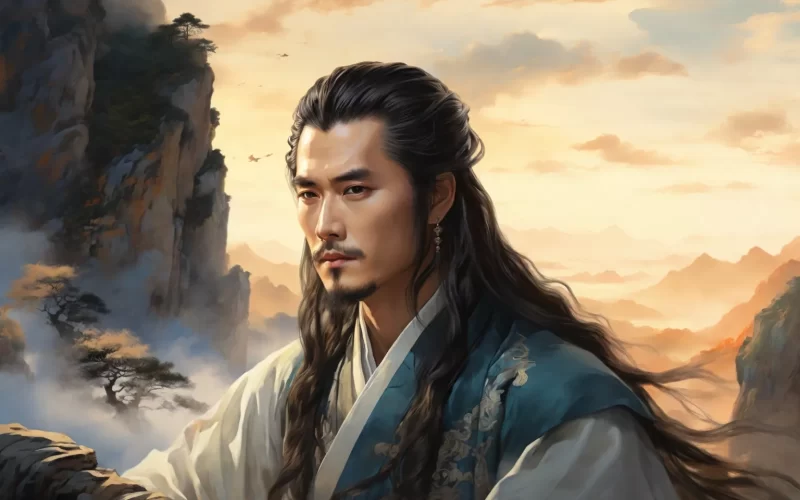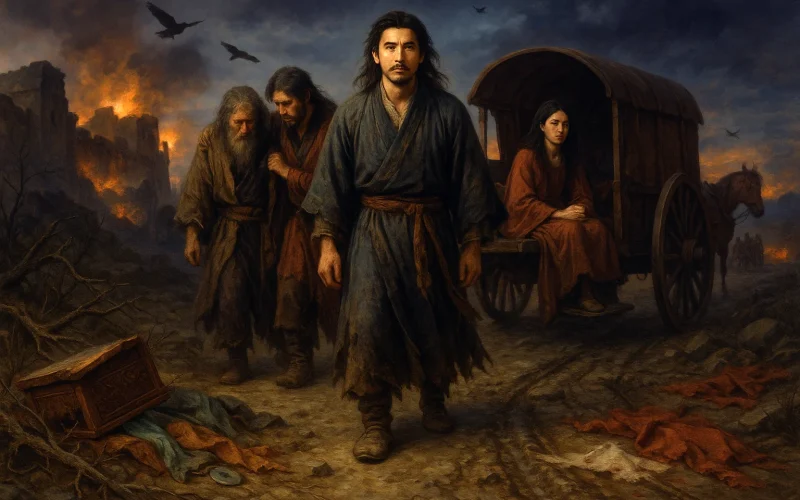
Along the wall of the Capital a white-headed crow
Flies to the Gate where Autumn Enters and screams there in the night,
Then turns again and pecks among the roofs of a tall mansion
Whose lord, a mighty mandarin, has fled before the Tartars,
With his golden whip now broken, his nine war-horses dead
And his own flesh and bone scattered to the winds....

There's a rare ring of green coral underneath the vest
Of a Prince at a street-corner, bitterly sobbing,
Who has to give a false name to anyone who asks him-
Just a poor fellow, hoping for employment.
A hundred days' hiding in grasses and thorns
Show on his body from head to foot.

But, since their first Emperor, all with hooknoses,
These Dragons look different from ordinary men.
Wolves are in the palace now and Dragons are lost in the desert --
O Prince, be very careful of your most sacred person!
I dare not address you long, here by the open road,
Nor even to stand beside you for more than these few moments.

Last night with the spring-wind there came a smell of blood;
The old Capital is full of camels from the east.
Our northern warriors are sound enough of body and of hand --
Oh, why so brave in olden times and so craven now?
Our Emperor, we hear, has given his son the throne
And the southern border-chieftains are loyally inclined
And the Huamen and Limian tribes are gathering to avenge us.

But still be careful-keep yourself well hidden from the dagger.
Unhappy Prince, I beg you, be constantly on guard --
Till power blow to your aid from the Five Imperial Tombs.
Original Poem
「哀王孙」
杜甫
长安城头头白乌,夜飞延秋门上呼。
又向人家啄大屋,屋底达官走避胡。
金鞭断折九马死,骨肉不待同驰驱。
腰下宝玦青珊瑚,可怜王孙泣路隅。
问之不肯道姓名,但道困苦乞为奴。
已经百日窜荆棘,身上无有完肌肤。
高帝子孙尽隆准,龙种自与常人殊。
豺狼在邑龙在野,王孙善保千金躯。
不敢长语临交衢,且为王孙立斯须。
昨夜东风吹血腥,东来橐驼满旧都。
朔方健儿好身手,昔何勇锐今何愚。
窃闻天子已传位,圣德北服南单于。
花门剺面请雪耻,慎勿出口他人狙。
哀哉王孙慎勿疏,五陵佳气无时无。
Interpretation
This poem was composed in the autumn of 756 CE, the first year of the Zhide era under Emperor Suzong, which marked the second year of the An Lushan Rebellion. In the sixth month of that year, rebel forces breached the Tong Pass. Emperor Xuanzong fled in disarray to Shu, and the capital, Chang'an, fell. Du Fu, attempting to escape with his family, was captured by the rebels and taken back to Chang'an. Due to his low official rank, he was not placed under close guard, allowing the poet to move with difficulty through the occupied capital. He thus witnessed with his own eyes how this former imperial heart—where once "envoys from all states paid homage to the crown"—had been turned to ruins by war. This poem was written while Du Fu was trapped behind enemy lines, after he personally witnessed the wretched and tragic state of fallen imperial scions. It not only records the suffering of a specific historical moment but also uses the individual fate of a single "princeling" as a microcosm, revealing war's ruthless crushing of all order and dignity. The poem is imbued with the poet's profound compassion and an unextinguished faith in eventual restoration.
First Section: “长安城头头白乌,夜飞延秋门上呼。又向人家啄大屋,屋底达官走避胡。”
Cháng'ān chéng tóu tóu bái wū, yè fēi Yánqiū mén shàng hū. Yòu xiàng rénjiā zhuó dà wū, wū dǐ dáguān zǒu bì hú.
On Chang'an's walls, the white-headed crows take flight, / Cawing at night by the Yanqiu Gate, a baleful sight. / They peck at the roofs of mansions, great and tall, / While underneath, high officials flee the rebels' thrall.
The poem opens with an ill omen. The white-headed crow, traditionally an augury of war, perches on the imperial battlements, its nocturnal cries creating an immediate atmosphere of impending doom. The unnatural image of crows pecking at mansions symbolically rends the façade of aristocratic dignity, contrasting sharply with the狼狈 reality of officials in flight. The chaos of a fallen capital is powerfully set in just four lines.
Second Section: “金鞭断折九马死,骨肉不待同驰驱。腰下宝玦青珊瑚,可怜王孙泣路隅。问之不肯道姓名,但道困苦乞为奴。已经百日窜荆棘,身上无有完肌肤。”
Jīn biān duàn zhé jiǔ mǎ sǐ, gǔròu bù dài tóng chí qū. Yāo xià bǎo jué qīng shānhú, kělián wángsūn qì lù yú. Wèn zhī bù kěn dào xìngmíng, dàn dào kùnkǔ qǐ wéi nú. Yǐjīng bǎi rì cuàn jīngjí, shēnshàng wú yǒu wán jīfū.
Golden whips lie snapped, nine chargers dead in flight, / Kin could not wait for kin in their panicked fright. / A princeling, with green coral gems at his waist, weeps, / A pitiful sight where the lone road crosses and sweeps. / Asked his name, he will not the truth declare, / But begs in his hardship to be a servant's care. / For a hundred days through thorns he's had to roam, / Not a single patch of whole skin is left on him at home.
The focus narrows to a specific victim. Details like shattered golden whips and dead chargers vividly convey the皇室's frantic,惨烈的 flight. The anonymous princeling embodies the era's cruel reversals: his precious jewels mock his present destitution; his noble blood contrasts with his plea for servitude; the hundred days of flight are written on his mutilated body. In this brief portrait, Du Fu captures the缩影 of an entire aristocracy's ruin.
Third Section: “高帝子孙尽隆准,龙种自与常人殊。豺狼在邑龙在野,王孙善保千金躯。不敢长语临交衢,且为王孙立斯须。”
Gāodì zǐsūn jìn lóng zhǔn, lóng zhǒng zì yǔ chángrén shū. Cháiláng zài yì lóng zài yě, wángsūn shàn bǎo qiānjīn qū. Bù gǎn cháng yǔ lín jiāo qú, qiě wèi wángsūn lì sī xū.
All Gaozu's line bear the imperial nose's high mark; / The dragon's seed is different from the common, dark. / Now wolves hold the town, the true dragon roams the plain; / O Princeling, guard well your body, worth more than gold in gain. / I dare not speak long here where the busy crossroads lie; / For you, a princeling, I can only stand a moment by.
The poet steps from observation into fraught communion. He affirms the princeling's noble lineage ("the dragon's seed")—a comfort that also subtly asserts continuing loyalty to the Tang. The potent metaphor "wolves hold the town, the true dragon roams the plain" condemns the usurpers. His urgent, whispered advice—"guard well your body"—and his fear of being overheard perfectly capture the atmosphere of terror and suspicion in the occupied city, revealing both deep concern and profound powerlessness.
Fourth Section: “昨夜东风吹血腥,东来橐驼满旧都。朔方健儿好身手,昔何勇锐今何愚。窃闻天子已传位,圣德北服南单于。花门剺面请雪耻,慎勿出口他人狙。哀哉王孙慎勿疏,五陵佳气无时无。”
Zuóyè dōngfēng chuī xuèxīng, dōng lái tuótuó mǎn jiù dū. Shuòfāng jiàn er hǎo shēnshǒu, xī hé yǒng ruì jīn hé yú. Qiè wén tiānzǐ yǐ chuán wèi, shèng dé běi fú Nán Chányú. Huāmén lí miàn qǐng xuěchǐ, shèn wù chūkǒu tārén jū. Āi zāi wángsūn shèn wù shū, wǔ líng jiā qì wú shí wú.
Last night an east wind brought the reek of blood and gore; / The old capital's crammed with camels from the eastern shore. / The northern troopers, once so valiant, keen, and brave, / Why are they now so dull, so impotent, so slave? / In secret, I've heard the Son of Heaven passed the throne; / His sage virtue has made the southern khan his own. / The Huamen, gashed cheeks pledging to wipe clean this shame— / Take care! Let none else hear, lest spies should catch the same. / Alas, O Princeling, be not remiss, beware! / The auspicious aura of the Five Mounds is always there!
The final section widens to the occupied city's sensory horror—the smell of blood, the alien camels—and voices a bitterly sorrowful reflection on the imperial army's failure. Then, in a hushed tone, the poet shares a dangerous secret hope: the emperor has abdicated, a new sovereign has Uighur allies. This fragile hope must be guarded with life-and-death caution. The poem concludes with a sudden, defiant leap from lament to prophecy, transforming into a fervent declaration that the dynasty's destiny remains unbroken. This final line kindles a flame of conviction in the deepest darkness.
Holistic Appreciation
This poem indeed represents a crowning achievement within Du Fu's "poetic history" project. Its enduring significance lies in this very ability to encapsulate, within a single, vividly rendered encounter, both the concrete historical truth of a dynasty's fall and the profound human tenderness that persists within its ruins. The work moves beyond a lament for a solitary, high-born casualty. By centering on the "princeling"—a living symbol where imperial lineage and raw, individual agony converge—the poem masterfully exposes the fundamental resonance between the trajectory of a state and the fate of a person. Each mirrors and determines the other.
Artistically, Du Fu achieves a remarkable equilibrium of opposing forces. He conjures the ominous dread of the "white-headed crow" and the visceral horror of the "east wind reeking of blood," yet counterbalances them with the quiet, defiant hope symbolized by the "auspicious aura over the Five Mausoleums." He does not flinch from depicting the brutal reality of a body with "no whole skin left" and a spirit broken to "begging to be a slave," yet suffuses the scene with the protective, urgent care of "guard well your precious body." Isolated within the enemy's grasp, Du Fu's pen transformed into a vital, secret channel—a means to document the suffering of the occupied realm, to reach beyond its borders, and to transmit an unshakeable conviction to those who would listen.
Artistic Merits
- Symbolism Grounded in Stark Realism: The opening omen (the crows) and the closing symbol (the dynasty's enduring "aura") frame a central narrative of shocking, concrete suffering (the princeling's wounds). This interplay gives the poem both metaphorical depth and visceral impact.
- Tense, Dialogic Structure: The poem unfolds as a precarious, hushed conversation, pulling the reader into the fearful immediacy of the occupied city. Lines like "I dare not speak long" generate powerful narrative tension.
- Layered Emotional Architecture: The poem moves from detached horror, to pained sympathy, to cautious solidarity, and finally to a suppressed but defiant hope. This progression showcases Du Fu's "deeply somber and powerfully cadenced" control over complex emotion.
- The Specific as Historical Epic: The anonymous, broken princeling becomes an epochal figure. Through him, the poem encapsulates the tragedy of a ruling class and becomes a lens on the catastrophe of the age itself.
Insights
This work transcends the bounds of a mere personal account of historical tragedy; it serves as a mirror reflecting the enduring truths of power, duty, and human nature. It sounds a timeless warning: No era of prosperity or structure of order is immutable. When the pursuits of indulgence and pleasure by the ruling elite become severed from the sufferings of the common populace, the seeds of systemic collapse are irrevocably sown.
Concurrently, the poem bears witness to the unyielding resilience inherent to civilization itself. Even in its darkest hour, when "predators hold sway in the capital," the enduring recognition of legitimate authority ("the dragon's seed"), the tenacious safeguarding of cultural heritage ("the enduring auspicious aura over the Imperial Mausoleums"), and the precious, fleeting kindness exchanged between individuals ("pausing a moment for the prince's sake") collectively form the vital embers from which a civilization's spirit may reignite. Du Fu demonstrates through this poem that authentic poetry can indeed be composed upon the ruins of a world, and in doing so, can transform into a force capable of illuminating the path forward and unifying the human spirit.
Poem translator
Kiang Kanghu
About the poet
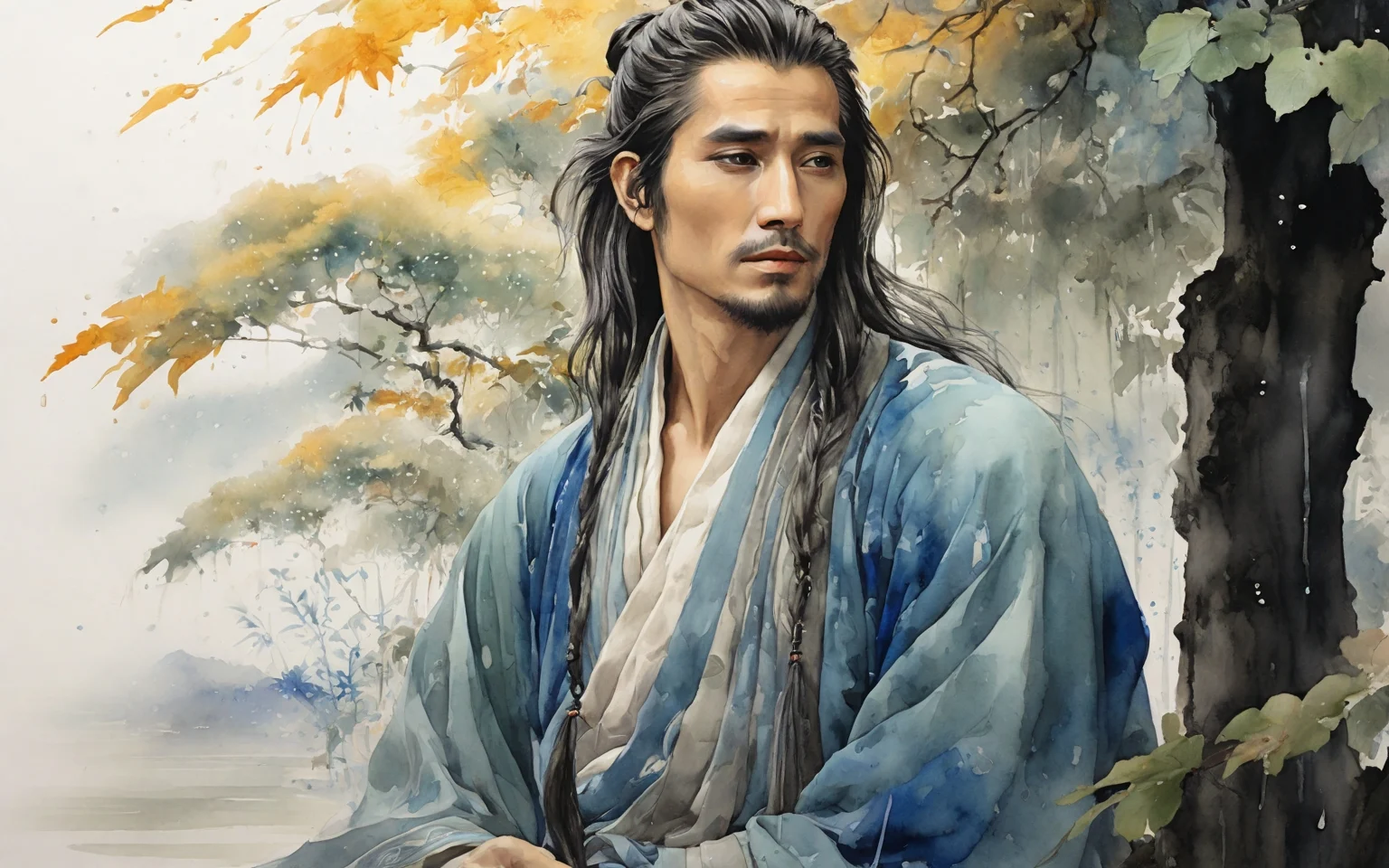
Du Fu (杜甫), 712 - 770 AD, was a great poet of the Tang Dynasty, known as the "Sage of Poetry". Born into a declining bureaucratic family, Du Fu had a rough life, and his turbulent and dislocated life made him keenly aware of the plight of the masses. Therefore, his poems were always closely related to the current affairs, reflecting the social life of that era in a more comprehensive way, with profound thoughts and a broad realm. In his poetic art, he was able to combine many styles, forming a unique style of "profound and thick", and becoming a great realist poet in the history of China.