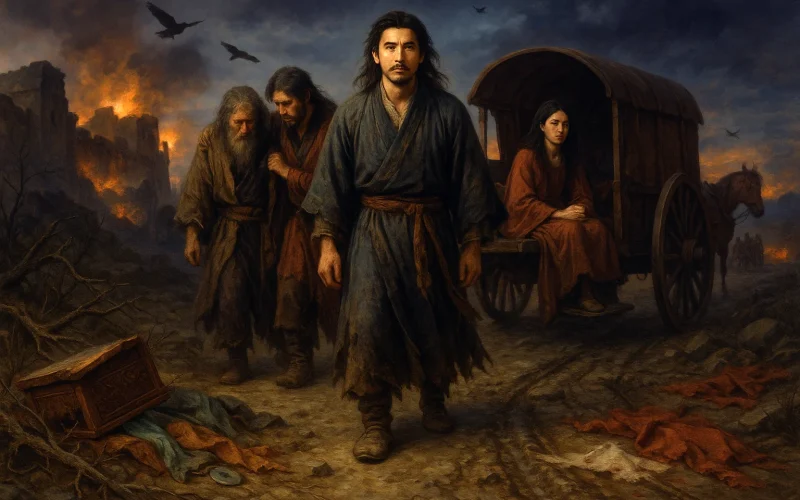



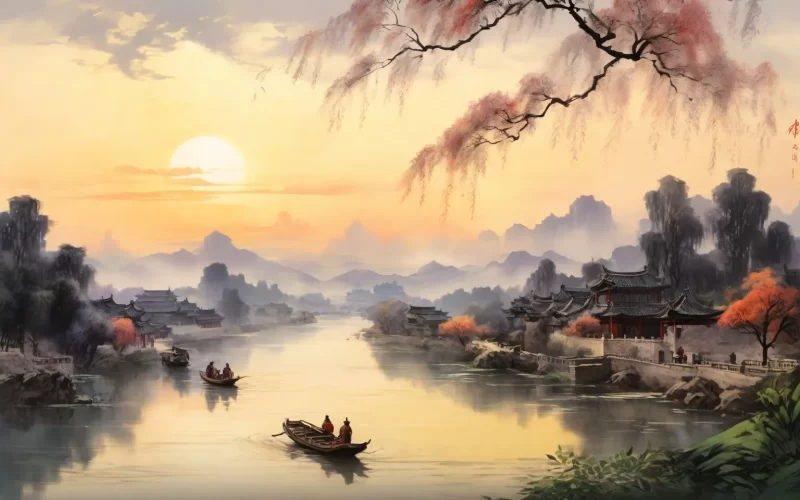
I am only an old woodsman, whispering a sob,
As I steal like a spring-shadow down the Winding River.
...Since the palaces ashore are sealed by a thousand gates --
Fine willows, new rushes, for whom are you so green?

...I remember a cloud of flags that came from the South Garden,
And ten thousand colours, heightening one another,
And the Kingdom's first Lady, from the Palace of the Bright Sun,
Attendant on the Emperor in his royal chariot,
And the horsemen before them, each with bow and arrows,
And the snowy horses, champing at bits of yellow gold,
And an archer, breast skyward, shooting through the clouds
And felling with one dart a pair of flying birds.

...Where are those perfect eyes, where are those pearly teeth?
A blood-stained spirit has no home, has nowhere to return.
And clear Wei waters running east, through the cleft on Dagger- Tower Trail,
Carry neither there nor here any news of her.
People, compassionate, are wishing with tears
That she were as eternal as the river and the flowers.

...Mounted Tartars, in the yellow twilight, cloud the town with dust.
I am fleeing south, but I linger-gazing northward toward the throne.
Original Poem
「哀江头」
杜甫
少陵野老吞生哭,春日潜行曲江曲。
江头宫殿锁千门,细柳新蒲为谁绿。
忆昔霓旌下南苑,苑中景物生颜色。
昭阳殿里第一人,同辇随君侍君侧。
辇前才人带弓箭,白马嚼啮黄金勒。
翻身向天仰射云,一箭正坠双飞翼。
明眸皓齿今何在,血污游魂归不得。
清渭东流剑阁深,去住彼此无消息。
人生有情泪沾臆,江水江花岂终极。
黄昏胡骑尘满城,欲往城南望城北。
Interpretation
This poem was composed in the spring of 757 CE. The previous year, in the sixth month of 756, the rebel forces of An Lushan breached the Tong Pass. Emperor Xuanzong fled in disarray to the west, and the capital, Chang’an, was lost. Du Fu, captured while trying to reach the exiled court of Emperor Suzong, was taken back to the occupied city. Because of his minor official status, he was not imprisoned but was permitted limited movement within the conquered capital. The following spring, the poet ventured secretly to the banks of the Serpentine in southeastern Chang’an. This had been the premier site for imperial excursions during the Kaiyuan and Tianbao eras. Each spring, the Emperor and his Consort Yang would pass in procession with their retinue, a spectacle of supreme worldly splendor. Now, the poet found only locked palace gates and a desolate silence. The violent clash between the memory of that glorious past—"rainbow banners descend[ing] to the South Park"—and the bleak present—"tender willows, fresh rushes, for whom now do you grow green?"—fused the poet’s agony for his broken nation, his lament for a vanished age, and his own personal sorrow into this profoundly poignant work, hailed as "the epic of fallen Chang’an in miniature."
First Section: “少陵野老吞声哭,春日潜行曲江曲。江头宫殿锁千门,细柳新蒲为谁绿。”
Shǎolíng yělǎo tūnshēng kū, chūnrì qiánxíng Qǔjiāng qū. Jiāng tóu gōngdiàn suǒ qiān mén, xì liǔ xīn pú wèi shuí lǜ.
The old rustic of Shaoling chokes back soundless tears; / In springtime light, to Qujiang’s lonely bends he steals. / The riverside palaces bar fast a thousand gates; / For whom, slim willows, tender reeds, your vernal states?
I, the old man of Shaoling, can only stifle my sobs, walking furtively alone on a spring day to a secluded bend of the Serpentine. The stately palaces lining the riverbank now have their thousand gates locked and barred; the slender willow wands and fresh green rushes still put forth their spring color—but for whose eyes do they display this vitality?
The poet names himself "The old rustic of Shaoling," a persona that emphasizes his aged, humble, yet loyal status in a time of chaos. "Chokes back soundless tears" expresses the immense, suppressed grief of those living under occupation. "Steals" conveys both the stealth of his movement and the submerged, contemplative state of a mind moving between memory and a desolate present. The following lines pose a silent, aching question to the scenery: nature’s cycle brings renewal ("your vernal states"), but human order lies in ruins, the palaces stand empty. This question gives voice to the profound sense of absurdity and emptiness in the aftermath of vanished glory, setting the poem’s tone of sorrowful bewilderment.
Second Section: “忆昔霓旌下南苑,苑中万物生颜色。昭阳殿里第一人,同辇随君侍君侧。辇前才人带弓箭,白马嚼啮黄金勒。翻身向天仰射云,一箭正坠双飞翼。”
Yì xī ní jīng xià nán yuàn, yuàn zhōng wànwù shēng yánsè. Zhāoyáng diàn lǐ dìyī rén, tóng niǎn suí jūn shì jūn cè. Niǎn qián cáirén dài gōngjiàn, bái mǎ jué niè huángjīn lè. Fānshēn xiàng tiān yǎng shè yún, yī jiàn zhèng zhuì shuāng fēi yì.
I remember rainbow banners sweeping to the Park, / Where every tree and blossom took on a brighter mark. / The peerless one from the Sunlit Palace, beauty’s sum, / Shared the imperial coach, stayed by her sovereign’s side, close-come. / Before the coach, fair maidens bore their bows, a martial sight, / Their white steeds champing on their golden bridles, burning bright. / They turned, they tilted to the sky, let their long arrows fly— / One shaft struck down a pair of wings that sailed across the sky.
I recall the past, when the emperor’s rainbow banners descended upon the South Park, and everything in the park seemed to glow with heightened color under the imperial gaze. That unrivalled beauty from the Zhao Yang Palace, the first lady of the court, shared the imperial carriage, ever in attendance at the sovereign’s side. Before the carriage, palace maidens carried bows and arrows, a splendid martial display, their white horses champing on golden bits. Watch as they twist their bodies, aim skyward, and shoot into the clouds—a single arrow brings down a pair of wings flying together.
Here, the poet’s gaze soars into the past, painting the zenith of former glory with vivid colors. "Rainbow banners" signify imperial majesty; "took on a brighter mark" describes the transformative, almost magical, effect of the imperial presence. The focus narrows to "The peerless one from the Sunlit Palace"—Consort Yang—establishing her unique position of favor. Details like the armed maidens and the gold-bitted steeds capture the extravagant spectacle and vigorous elegance of the imperial hunt. The climactic image, "One shaft struck down a pair of wings," is both a feat of skill and a potent symbol: the fallen paired wings foreshadow the "endless regret" of the imperial love story and symbolize the sudden, brutal end of an era of prosperity. Within this vibrant scene of joy, the seeds of future lament are already present.
Third Section: “明眸皓齿今何在?血污游魂归不得。清渭东流剑阁深,去住彼此无消息。人生有情泪沾臆,江水江花岂终极!黄昏胡骑尘满城,欲往城南望城北。”
Míngmóu hàochǐ jīn hé zài? Xuè wū yóuhún guī bù dé. Qīng Wèi dōng liú Jiàngé shēn, qù zhù bǐcǐ wú xiāoxi. Rénshēng yǒuqíng lèi zhān yì, jiāng shuǐ jiāng huā qǐ zhōngjí! Huánghūn hú qí chén mǎn chéng, yù wǎng chéng nán wàng chéng běi.
Where now are the bright eyes, the gleaming teeth—oh where? / A blood-stained, wandering ghost that cannot journey there. / The clear Wei flows east, the Swordgate Road lies deep; / The one who went, the one who stayed—a silence they must keep. / Our human hearts feel grief—tears soak the breast’s domain; / But do the river and its flowers know an end to pain? / At dusk, the dust of Tartar horsemen fills the town; / I mean to turn south toward my hut, but find I’m gazing down / The northern road.
Where now are those bright eyes and shining teeth? Only a blood-stained, wandering spirit remains, which can never return. The clear waters of the Wei flow eastward; the road to Shu through the Sword Gate Pass is long and remote. She who departed, he who remained—forever lost to one another. If the human heart is capable of feeling, it will weep until tears soak the breast; but can the river’s current and its bankside blooms ever know such finality? At dusk, the dust churned up by Tartar cavalry shrouds the city. I intend to head south toward my dwelling in the city, yet I find my gaze turning fixedly to the north.
The final section begins with a heart-stopping juxtaposition, placing the radiant beauty of the past directly alongside the horrific image of a "blood-stained, wandering ghost." The "clear Wei flows east" and the "Swordgate Road lies deep" create a vast, unbridgeable spatial and metaphysical divide, alluding to Consort Yang’s burial at Mawei (near the Wei) and Emperor Xuanzong’s journey into exile in Shu (via the Sword Gate), separated irrevocably in life and death. From this, the poet draws a timeless, philosophical lament: "Our human hearts feel grief… / But do the river and its flowers know an end?" The eternal, indifferent cycles of nature throw into sharp relief the transience and torment of human feeling, elevating personal tragedy to a meditation on the human condition. The poem concludes by snapping back to the immediate, oppressive reality: "the dust of Tartar horsemen" symbolizes the violent occupation. The final, disoriented action—"I mean to turn south… but find I’m gazing… / The northern road"—powerfully externalizes the poet’s profound anguish, his mental confusion, and a subconscious, desperate yearning toward where the loyalist court resides (north, in Lingwu). The ending resonates with a deep, unresolved desolation.
Holistic Appreciation
This poem is a masterwork of Du Fu’s "poetic history." Its supreme achievement lies in using the transformation of a single, specific locale—the Serpentine Riverside—to achieve an epic condensation of a capital’s fate, an era’s character, and a legendary romance. The structure is masterful, the emotional arc dramatic: it moves from the stifled sorrow of the present ("chokes back soundless tears"), to the dazzling recollection of past glory ("rainbow banners"), to the horrific crash into a more profound present reality ("blood-stained, wandering ghost"), finally resolving into a philosophical sigh ("tears soak the breast’s domain") and a gesture of bewildered longing ("gazing down / The northern road"). Du Fu demonstrates here not merely personal lament but profound historical insight. He implicitly connects the extravagance and romance of the Xuanzong reign with the catastrophic consequences of the rebellion, lending the poem the weight of historical judgment and the somber, resonant power characteristic of his most mature work.
Artistic Merits
- A Masterfully Circular Structure of Contrast: The poem follows a "present (desolation) – past (splendor) – present (deepened desolation and reflection)" structure. This circular movement intensifies the emotional and philosophical impact with each return.
- Precise, Symbolically Rich Imagery: Each key image is a vessel of meaning. The "slim willows, tender reeds" represent untended, meaningless natural renewal; the felled "pair of wings" symbolizes doomed love and shattered glory; the "blood-stained, wandering ghost" embodies the brutal price of political folly; the "river and its flowers" stand for nature’s impassive, eternal cycles.
- Exquisite Control of Emotional Rhythm: The poem’s emotional music moves from suppressed agony, to soaring recollection, to horrified interrogation, to deep philosophical grief, ending in distracted paralysis. This progression is as controlled and moving as a tragic symphony.
- The Poet as Embodied Witness: The figure of "The old rustic of Shaoling" is more than a persona; it is the archetype of the loyal, suffering intellectual bearing witness amid the ruins. His personal disorientation is inseparable from the nation’s trauma, granting the poem immense immediacy and representative power.
Insights
This work offers enduring insights into the fragile, fatal links between luxury and ruin, romantic love and statecraft, the individual and historical destiny. It serves as a stark warning: glory and romance built upon the pinnacle of power, divorced from the welfare of the people—like the spectacularly felled "pair of wings"—may achieve breathtaking heights but lack durable foundations. When crisis comes, they dissolve into the stuff of tragedy and ghost stories. Yet, the poem also reveals the resilience of the human spirit. Even in the depths of occupation ("dust of Tartar horsemen"), Du Fu’s gaze, against his own intention, turns north. This subconscious gesture betrays an unquenchable hope for restoration, a fidelity that persists in the deepest despair. Thus, the poem functions as a dual mirror: it reflects the inevitable dissolution of vanity, and it also reveals the figure of the poet-scholar—standing firm in the rubble, his heart stubbornly fixed on a future for his homeland.
Poem translator:
Kiang Kanghu
About the poet
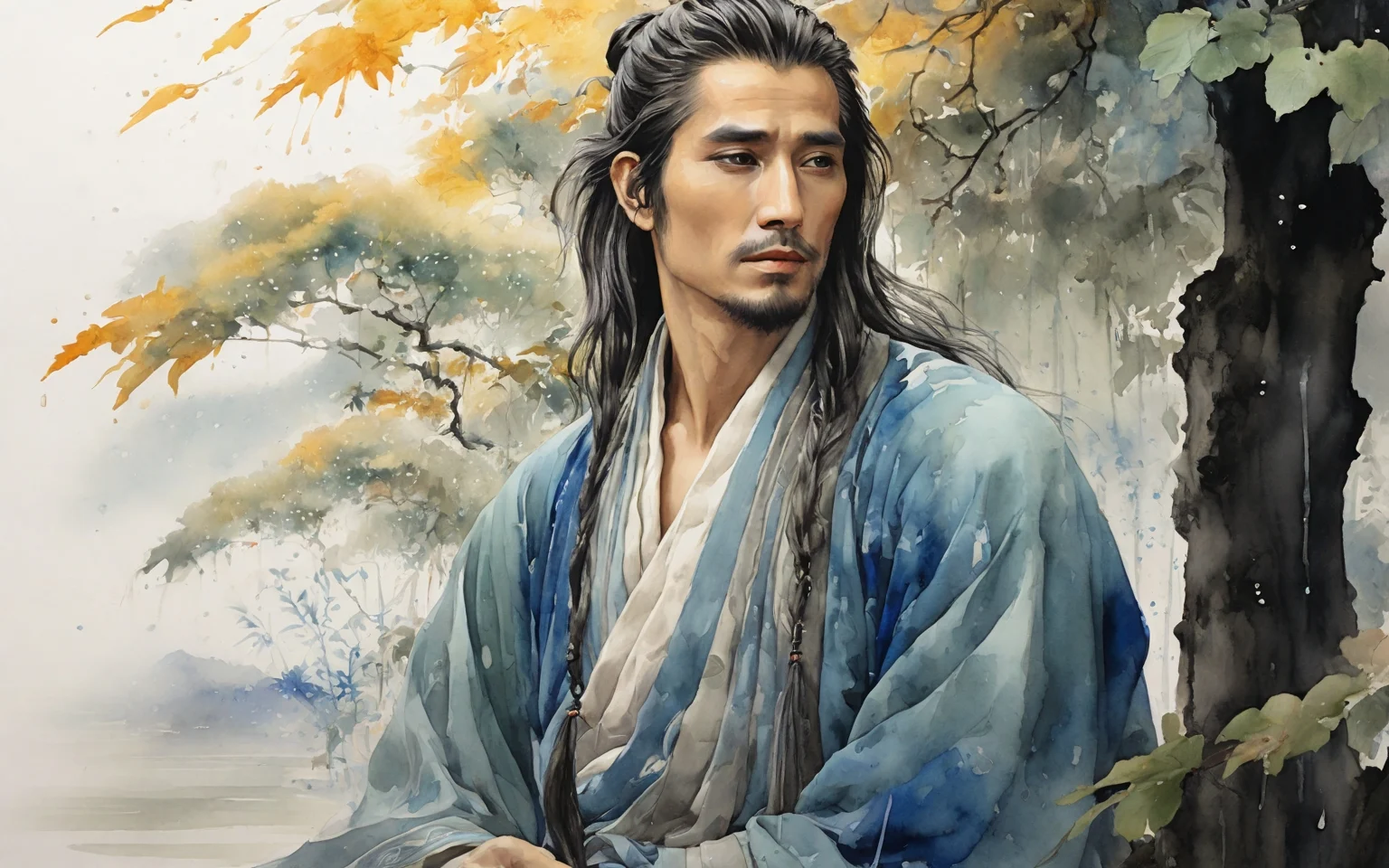
Du Fu (杜甫), 712 - 770 AD, was a great poet of the Tang Dynasty, known as the "Sage of Poetry". Born into a declining bureaucratic family, Du Fu had a rough life, and his turbulent and dislocated life made him keenly aware of the plight of the masses. Therefore, his poems were always closely related to the current affairs, reflecting the social life of that era in a more comprehensive way, with profound thoughts and a broad realm. In his poetic art, he was able to combine many styles, forming a unique style of "profound and thick", and becoming a great realist poet in the history of China.