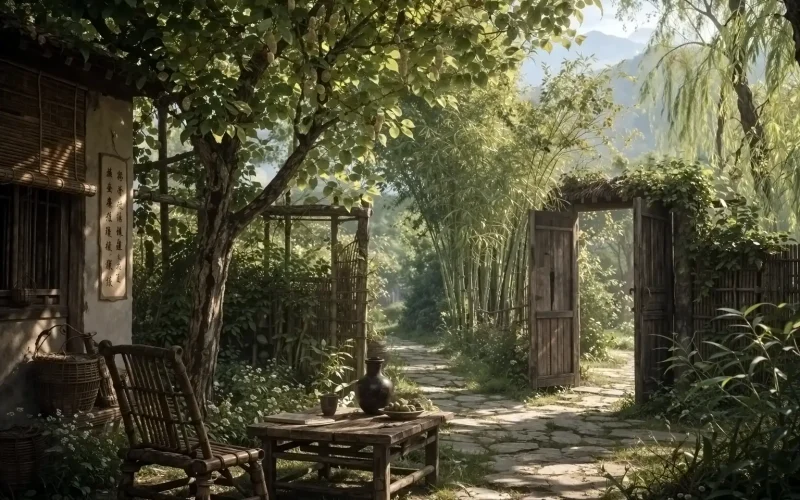
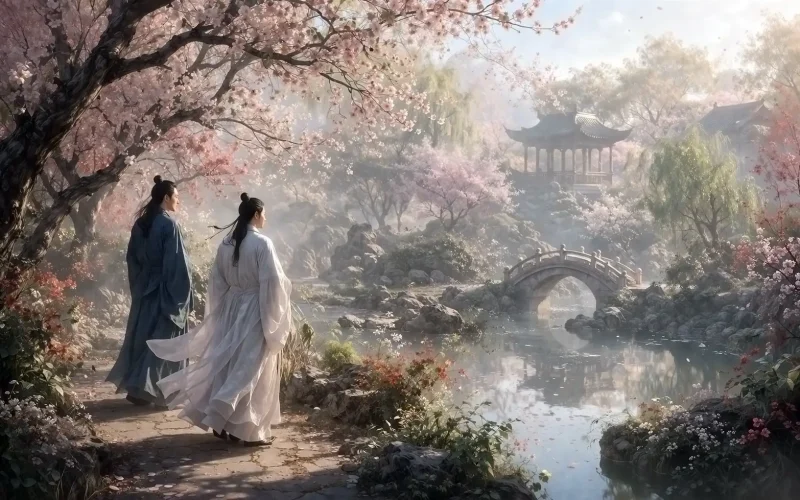
We go to look at blossom, and we do not ask
Whether the spring be early now or late.

A petal fallen, fading, is enough
To make a verse of, and to keep it fair.

We walk a slow circle by each separate tree,

And wonder, in the stillness, whose garden now
Has most of bloom beneath the changing air.
Original Poem
「同友人看花」
朱庆馀
寻花不问春深浅,纵是残红也入诗。
每个树边行一匝,谁家园里最多时。
Interpretation
This poem was composed during Zhu Qingyu's later years of seclusion in Yuezhou. After resigning from his official post and returning to his hometown, he was no longer burdened by worldly affairs and would often visit mountains and seek out blossoms in secluded places with a few friends. By then, he had completely let go of his lingering attachment to an official career and no longer dwelt on the passage of time. In his distant youth, like all scholars of the world, he had diligently pursued fame and fortune, anxiously fixated on gains and losses, and insisted on seizing the "optimal moment" for everything—taking the imperial examinations while young, seeking an official post as early as possible, and even viewing blossoms only at the peak of their bloom. However, after decades of ups and downs in the officialdom, he finally realized: how could life have so many "perfectly opportune" moments? Rather than painfully waiting for the so-called best moment, it is better to set out anytime and appreciate beauty whenever.
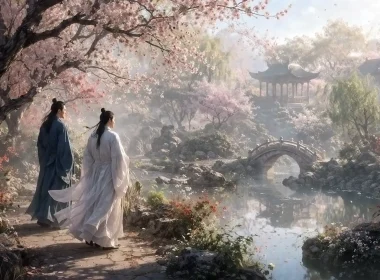
One spring day, he went out with friends to enjoy the scenery. They did not deliberately choose a specific day, nor did they inquire beforehand where the blossoms were at their best; they simply followed their inclinations. Passing by grove after grove of flowering trees, they saw that in some places, the flowers were already past their prime, with petals scattering in profusion—what others might dismiss as "withered blossoms and broken willows." Yet, Zhu Qingyu felt no regret. Instead, he stopped to carefully observe the beauty of their fading state and even suggested writing about it in a poem. This attitude of "not asking how deep the spring is" is a true reflection of his state of mind in his later years: no longer clinging to the "best" moments, no longer obsessing over gains, losses, perfection, or imperfection, but accepting each situation as it comes, discovering and cherishing beauty in every present moment. With his friends, he would walk slowly around each flowering tree, gazing at it for a long time, even comparing whose garden's blooms lasted the longest or were the most abundant. This seemingly childish act was, in reality, the fruit of learning to reconcile with time after experiencing life's vicissitudes—blossoms have their time to bloom and their time to fall; one appreciates both the blooming and the falling; everything is exactly as it should be.
First Couplet: "寻花不问春深浅,纵是残红也入诗。"
Xún huā bù wèn chūn shēn qiǎn, zòng shì cán hóng yě rù shī.
Seeking blossoms, I do not ask if spring is early or late; even if they are fading reds, they still enter my verse.
The poem opens with the poet's unique attitude towards viewing flowers. "寻花不问春深浅" (Seeking blossoms, I do not ask if spring is early or late)—the phrase "不问" (do not ask) completely discards worldly, utilitarian considerations. Ordinary flower viewers always choose the best season and the most perfect blooms, but the poet cares not for these. Whether it is early or late spring, to simply seek is meaningful. The next line, "纵是残红也入诗" (even if they are fading reds, they still enter my verse), goes a step further: "残红" (fading reds) refers to blossoms on the verge of fading, which ordinary eyes might see as "spoiling the enjoyment." Yet the poet says "也入诗" (they still enter my verse)—even the withering petals have their own beauty, equally worthy of being written about and remembered. The two characters "纵是"(even if) are the "eye" of the entire poem: it is not about loving only the glory of full bloom; it is about accepting even decay. It is not about admiring only perfection; poetry can also be found in the incomplete.
Final Couplet: "每个树边行一匝,谁家园里最多时。"
Měi gè shù biān xíng yī zā, shuí jiā yuán lǐ zuì duō shí.
By each tree's side, I walk a full circle; in whose garden do they bloom the longest, the most?
This couplet shifts from attitude to action, depicting the specific manner of their flower viewing. "每个树边行一匝" (By each tree's side, I walk a full circle) describes the focus of him and his friends carefully observing each tree by walking around it—it is not a cursory glance, but a full circle for each tree, gazing from different angles. The three characters "行一匝" (walk a full circle) convey a lingering of time and an almost obsessive attentiveness. The next line, "谁家园里最多时" (in whose garden do they bloom the longest, the most), describes them comparing as they look, even caring about which garden's flowers bloom most abundantly and longest. The three characters "最多时"(the longest, the most) seem like a trivial comparison, but in reality, they express a cherishing and lingering over beauty—they are not competing, but wanting to remember the blossoms at their best, to look a few more times before they fade. Here, the poem captures the innocent sincerity of a flower viewer with plain yet moving simplicity.
Holistic Appreciation
This is a short poem, rich in the flavor of everyday life, composed by Zhu Qingyu in his later years. The entire poem consists of four lines and twenty-eight characters. Using "seeking blossoms" as its thread, it blends the poet's attitude of appreciating flowers regardless of season or state of glory/decay with the enchanted demeanor of carefully circling trees and lingering, reluctant to leave. It reveals his later-years state of mind: accepting each situation as it comes and discovering poetry in the ordinary.
Structurally, the poem presents a progressive sequence from attitude to action. The first couplet expresses the "heart for viewing flowers"—not asking about spring's depth, and letting even fading reds enter the verse; this is a transcendence on the spiritual level. The final couplet describes the "act of viewing flowers"—walking a circle around each tree, comparing which blooms the most; this is engagement on the behavioral level. Between the two lines, the poem moves from heart to action, from principle to event, advancing layer by layer, forming a seamless whole.
Thematically, the core of this poem lies in the resonance between "不问" (not asking) and "纵是" (even if). That "不问春深浅" (not asking if spring is early or late) is letting go of the obsession with the "optimal moment." That "纵是残红也入诗" (even if they are fading reds, they still enter my verse) is the open-minded acceptance of imperfection. Between this "不问" and "纵是" lies the poet's attitude towards life: it is not about loving only the prime of life; even old age has its scenery. It is not about seeking only perfection; the incomplete is also truth.
Artistically, the poem's most moving aspect lies in the plain technique of "writing a peaceful heart through ordinary events." The poet does not describe exotic flowers or extraordinary events; he only writes of the ordinary act of viewing flowers with friends. He does not express passionate emotions, only uses homely phrases like "walk a full circle" and "bloom the longest, the most." Yet it is precisely this ordinariness and plainness that make the poem's realm feel exceptionally genuine and intimate. The composure in "even if they are fading reds, they still enter my verse" and the enchantment in "by each tree's side, I walk a full circle" vividly portray the image of an old man who, after weathering life's storms, still loves life and remains sensitive to beauty.
Artistic Merits
- Concise Language, Rich Meaning: Within twenty-eight characters, there is attitude, action, innocent passion, and open-mindedness. Each word is plain, yet each word is flavorful.
- Seeing the Great in the Small, Revealing the Extraordinary in the Common: Using the ordinary event of "seeking blossoms" to express an extraordinary attitude towards life. Lifting a heavy subject with ease, wonderfully subtle.
- Precise Word Choice, Each Character Vivid: "不问" (not asking) expresses letting go, "纵是" (even if) expresses acceptance, "行一匝" (walk a full circle) expresses enchantment, "最多时" (the longest, the most) expresses cherishing. Each word is ordinary, yet each carries great weight.
- Genuine Emotion, Unadorned: The entire poem reads like a casual chat between friends. Not intentionally striving for elegance, yet elegant by nature; not intentionally striving for profundity, yet profound by nature.
Insights
Through an ordinary act of viewing flowers, this poem speaks to an eternal theme—True beauty lies not in whether it is the "best," but in whether you are willing to look. True life lies not in whether it is "perfect," but in whether you are able to accept.
First, it lets us see the "freedom after letting go of attachments." "Seeking blossoms, I do not ask if spring is early or late"—the poet does not check the calendar, does not ask the season, but acts according to his heart. This "not asking" is a relinquishment of the "optimal moment" and a belief that "anytime is good." It reminds us: In life, we need not always wait for the "best time"; the present moment is the best time.
On a deeper level, this poem makes us contemplate the wisdom of "accepting imperfection." "Even if they are fading reds, they still enter my verse"—the flowers are fading, but the poet does not lament; instead, he writes them into his poem. Because fading reds are not "ruin," but another kind of beauty; withering is not an "end," but another form of completion. It makes us understand: Only by accepting the incomplete can we see wholeness; only by embracing decay can we understand renewal.
And what is most touching is the earnestness of that "walk a full circle" in the poem. He does not glance casually, but walks a circle around each tree; he does not view flowers hastily, but stops, looks around, and savors carefully. This earnestness is respect for beauty and cherishing of life. A person who truly loves life will not turn away because "the flowers are already fading," but is willing to pause for each blossom.
This poem is about a viewing of flowers in the Mid-Tang era, yet it allows everyone who, in their haste, forgets to appreciate, and in their pursuit of perfection, misses the present, to find resonance within it. The spontaneity of "not asking if spring is early or late" is the ease of all who have let go of anxiety. The open-mindedness of "even if they are fading reds, they still enter my verse" is the wisdom of all who accept imperfection. The enchanted posture of "by each tree's side, I walk a full circle" is the stance of all who are willing to pause for beauty. The comparison in "in whose garden do they bloom the longest, the most" is the gentle obsession of all who cherish the present moment. This is the vitality of poetry: it writes of Zhu Qingyu's viewing of flowers, but one reads of people of all eras—those who still live earnestly in ordinary days and still discover poetry in commonplace scenery.
About the Poet
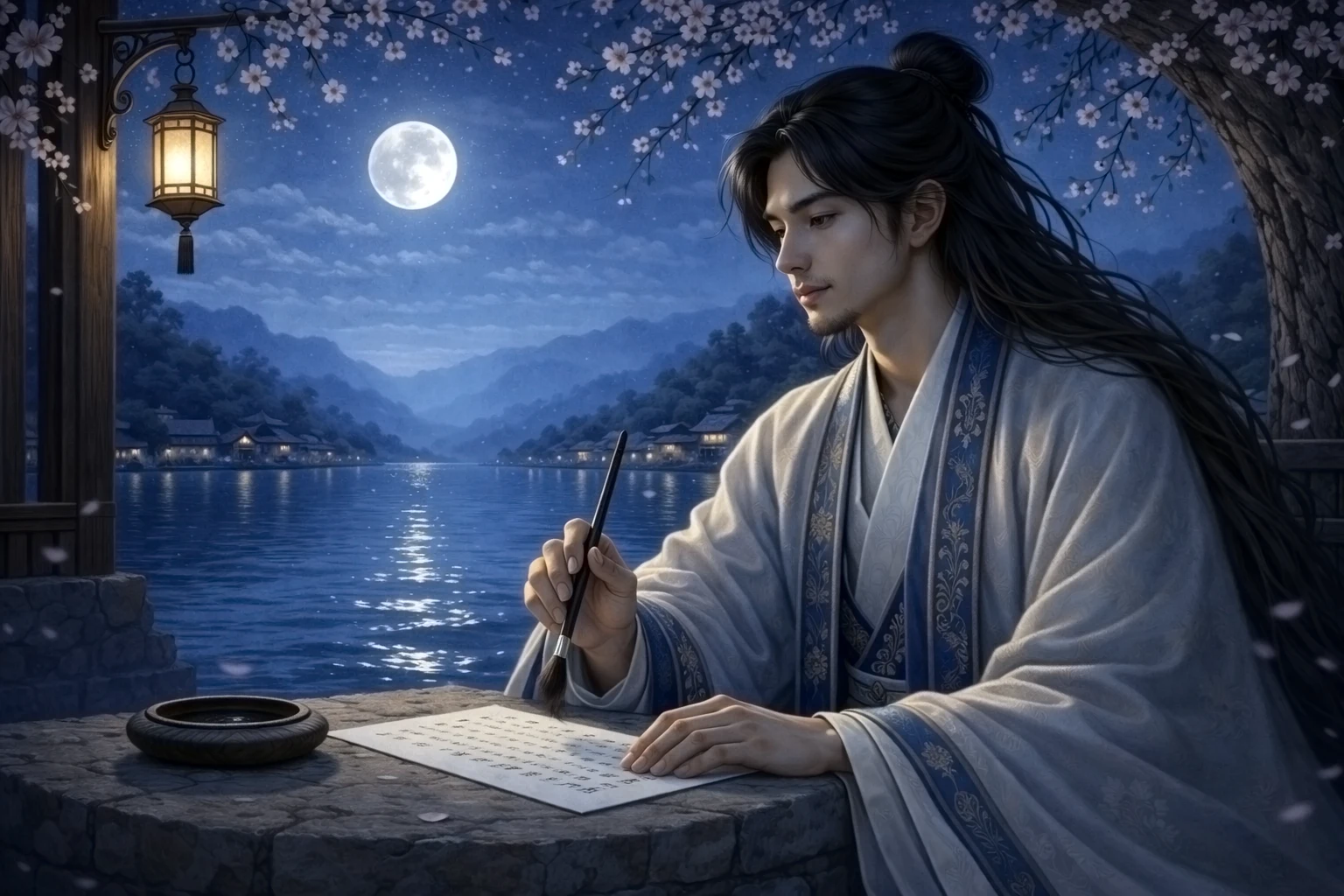
Zhu Qingyu (朱庆馀 dates of birth and death unknown), also known by his given name Kejiu, was a poet of the Mid-Tang period, a native of Yuezhou (present-day Shaoxing, Zhejiang Province). He passed the jinshi examination in the second year of the Baoli era (826 AD) and held the position of Collator in the Imperial Library. His poetry excelled in the five-character regulated verse style, characterized by a refined and subtle elegance, with particular skill in depicting the emotions of boudoir women and palace maidens. In the Complete Tang Poems, two volumes containing 177 of his works are preserved. He was adept at using allegorical and metaphorical techniques, blending everyday emotions with political aspirations. Although not many of his poems survive, his exquisite craftsmanship secures him a unique place in the history of Tang poetry, with his poem Boudoir Sentiments becoming a quintessential example of the fusion of examination-themed and boudoir poetry in later generations.