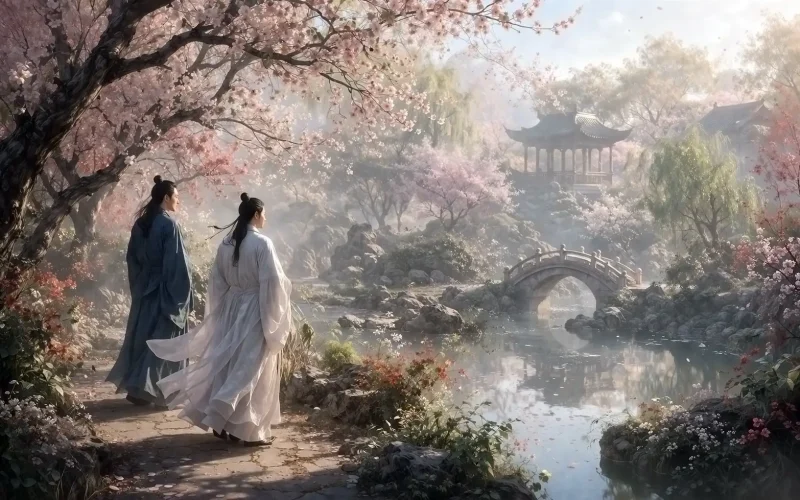

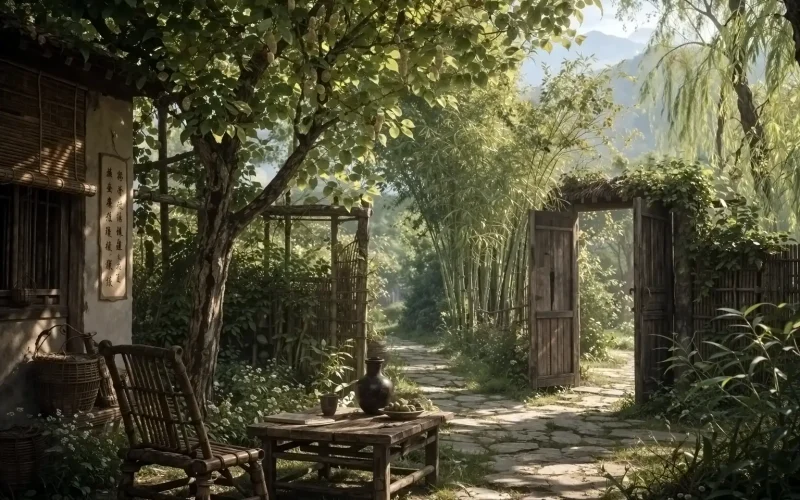
A few scant acres, where the mulberries grow
In thick‑set ranks; and at the wicket‑gate
Five willows, that invite the hand to pluck
Their vernal boughs — a fair, a quiet state.

The beaker at my board I keep supplied;
The bubble‑fame that floats beyond the man
I count as nothing — a vain stir, a breath
That comes and goes according to no plan.

There is a walk where bamboo‑stems make shade;
The wind, that comes an unbid servitor,
Sweeps it at times; and, having nought within
To lure the world, I keep the door

Shut, as the quiet evenings close. And here,
Even here, I find a tract of mind set free
From cunning thoughts — a region of my own.
What need to barter gold for some far hill
that is not mine, and may not ever be?
Original Poem
「归故园」
朱庆馀
桑柘骈阗数亩间,门前五柳正堪攀。
尊中美酒长须满,身外浮名总是闲。
竹径有时风为扫,柴门无事日常关。
于焉已是忘机地,何用将金别买山。
Interpretation
This poem was composed in Zhu Qingyu's later years after he resigned from his official post and returned to his hometown. Having earned the jinshi degree in his youth, he remained stuck in low-ranking positions for a long time, unable to advance in his official career. The reasons for this were not only the corruption of the imperial examination system and the persistence of aristocratic bias in the late Tang, but also his own upright character, which disdained flattering the powerful and conforming to vulgar trends. After struggling for years within the confines of the bureaucracy, he finally understood: that official's black gauze cap was not worth a lifetime of freedom in exchange. Thus, he resolutely resigned and returned to his homeland in Yuezhou—the land he had left in his youth and had longed for in his heart since middle age.
His homeland was in the countryside of Yuezhou. It comprised a few acres of mulberry and paper mulberry trees. In front of the gate, he had planted five willow trees himself; behind the house, a path was formed by verdant bamboo. Here, there was no infighting of the officialdom, no weariness from official documents, only the agricultural work that followed the changing seasons and the shifting scenery of dawn and dusk. This poem was written after his return, expressing his state of mind upon coming back to his old garden—withdrawing from the turmoil of the mundane world, stepping back from the pursuit of fame and fortune, and rediscovering a long-lost peace and true self amidst the familiar pastoral scenes. The "sericulture trees stand[ing] closely" in the poem represents, in his eyes, the most tangible wealth of his homeland; the "five willows before the door" are not only an homage to Tao Yuanming but also the spiritual banner he erected for himself. He no longer needed the deliberate gesture of "picking chrysanthemums by the eastern hedge," for his entire life had already merged with nature.
First Couplet: "桑柘骈阗数亩间,门前五柳正堪攀。"
Sāng zhè pián tián shù mǔ jiān, mén qián wǔ liǔ zhèng kān pān.
Mulberry and paper mulberry trees stand densely across several acres of land; the five willow trees before the gate, with their drooping branches, are just right for plucking.
The poem opens by depicting the scenery of the old garden. "桑柘骈阗" (Mulberry and paper mulberry trees stand densely) describes the lush, interwoven mulberry and paper mulberry trees forming shade in the fields—the two characters "骈阗" (stand densely) convey both their density and vitality, symbolizing the prosperity and tranquility of pastoral life. "门前五柳" (the five willow trees before the gate) subtly alludes to Tao Yuanming's sobriquet "Master Five Willows"; the poet compares himself to Tao Qian, expressing his heart's inclination towards the pastoral and his aspiration for transcendence. The phrase "正堪攀" (are just right for plucking) captures the intimacy of the willow branches hanging low enough to be touched at hand, and also conveys the long-missed leisure and ease the poet feels upon returning home. Within this couplet, the poet uses the mulberry and paper mulberry trees to write of life's tranquility, and the five willows to write of the spirit's return, capturing with his brush the dual satisfaction found after returning to the garden.
Second Couplet: "尊中美酒长须满,身外浮名总是闲。"
Zūn zhōng měi jiǔ cháng xū mǎn, shēn wài fú míng zǒng shì xián.
The fine wine in the cup should always be kept full; the hollow fame beyond one's person is ultimately an irrelevant triviality.
This couplet shifts from scenery to the heart, directly expressing the poet's attitude towards life. "尊中美酒长须满" (The fine wine in the cup should always be kept full) uses the three characters "长须满" (should always be kept full) to convey the poet's cherishing and enjoyment of his present life—the wine need not be precious, only that it be ever-present; days need not be grand, only that they be free and unrestrained. The next line, "身外浮名总是闲" (the hollow fame beyond one's person is ultimately an irrelevant triviality), uses the three characters "总是闲" (is ultimately an irrelevant triviality) to gently set aside the fame and fortune he pursued for half a lifetime. That word "闲" (triviality/idle) is not laziness, but the spiritual freedom of "having no heart for contention"; the two characters "浮名" (hollow fame) represent his complete disillusionment with his past official career. Within this couplet, the poet uses wine to write of life's richness and the word "闲" to write of his broad-minded state; the language is extremely plain, yet the meaning is profoundly far-reaching.
Third Couplet: "竹径有时风为扫,柴门无事日常关。"
Zhú jìng yǒu shí fēng wéi sǎo, zhài mén wú shì rì cháng guān.
The bamboo path is occasionally swept clean by the wind; the wooden gate, with nothing to attend to, is usually closed.
This couplet uses two sets of life details to depict the tranquility and self-sufficiency after returning to the garden. "竹径有时风为扫" (The bamboo path is occasionally swept clean by the wind) employs personification to write of the默契 (tacit understanding) between nature and the poet—the wind sweeping the path, as if heaven and earth are also sharing his trivial chores; the word "为" (by/for) writes of the intimate bond between man and nature. The next line, "柴门无事日常关" (the wooden gate, with nothing to attend to, is usually closed), writes of the simplicity and quietude of daily life—the gate being often closed is not about isolating oneself from others, but about having no need for social engagements or busyness, simply enjoying peace and quiet within one's own small world. These three characters "日常关" (is usually closed) represent the solitude actively chosen by the poet, and also the composure that follows the clarity of his mind. Within this couplet, the poet uses the wind sweeping the bamboo path to write of the unity of heaven and man, and the gate being usually closed to write of contentment with peaceful tranquility, blending the poetic and Zen-like qualities of pastoral life into one.
Final Couplet: "于焉已是忘机地,何用将金别买山。"
Yú yān yǐ shì wàng jī dì, hé yòng jiāng jīn bié mǎi shān.
Here already is a place that allows one to forget worldly scheming; why then spend money to seek out another mountain elsewhere?
The final couplet concludes with reflection, serving as the focal point that illuminates the entire poem. "于焉已是忘机地" (Here already is a place that allows one to forget worldly scheming) adapts the allusion of "机心" (worldly scheming) from Zhuangzi—"忘机" (forget worldly scheming) means to abandon worldly calculation and cunning, returning to one's pure, innate nature. The poet affirms that this old garden beneath his feet is already sufficient to settle his body and mind, enough to allow him to "忘机". The next line, "何用将金别买山" (why then spend money to seek out another mountain elsewhere?), concludes with a rhetorical question, expressing the self-sufficiency and坦然 (composure) in his heart—there is no need to seek a more "ideal" place for reclusion, because the best place of return is right before his eyes. This question is asked with composure and answered with resolve: true reclusion lies not in famous mountains or ancient temples, but in a heart that has "忘机". At this point, the poem elevates the theme of returning to the garden from the geographical act of "coming home" to the spiritual act of "returning to authenticity."
Holistic Appreciation
This is a representative work among Zhu Qingyu's poems on reclusion. The entire poem consists of eight lines and fifty-six characters. Using the scenery of his old garden as the thread, it weaves together the tranquility of pastoral life, the contentment of a simple existence, the broadmindedness of his state of mind, and the return of his spirit to authenticity, revealing the poet's gentle, peaceful, clear, and free spiritual realm after retirement.
Structurally, the poem presents a progressive sequence from scenery to heart, from the external to the internal. The first couplet uses "sericulture trees" and "five willows" to depict the pastoral scene, which is what the eyes see. The second couplet uses "good wine" and "floating fame" to express his attitude towards life, which is where his heart leans. The third couplet uses "bamboo path" and "wicket gate" to write of the quietude of daily life, which is where his body finds peace. The final couplet concludes with "a place to forget the world" and "buy another hill," which is where his aspirations ultimately reside. Between the four couplets, the poem moves from scene to heart, from heart to body, from body to aspiration, progressing layer by layer, forming a seamless whole.
Thematically, the core of this poem lies in the two characters "忘机" (forget worldly wisdom/forget the world). The "闲" (idle/vain dream) in "浮名总是闲" (Floating fame... is but a vain dream) is the starting point of "forgetting the world." The "关" (closed/shut) in "柴门无事日常关" (My wicket gate, when I'm free, is closed all the day long) is the posture of "forgetting the world." The "忘机" (place to forget the world) in "于焉已是忘机地" (Here is a place to forget the world) is the completion of "forgetting the world." This "forgetting the world" is not escapism, but transcendence; it is not passive, but self-sufficient. Using the simple pastoral life as a vessel, the poet transforms the Daoist realm of "fasting of the mind and sitting in forgetfulness" into a tangible, touchable daily reality.
Artistically, the poem's most moving aspect lies in the plain technique of "conveying deep meaning through common scenes, revealing true simplicity through understatement." The poet does not describe spectacular mountains and exotic waters, only ordinary scenes like mulberry trees, willows, bamboo paths, and a wicket gate. He does not express intense passions, only uses simple phrases like "shall often fill up" (长须满), "is but a vain dream" (总是闲), "wind sweeps it clean" (风为扫), and "is closed all the day long" (日常关). Yet it is precisely this commonness and understatement that makes the poem's realm feel exceptionally genuine and intimate. The personification in "wind sweeps it clean" and the rhetorical question in "Why should I spend gold to buy another hill?" inadvertently reveal the poet's clear state of mind, in harmony with nature and reconciled with himself.
Artistic Merits
- Unified Imagery, Scene Infused with Feeling: The sericulture trees, five willows, bamboo path, and wicket gate—these form a complete pastoral imagery group, embedding emotion within the scene, advancing layer by layer.
- Plain Language, Profound Meaning: The poem uses almost no ornate diction, yet with ordinary phrases like "shall often fill up," "is but a vain dream," "wind sweeps it clean," and "is closed all the day long," it expresses extraordinary broadmindedness and self-contentment.
- Allusions Used Naturally, Without Trace: Alluding to Tao Yuanming with "five willows" and transforming Zhuangzi's concept with "forget the world," the allusions blend with the scene and harmonize with the emotion, feeling completely natural.
- Concluding Line as the Focal Point, with Lasting Resonance: The final couplet concludes with "Here is a place to forget the world; Why should I spend gold to buy another hill?" Using a rhetorical question to emphasize self-sufficiency, expressing composure through understatement, the words end but the meaning lingers.
Insights
Through an account of returning home, this poem speaks to an eternal theme—True peace lies not in remote mountains, but in a heart that has "forgotten the world"; true reclusion is not an escape from the world, but finding one's true self amidst ordinary life.
First, it lets us see the "meaning of returning." The poet's return to his old garden is not a geographical "going home," but a spiritual "return to authenticity"—stepping back from the pursuit of fame and fortune, withdrawing from the turmoil of the mundane world, and rediscovering his pure self amidst the mulberry trees, willows, bamboo path, and wicket gate. It reminds us: Sometimes, when we have gone too far, we should not forget why we started; when we chase after too much, we should not forget what is truly important.
On a deeper level, this poem makes us contemplate the "value of self-sufficiency." "Why should I spend gold to buy another hill?"—the poet tells us that the best place of return is not somewhere far away, but right under our feet; the best life is not elsewhere, but in the present moment. It makes us understand: True abundance is not having more, but needing less; true freedom is not the ability to go anywhere, but finding peace of heart wherever you are.
And what is most memorable is the poem's gentle and peaceful posture towards reclusion. Zhu Qingyu is not as aloof and transcendent as Tao Yuanming, nor as cynical and misanthropic as some other hermits. He simply returned quietly to his old garden, drank wine, closed his gate, watched the wind sweep the bamboo path, and then said gently in his poem, "Here is a place to forget the world." This gentleness is reconciliation with oneself after experiencing the world; this peace is the composure that comes from seeing through hollow fame.
This poem is about a homecoming in the Mid-Tang era, yet it allows everyone rushing about in the dusty world, longing for a moment of peace, to find resonance within it. The lush growth of the "sericulture trees" is the homeland in every wanderer's memory. The intimacy of the "five willows before the door" is the scenery in the eyes of everyone returning home. The letting go in "Floating fame... is but a vain dream" is the shared realization of all who have weathered life's storms. The self-sufficiency in "Here is a place to forget the world" is the deepest peace in the hearts of all who have reconciled with life. This is the vitality of poetry: it writes of Zhu Qingyu's return to his old garden, but one reads of people of all eras—those who rediscover their true selves in ordinary life and settle their hearts in everyday days.
About the Poet
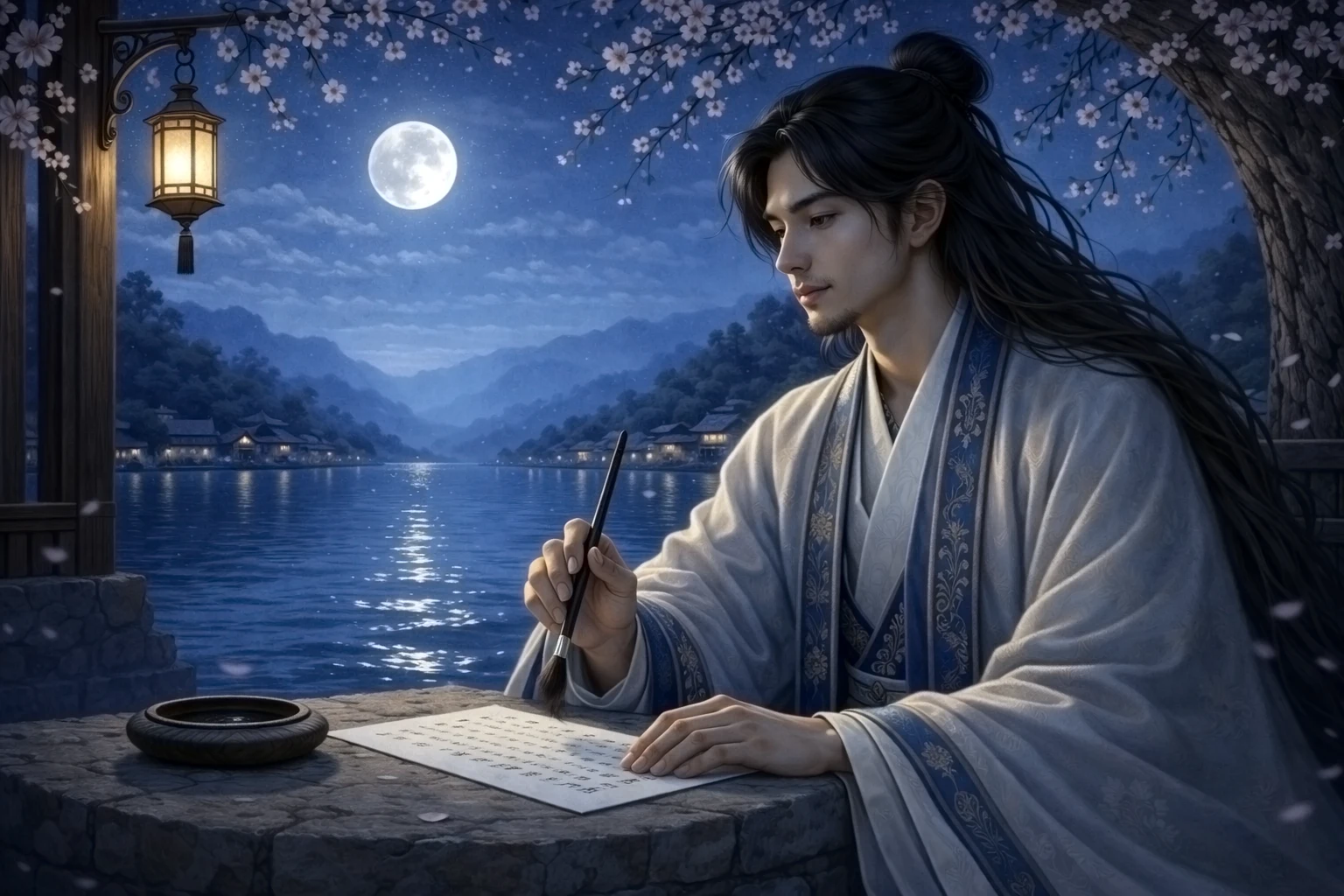
Zhu Qingyu (朱庆馀 dates of birth and death unknown), also known by his given name Kejiu, was a poet of the Mid-Tang period, a native of Yuezhou (present-day Shaoxing, Zhejiang Province). He passed the jinshi examination in the second year of the Baoli era (826 AD) and held the position of Collator in the Imperial Library. His poetry excelled in the five-character regulated verse style, characterized by a refined and subtle elegance, with particular skill in depicting the emotions of boudoir women and palace maidens. In the Complete Tang Poems, two volumes containing 177 of his works are preserved. He was adept at using allegorical and metaphorical techniques, blending everyday emotions with political aspirations. Although not many of his poems survive, his exquisite craftsmanship secures him a unique place in the history of Tang poetry, with his poem Boudoir Sentiments becoming a quintessential example of the fusion of examination-themed and boudoir poetry in later generations.