
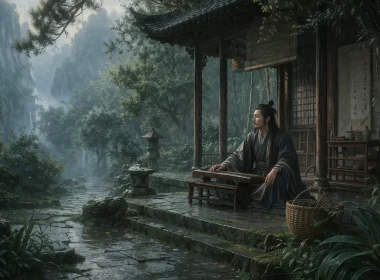
In the rain, the wet hens clucking from a roof or so;
The bamboos by the stream, the lane, the poles that bridge its flow.

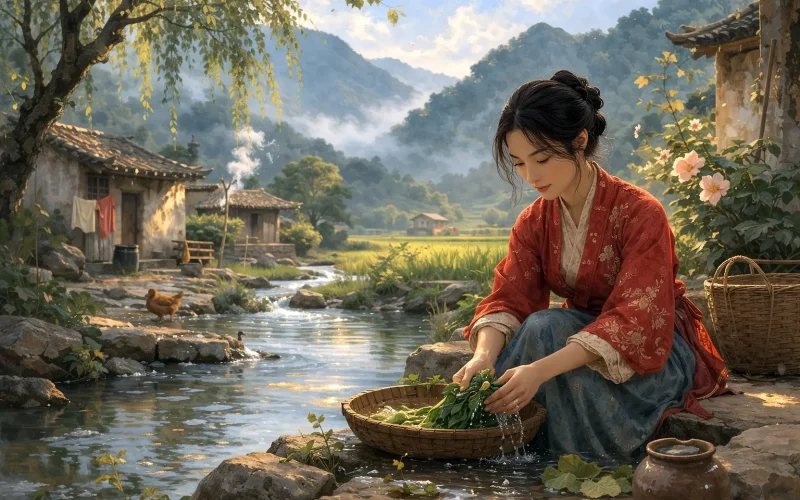
The women call each other, to the silkworms’ bathing‑time;
And stop to note the gardenia‑flower, in its prime.
Original Poem
「雨过山村」
王建
雨里鸡鸣一两家,竹溪村路板桥斜。
妇姑相唤浴蚕去,闲看中庭栀子花。
Interpretation
This poem is an excellent pastoral work by the Mid-Tang poet Wang Jian. Wang Jian, renowned for his yuefu poetry and often paired with Zhang Ji as "Zhang and Wang of Yuefu," primarily wrote about the hardships of the people and the fates of women. His language is simple and unadorned, yet his emotions are profound and moving. In his later years, he retreated to the countryside, where he gained a deep understanding and genuine affection for rural life. His poems often reveal a love for pastoral scenery and an appreciation for the lives of farmers.
This poem depicts a scene in a mountain village after rain, sketching a vivid picture of spring rain in a farming household with extremely minimal brushstrokes. "雨里鸡鸣" (cocks crow in the rain) captures the unique tranquility of a mountain hamlet; "竹溪板桥" (bamboo-fringed stream, a plank bridge) are common sights in the countryside; "妇姑相唤" (sister calls to sister-in-law) is the everyday warmth of farm life; "栀子花开" (the gardenia bloom) is the silent, quiet beauty of a courtyard. With his keen observational eye, the poet captures a few moments in a mountain village during the spring rains, blending sound, color, human connection, and floral imagery, making the reader feel as if transported there—smelling the fresh post-rain air, hearing the sparse crow of cocks, seeing the busy yet harmonious figures of farm life. Though short, the poem has a lingering charm and is a rare gem among Wang Jian's pastoral poems.
First Couplet: "雨里鸡鸣一两家,竹溪村路板桥斜。"
Yǔ lǐ jī míng yī liǎng jiā, zhú xī cūn lù bǎn qiáo xiá.
Cocks crow in the rain; a household two or three, A bamboo-fringed stream, a winding country way, A plank bridge slants before a cottage door.
The poem opens with sound entering the scene. "雨里鸡鸣" (cocks crow in the rain)—four characters depict the unique tranquility of a mountain village: the sound of pattering rain, sparse cockcrows, unlike the clamor of plains villages, precisely reflecting the scattered dwellings of mountain homes. The phrase "一两家" (a household two or three) emphasizes the smallness of the hamlet and the sparseness of its inhabitants, which in turn enhances the sense of peace. The next line, "竹溪村路板桥斜" (a bamboo-fringed stream, a winding country way, a plank bridge slants), shifts from aural to visual. A stream flanked by bamboo groves, a winding village path, a slanting plank bridge—these utterly ordinary rural scenes gain a pictorial quality under the poet's brush. The word "斜" (slanting) is used masterfully: the bridge naturally slants, a truthful depiction of the mountainous terrain; the slanting bridge also adds a touch of liveliness and rustic charm to this tranquil picture. In one couplet, there is sound and color, stillness and movement; the picture of a mountain village in spring rain already leaps off the page.
Second Couplet: "妇姑相唤浴蚕去,闲看中庭栀子花。"
Fù gū xiāng huàn yù cán qù, xián kàn zhōng tíng zhīzihuā.
A sister calls to sister-in-law to bathe cocoons, Leisure to watch mid-court the gardenia bloom.
This couplet moves from scenery to people, from outside to inside. "妇姑相唤" (sister calls to sister-in-law)—four characters depict the harmony and intimacy between mother-in-law and daughter-in-law in a farm household. They call to each other, going together to "bathe cocoons" (a process of selecting and disinfecting silkworm eggs), an important farming task during the busy spring season. The word "唤" (calls) instantly animates the picture, as if one can hear the familiar calls echoing in the mountain hamlet. The next line, "闲看中庭栀子花" (leisure to watch mid-court the gardenia bloom), abruptly shifts the brush, moving from motion to stillness. The two words "闲看" (leisure to watch) seem to describe a person, but in reality describe the flower—it is not that someone is leisurely watching, but that the flower blooms alone, as if waiting for someone to appreciate it. Gardenias, white and fragrant, have long symbolized "shared hearts" or "harmony," yet during the busy farming season, they are left unattended. This word "闲" (leisure/idle) uses the idleness of the flower to contrast with the busyness of the people; the silent beauty of being unwatched highlights the bustling atmosphere of spring labor in every household. One "唤" (call) and one "闲" (leisure), one busy, one still—they play off each other, creating endless charm.
Holistic Appreciation
This is a fine work among Wang Jian's pastoral poems. The entire poem consists of four lines and twenty-eight characters. Using the post-rain mountain village as its entry point, it blends natural scenery with farm life, showcasing the tranquility and busyness, the seclusion and warmth of a mountain village in spring.
Structurally, the poem exhibits a progression from outside to inside, from scenery to people. The first two lines describe the external scenery of the mountain village—cocks crowing in the rain, the bamboo stream and slanting bridge—outlining a serene landscape painting through sound and sight. The latter two lines describe the interior scene of the farmstead—mother-in-law and daughter-in-law calling to each other, the task of bathing cocoons—showing the vitality of mountain village life through human activity. The final line, "闲看中庭栀子花", concludes, simultaneously revealing the motion and stillness, busyness and leisure of the preceding lines. Between the four lines, the poem moves from far to near, from stillness to motion, then from motion back to stillness, progressing layer by layer, forming a seamless whole.
Thematically, the core of this poem lies in the contrast between "busyness" and "leisure". The busyness of "妇姑相唤" is the rhythm of spring farm work; the idle blooming of the "中庭栀子" is the silent existence of nature. Between this "busyness" and "leisure" lies the poet's deep understanding of mountain village life: the farmers are busy, yet fulfilled; the flower is idly blooming, yet lonely. The poet does not explicitly praise nor directly express sympathy; he merely presents this contrast before the reader's eyes, allowing each person to savor its flavor for themselves.
Artistically, the poem's most moving aspect lies in its technique of contrast: "using leisure to depict busyness, using flowers to set off people." The poet does not write about how hard the farmers toil; he only writes of their "相唤" (calling to each other). He does not write about the busyness of spring ploughing; he only writes of the silent "无人看" (being unwatched) of the gardenia. It is precisely this unwatched flower that lets us sense the bustling springtime activity in every household; it is precisely this silent courtyard that lets us imagine the fervent labor in the fields.
This technique of "the words are here, but the meaning lies elsewhere" is the highest realm of "subtlety and implicitness" in classical Chinese poetry.
Artistic Merits
- Using Sound to Create Scene, Instantly Evoking Mood: "雨里鸡鸣" uses sound to embellish the picture, instantly transporting the reader into that serene morning scene of the mountain hamlet.
- Vivid Details, Rich with Life's Atmosphere: The four characters "妇姑相唤" vividly depict the intimacy and busyness of farm women, making the scene feel present and warmly familiar.
- Skillful Contrast, Simple Words with Rich Meaning: Using the still scene of "闲看中庭栀子花" to contrast the busyness of the farm household, it shows busyness without stating it, implies weariness without mentioning it.
- Simple Language, Lingering Charm: The entire poem is as natural as spoken language, yet each word carries pictorial beauty, each line holds deep feeling, reading it is like drinking from a mountain spring—clear, cool, and sweetly lingering.
Insights
This poem, through a spring rain, speaks to an eternal theme—within the most ordinary life lies the deepest poetry.
First, it lets us see "beauty in the ordinary." The cocks crowing in the rain, the bamboo stream and plank bridge, the women calling to each other, the gardenia in the courtyard—nothing is particularly rare, nothing strikingly dazzling. Yet it is precisely these most ordinary details that compose the most truthful picture of mountain village life. It tells us: poetry is not in the distance, but in the everyday sights and sounds around us; beauty is not elsewhere, but in the fine details we so often overlook.
On a deeper level, this poem makes us contemplate the dialectic of "busyness and leisure." The farmers are busy, busy bathing cocoons, busy with spring ploughing, with no leisure to glance at the gardenia in the courtyard. Yet it is precisely this busyness that gives life warmth and purpose. The flower idly blooms, unwatched, yet it blooms freely nonetheless. This busyness and leisure are two sides of life: without busyness, leisure is hollow; without leisure, busyness is barren.
And what is most haunting is the subtlety of "emotion appearing without being stated" in the poem. The poet does not say the farmers are toiling, does not say the mountain village is beautiful; he simply, calmly writes these few scenes. Yet it is precisely this calmness that allows readers to discover, to feel, to resonate for themselves. Truly moving poetry often does not exhaust all words, but leaves space for the reader's imagination.
This poem writes of a Tang Dynasty mountain village, yet allows anyone who loves life to find resonance within it. The cocks crowing in the rain are the memory of every dawn; the slanting shadow of the plank bridge is the scenery of every country path; the women calling to each other are the everyday warmth of every family; the unwatched gardenia is the silent blooming of every spring. This is the vitality of poetry: it writes of the everyday life of a mountain village, but one reads the attachment to a simple life that lies in everyone's heart.
About the poet
Wang Jian (王建 c. 767 – c. 830), a native of Xuchang, Henan Province, was a renowned poet of the Mid-Tang Dynasty. Born into a humble family, he served on the frontier in his early years. During the Yuanhe era, he held positions such as Assistant Magistrate of Zhaoying County and Assistant Director of the Court of Imperial Treasury. In his later years, he rose to the post of Sima (Minister of War) in Shanzhou, earning him the sobriquet "Sima Wang." His greatest poetic achievements were in the yuefu (Music Bureau) style, and he was often mentioned alongside Zhang Ji as the "Zhang-Wang Yuefu," becoming an important representative of the New Yuefu Movement. His poetic style is characterized by accessible language and profound meaning, securing him a significant place in the tradition of Tang Dynasty realist poetry.