
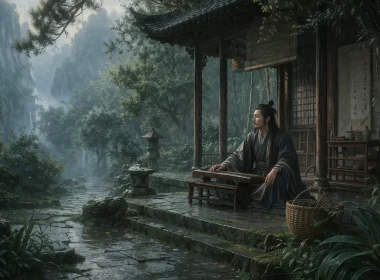

Upon the tower, alone, in the rain’s blinding folds I stand,
While the whole river roars, and the storm takes the land.
And there — the distant peaks, like the dark‑twisted hair
Of the drowned nymphs of Xiang, in the cloud‑laden air!

O, to be on the waters! To ride that heaving plain,
And from the silver mountains of the surge, to behold again
The eternal greens of the hills — a more glorious, terrible sight,
Torn from the heart of the tempest, and clothed in its light!
Original Poem
「雨中登岳阳楼望君山 · 其二」
黄庭坚
满川风雨独凭栏,绾结湘娥十二鬟。
可惜不当湖水面,银山堆里看青山。
Interpretation
This poem was composed in the first year of the Chongning era of the Northern Song Dynasty (1102), when Huang Tingjian, having received a pardon, was returning home from Jiangling. He wrote it while climbing a tower in Yueyang and gazing at Mount Jun. Previously, Huang Tingjian had been accused of "defaming the late emperor" due to his work on the Veritable Records of Emperor Shenzong and was exiled for six long years, first to Qianzhou and then to Rongzhou. In the first month of 1102, he was finally pardoned and allowed to return east, ending his long exile. His heart was filled with complex emotions.
The Yueyang Tower overlooks Dongting Lake, with Mount Jun resembling a green spiral shell floating upon endless blue waves—a renowned site that had inspired literati throughout the ages. Huang Tingjian ascended the tower during a storm. Leaning on the railing and gazing into the distance, he wrote two heptasyllabic quatrains. The first poem focuses on the personal sentiment of "Surviving exile, my temples streaked with grey," expressing relief and release after surviving hardship with the line "Before reaching the Southland, I first smile." The second poem focuses more on the lakes-and-mountains scene before his eyes—leaning alone on the railing amidst a riverful of wind and rain, seeing Mount Jun like the hair-coils of the Xiang River goddess, and sighing that he cannot sail on the lake to view the green hill amidst the silver mountains of waves. One poem expresses emotion, the other depicts scenery; one is introspective, the other looks outward. Together, they form a complete presentation of the poet's complex state of mind after enduring tribulations: relief for his preserved life, sighs over the helplessness of worldly affairs, intoxication with natural beauty, and regret over the distance between ideal and reality.
First Couplet: "满川风雨独凭栏,绾结湘娥十二鬟。"
Mǎn chuān fēngyǔ dú píng lán, wǎn jié Xiāng'é shí'èr huán.
A riverful of wind and rain, I lean alone on the rail;
Coiled like the twelve locks of the Goddess of the River Xiang, so frail.
The opening line, "A riverful of wind and rain," sketches a vast, magnificent scene of the storm over Dongting. "A riverful" emphasizes the breadth of the storm; "wind and rain" is both the actual scene before his eyes and a metaphor for the political tempests of the poet's life. Yet, the poet does not speak of "sheltering from the storm" but of "leaning alone on the rail"—the word "alone" depicts his solitary figure after surviving calamity, and even more, conveys the composure and resilience of "let the storm rage, I stand firm and unshaken." The next line abruptly shifts the brushstroke, moving from the vast storm to the exquisite Mount Jun. "Coiled like the twelve locks of the Goddess of the River Xiang" uses mythological imagery to depict the mountain's form—legend says the two consorts of Emperor Shun, Ehuang and Nüying, became goddesses of the Xiang River, transforming into Mount Jun after death. Comparing the undulating peaks to the goddess's coiled hair-knots not only captures the mountain's verdant, layered beauty but also endows it with spirit and deep feeling. From "wind and rain" to "Goddess of the Xiang," from magnificent to exquisite, the flow of the poet's mood and the shift in artistic conception are fully contained within these fourteen characters.
Second Couplet: "可惜不当湖水面,银山堆里看青山。"
Kěxī bù dàng húshuǐ miàn, yín shān duī lǐ kàn qīng shān.
It's a pity I'm not afloat on the surface of the lake,
To view the green hill from within those heaped-up silver mountains' wake.
This couplet shifts from the scene before his eyes to the thoughts in his heart, from the real to the imagined, from near to far. The two words, "It's a pity," are the emotional turning point of the entire poem, revealing deep regret and longing. "Not afloat on the surface of the lake"—the poet is on the tower, only able to gaze from afar, unable to sail upon the lake and face Mount Jun intimately. The next line, "To view the green hill from within those heaped-up silver mountains' wake," paints an intensely dynamic scene from the poet's imagination. "Silver mountains" metaphorically refers to the churning white waves of Dongting Lake, piled up like silver mountains; "green hill" refers to the emerald-green Mount Jun. The color contrast between "silver" and "green," the interplay of movement in "heaped-up" and stillness in "view," constitutes a magnificent and vivid picture. What the poet longs for is precisely to place himself amidst those surging waves, to stand silently facing Mount Jun between heaven and earth. However, the words "It's a pity" fix this longing as an eternal regret—he can only gaze from the tower, he can only arrive there in his imagination.
Holistic Appreciation
This is a heptasyllabic quatrain that perfectly fuses the poet's personal life experience with the beauty of the lake and mountains. The poem's four lines and twenty-eight characters begin with wind and rain and conclude with the green hill, displaying within its brief scope rich layers of vastness and delicacy, reality and longing.
Structurally, the poem reveals a progressive trajectory from the external to the internal, from the real to the imagined. The first line, "A riverful of wind and rain, I lean alone on the rail," opens with a grand scene and a solitary stance, setting a desolate yet resilient tone for the entire poem. The second line, "Coiled like the twelve locks of the Goddess of the River Xiang, so frail," shifts from the storm to Mount Jun, depicting its delicate beauty with mythological imagery, transforming the artistic conception. The third line, "It's a pity I'm not afloat on the surface of the lake," turns abruptly, shifting from the scene before his eyes to the thoughts in his heart, from reality to longing. The final line, "To view the green hill from within those heaped-up silver mountains' wake," concludes the poem with a magnificent, imagined scene, transforming regret into poetry and solidifying longing into eternity. Within these four lines, the initiation, continuation, turn, and conclusion are seamless and natural.
In its conception, the poem's core lies in the complex sentiment contained within the words "It's a pity." Having endured tribulations and finally received a pardon to return east, the poet ascends the Yueyang Tower. Facing the storm over Dongting and the beautiful scenery of Mount Jun, his heart holds both relief and emotion, both appreciation for the scene before him and longing for a closer communion with the landscape, for a freer realm. This "pity" is regret for not being able to sail on the lake, and even more, it is a sigh for all the "visible yet unattainable" things in life. However, the poet does not drown in regret. Instead, with the magnificent imagination of "view[ing] the green hill from within those heaped-up silver mountains' wake," he elevates this regret into a poetic longing. This capacity for imagination and aesthetic appreciation, maintained even amidst regret, is precisely the unique charm of Huang Tingjian as a poet.
Artistically, the most moving aspect of this poem lies in the contrast and transformation of imagery. The contrast between "wind and rain" and "Goddess of the Xiang" is one between vast desolation and delicate beauty; the contrast between "silver mountains" and "green hill" is one between movement and stillness, white and green. Between "lean alone on the rail" and "view the green hill" lies the implied trajectory of the poet's soul from solitude to longing, from reality to ideal. These contrasts and transformations give the poem, within its limited length, a rich sense of layers and a far-reaching artistic conception.
Artistic Merits
- Vivid Imagistic Contrast, Rich Pictorial Layers: The contrast between the vast desolation of "wind and rain" and the delicate beauty of "Goddess of the Xiang," the interplay of the movement/stillness and white/green in "silver mountains" and "green hill," creates multiple visual layers. Tension resides in the contrast; artistic conception is revealed within the layers.
- Mythological Imagery in Poetry, Endowing Scenery with Spirit: "Coiled like the twelve locks of the Goddess of the River Xiang" uses the river goddess as a metaphor for Mount Jun, bestowing a mythological radiance upon the natural landscape, adding poetic depth and romance. Imagination is seen in the myth; talent is revealed in the spirit.
- Fusion of Feeling and Scene, Profound Conveyance of Meaning: "A riverful of wind and rain" is both the actual scene and a metaphor for the political storms of the poet's life; "lean alone on the rail" is both an action and a portrait of the poet's solitary, proud figure after surviving calamity. Feeling is contained within the scene; the person is revealed within the feeling.
- Concise Language, Rich Connotation: The entire poem consists of twenty-eight characters, yet it melds personal experience, the beauty of lake and mountain, mythological imagination, and reflections on life. Brevity holds comprehensiveness; each word is a gem.
- Skillful Transition, Lasting Resonance: The third line turns abruptly with "It's a pity," shifting the poetry from the real to the imagined, from the immediate to the envisioned. The final line concludes with a magnificent picture, leaving endless aftertaste. Ingenuity is seen in the transition; depth is revealed in the resonance.
Insights
Using the storm over Dongting and the beautiful scenery of Mount Jun as its backdrop, this poem articulates the complex emotions felt when encountering beauty after enduring hardship, offering profound insights. It allows us to see the power of maintaining aesthetic capacity even in adversity. Amidst "满川风雨" the poet could still "lean alone on the rail" and gaze afar, could still appreciate the delicate beauty of Mount Jun, could still use mythological imagination to endow the scenery with poetry. This ability to not shut one's eyes in the storm, to still discover beauty amidst hardship, is the most potent weapon against fate. It enlightens us: No matter what "storms" one encounters in life, do not close the heart that perceives the world. Beauty is always there, waiting to be discovered; and a heart capable of discovering beauty can never be utterly defeated.
The regret of "可惜不当湖水面" and the imagination of "view[ing] the green hill from within those heaped-up silver mountains' wake" lead us to contemplate the relationship between "distance" and "longing." Unable to sail on the lake, able only to gaze from the tower, this state of being "visible yet unattainable" precisely fuels his more intense longing and more magnificent imagination. The picture of "view[ing] the green hill from within those heaped-up silver mountains' wake" is more magnificent, more moving than any real scene beheld with the eyes. It enlightens us: Some beauties shine forever precisely because they cannot be fully possessed; some longings remain forever vibrant precisely because they cannot be truly reached. Just as the poet experienced, life's regrets can also be transformed into poetic eternity.
On a deeper level, this poem also shows us the openness and transcendence Huang Tingjian maintained after enduring hardship. He did not blame fate amidst "a riverful of wind and rain," nor did he drown in self-pity over "It's a pity." Instead, with the magnificent imagination of "view[ing] the green hill from within those heaped-up silver mountains' wake," he elevated regret into art and solidified longing into eternity. This spiritual height maintained in adversity is more precious than any success. It tells us: What truly determines the realm of one's life is not what one encounters, but how one faces those encounters; not how much one possesses, but how one imagines the beauty one has not yet possessed.
About the Poet
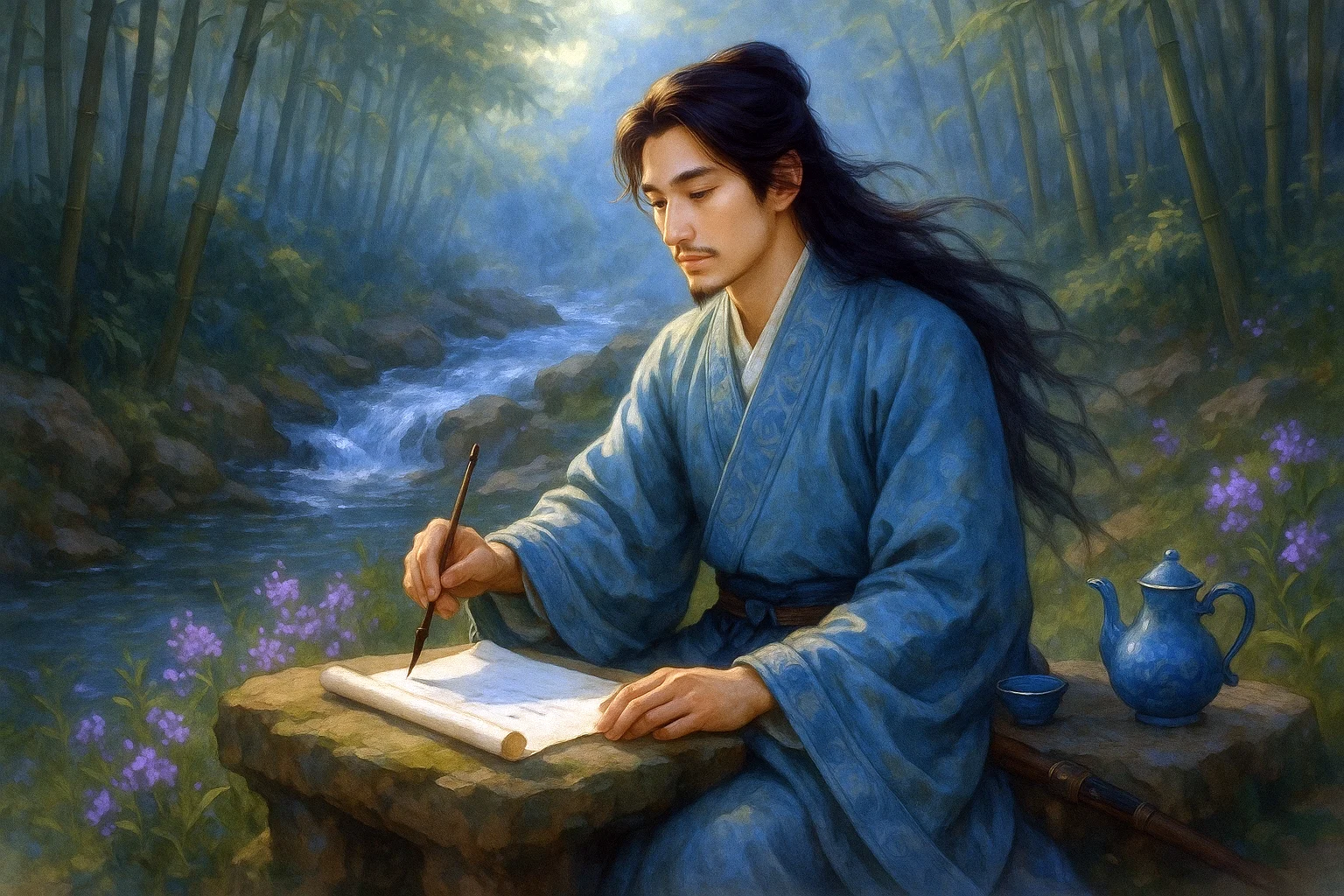
Huang Tingjian (黄庭坚 1045 - 1105), a native of Xiushui, Jiangxi Province, was a renowned poet and calligrapher of the Northern Song Dynasty. He became a jinshi (presented scholar) in the fourth year of the Zhiping era (1067 AD) and held various official posts, including Professor at the Imperial Academy and Secretary to the Imperial Archives. Later, he became entangled in the political strife between the conservative and reformist factions, suffering repeated demotions. As the foremost of the "Four Scholars of the Su School," he was often paired with Su Shi as "Su-Huang" in literary circles. Modeling his poetry on Du Fu, he founded the "Jiangxi School of Poetry" and proposed the influential creative theory of "transforming the bones and seizing the embryo, turning iron into gold," emphasizing that every word in poetry should have its origin. His work established a new paradigm for Song Dynasty poetics, exerting a profound and lasting influence on subsequent generations.