
In sleep, the perished things the heart obeys
Return; in wine, a pageant of false days
Confounds the sight — rich, glittering, and untrue.

O, I am sick of this too‑tender mood,
This fever of the soul, this lyrical blood!
To be of marble, and to feel no ache,
How blessèd were such frost, for pity’s sake!
Original Poem
「奉答李和甫代简 · 其二」
黄庭坚
梦中往事随心见,醉里繁华乱眼生。
长为风流恼人病,不如天性总无情。
Interpretation
This poem was written during Huang Tingjian's period of political exile, most likely after the Shaosheng reign period (1094-1098). His official life was fraught with difficulty. His work on the Veritable Records of Emperor Shenzong led to accusations of "defaming the late emperor," resulting in his demotion and exile to Qianzhou, followed by a further relocation to Rongzhou. During the long years in exile, the poet fully tasted the bitterness of the world, gaining a deeper understanding of life and human affairs.
Historical records provide little detail about Li Hefu, who is believed to have been a friend of Huang Tingjian. The title, "In Reverent Reply to Li Hefu, Using This Poem as a Letter," explains its function as a poetic missive. Although both poems express longing and reflection, they each emphasize different aspects. The first poem focuses on 'imbuing scenes with feeling'—it uses serene imagery like the mountain's hue, the river's sound, rolling up the blind to await the moon, and a flute from a nearby boat to subtly convey longing for a friend. Scene and emotion are seamlessly fused, creating a lasting resonance. The second poem turns inward to an 'inner monologue.' It begins with memories from dreams and the illusory splendors witnessed in a wine-induced haze, directly expressing the helpless frustration born from one's uncompromising integrity, even sighing with the ironic lament, 'Better had nature made me ever cold, untouched by feeling.' One poem is implicit, the other candid; one gazes outward at scenery, the other inward in introspection. Together, they form a complete portrayal of the poet's complex state of mind during his banishment.
First Couplet: "梦中往事随心见,醉里繁华乱眼生。"
Mèng zhōng wǎngshì suí xīn jiàn, zuì lǐ fánhuá luàn yǎn shēng.
In dreams, the past appears just as the heart may please;
In wine, a dazzling world confuses drunken eyes with unease.
The opening line juxtaposes two altered states of mind—"in dreams" and "in wine"—depicting the poet's remembrance of the past and his detachment from reality. "In dreams, the past appears just as the heart may please": Dreams are beyond control, yet memories come precisely "as the heart may please." This phrase ironically underscores the lack of agency in his waking life. The past, unattainable in reality, can only appear unbidden in dreams; the fate, ungraspable in reality, can only be briefly forgotten in wine. The next line, "In wine, a dazzling world confuses drunken eyes with unease," describes the illusory, glittering spectacle seen through intoxicated eyes—the fame, fortune, and worldly glamour once pursued seem even more unreal, chaotic, and false in this state. The phrase "confuses…with unease" describes not merely drunkenness but, more pointedly, the nature of that spectacle: that very splendor is itself a delusion, a form of emptiness.
Second Couplet: "长为风流恼人病,不如天性总无情。"
Cháng wéi fēngliú nǎo rén bìng, bùrú tiānxìng zǒng wúqíng.
Long has a noble spirit brought me nothing but spite and pain;
Better had nature made me ever cold, untouched by feeling's reign.
This couplet forms the core of the poem, using irony to voice inner conflict and sorrow. Here, "a noble spirit" does not imply frivolity but signifies integrity of character, transcendent talent, and a steadfast refusal to follow the crowd. This was Huang Tingjian's self-regard and the conviction he upheld throughout his life. Yet, it was precisely this "noble spirit" that led to repeated persecution and profound hardship. The phrase "brought me nothing but spite and pain" encompasses all the trouble, rejection, and suffering incurred because of his character. The following line, "Better had nature made me ever cold, untouched by feeling's reign," is delivered with bitter irony: rather than suffer for possessing passion, talent, and principle, it would be better to have been born without feeling, thus avoiding entanglement in worldly affairs, the pain of separation, and the sting of injustice. The words "Better had…" seem on the surface a form of self-mockery, a surrender, but in truth, they signify a more profound persistence—if he were not so deeply committed to his "noble spirit," how could this sigh of "better…untouched by feeling" arise? Just as in the ancient line whose surface meaning plays on a homophone for "feeling," here too, in "saying 'untouched by feeling,' there is, in fact, deep feeling."
Holistic Appreciation
This is a heptasyllabic quatrain of direct emotional expression. Its four lines and twenty-eight characters begin with memories from dreams and the illusory splendors of wine, and conclude with the "spite and pain" of a "noble spirit" and the thought that it would be "better…untouched by feeling," fully articulating the poet's inner conflict, pain, and steadfastness during exile.
Structurally, the poem exhibits a progressive layering, moving from the external to the internal, from appearance to essence. The first two lines describe the two altered states of "dream" and "wine," representing the poet's stance towards the past and present reality. The last two lines draw forth the inner monologue from this stance—the "pain" brought by a "noble spirit," culminating in the lament, "better…untouched by feeling." Within these four lines, the poem moves from image to heart, from heart to nature, peeling away layer by layer until it reaches the soul's depths.
In its conception, the poem's core lies in the dialectical tension between "noble spirit" and "untouched by feeling." "Noble spirit" is the poet's self-conception and the value he steadfastly upholds; "untouched by feeling" is the ironic fantasy born from his pain. The two seem opposed yet are fundamentally united—precisely because of his profound commitment to a "noble spirit" does the thought of being "untouched by feeling" arise in hardship; and the very emergence of this thought conversely proves that the "noble spirit" is already bone-deep, impossible to discard. This conflicted state of mind is the truest portrait of the soul when ideals clash with reality.
Artistically, the poem's most moving aspect is how "genuine feeling is revealed through irony." The line "Better had nature made me ever cold, untouched by feeling's reign" seems superficially a form of self-abandonment but is, in fact, a more profound self-affirmation. The poet uses irony to present simultaneously his inner pain and his steadfastness, making the emotion more nuanced, profound, and powerfully stirring.
Artistic Merits
- Parallel Structure, Rigorous Composition: The first couplet parallels "in dreams" with "in wine," "the past" with "a dazzling world," and "appears just as the heart may please" with "confuses drunken eyes with unease." The parallelism is exquisite, with meanings reinforcing each other. Skill is evident in the precision; depth of feeling is revealed within the parallel structure.
- Meaning Conveyed Through Irony, Subtle and Lasting: "Better had nature made me ever cold, untouched by feeling's reign" is expressed with irony. Superficial self-mockery and resignation, in reality, express a deeper commitment to the integrity of a "noble spirit." Truth is seen in the irony; character is revealed in the self-mockery.
- Precise Imagery, Intense Emotion: Imagery such as "memories in dreams," "dazzling world in wine," "noble spirit's pain," and "nature…untouched by feeling" precisely conveys the poet's complex state of mind. The emotion is intense, striking directly at the heart. State of mind is seen in the imagery; depth is seen in the intensity.
- Concise Language, Rich Meaning: The entire poem comprises only twenty-eight characters, yet contains within it a lifetime of hardship, steadfastness, conflict, and self-mockery. Brevity holds comprehensiveness; each word is a gem.
- Philosophical Reflection, Lofty Realm: It elevates personal experience to philosophical reflection on "possessing feeling" and being "untouched by feeling," granting the poem a universal significance that transcends personal lament. The greater self is seen within the lesser self; a lofty realm is seen within the reflection.
Insights
Beginning with memories from dreams and the illusory splendors of wine, and concluding with the "spite and pain" of a "noble spirit" and the thought that it would be "better…untouched by feeling," this poem articulates the spiritual dilemma faced when ideals conflict with reality, offering profound insight. It allows us to see the potential cost of upholding one's character. The poet, afflicted by the "pain" of his "noble spirit" (his integrity and talent), suffered repeated rejection and profound hardship. This is the shared fate of countless upright individuals throughout history. It enlightens us: In this world, holding true to oneself and refusing to drift with the current has never been easy. It requires courage, responsibility, and, even more, the readiness to endure solitude and pain.
The ironic line in the poem, "不如天性总无情" leads us to contemplate the dialectical relationship between "possessing feeling" and being "untouched by feeling." The poet says it would be "better…untouched by feeling" precisely because he feels too deeply, cares too much—in his dedication to ideals, his adherence to principle, his longing for friends, his indignation at the world's ways. It is precisely this depth of feeling that causes him pain; and it is also this depth of feeling that makes him uniquely Huang Tingjian. It tells us: True pain often springs from true love. If one day we cease to feel pain for anything, it may mean we have lost the capacity to love.
On a deeper level, this poem also shows us how to maintain spiritual independence in adversity. The poet did not abandon his "noble spirit" because of pain, nor did he drift with the current because of hardship. He merely utters a sigh of "better…untouched by feeling" in the poem, then transforms this sigh into the strength to move forward. It enlightens us: Facing the blows of fate, we may feel hurt, we may be confused, we may even entertain a fleeting thought that it would be "better…untouched by feeling." But in the end, we must, like Huang Tingjian, safeguard that inner "noble spirit" which refuses to compromise. For it is precisely this "noble spirit" that defines who we are and illuminates the path ahead.
About the Poet
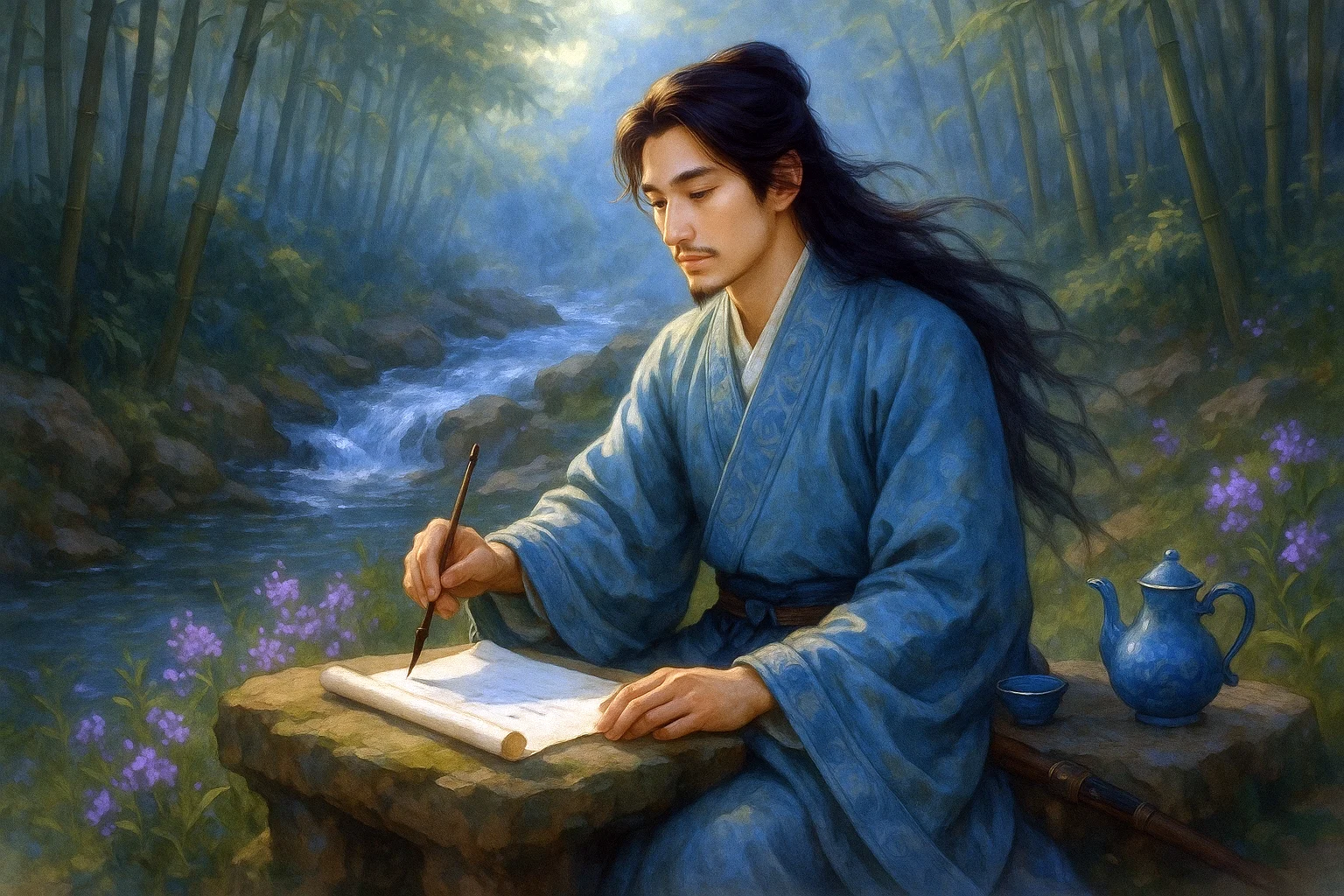
Huang Tingjian (黄庭坚 1045 - 1105), a native of Xiushui, Jiangxi Province, was a renowned poet and calligrapher of the Northern Song Dynasty. He became a jinshi (presented scholar) in the fourth year of the Zhiping era (1067 AD) and held various official posts, including Professor at the Imperial Academy and Secretary to the Imperial Archives. Later, he became entangled in the political strife between the conservative and reformist factions, suffering repeated demotions. As the foremost of the "Four Scholars of the Su School," he was often paired with Su Shi as "Su-Huang" in literary circles. Modeling his poetry on Du Fu, he founded the "Jiangxi School of Poetry" and proposed the influential creative theory of "transforming the bones and seizing the embryo, turning iron into gold," emphasizing that every word in poetry should have its origin. His work established a new paradigm for Song Dynasty poetics, exerting a profound and lasting influence on subsequent generations.