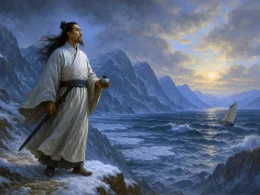

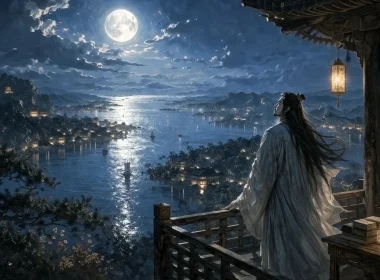
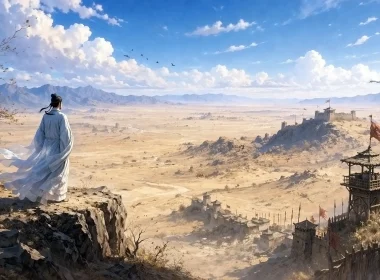
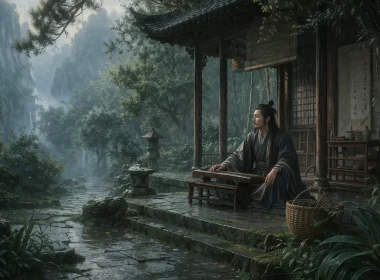
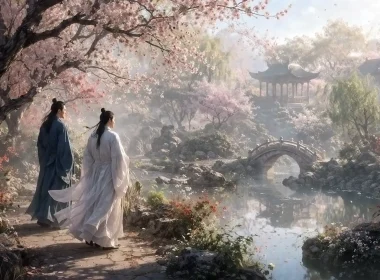
The grief is in the song, though it has no shape to hold;
The grief is in this painting, though its world is soundless, cold.

And the mind goes travelling the road that stretches still
West of the Pass, where the north wind bows the grass upon the hill,
And sheep and cattle graze — a vision calm and vast,
A stillness that remembers all the travelling past.
Original Poem
「题阳关图二首 · 其一」
黄庭坚
断肠声里无形影,画出无声亦断肠。
想得阳关更西路,北风低草见牛羊。
Interpretation
This poem is an inscription written by the Northern Song poet Huang Tingjian for the painting "Picture of Yang Pass" by Li Gonglin (courtesy name Bolishi). Li Gonglin was a famous Northern Song painter renowned for his figure and horse paintings, and particularly skilled in line drawing. Taking the poetic sentiment from Wang Wei's "Farewell Song at Weicheng"—"劝君更尽一杯酒,西出阳关无故人"—as his theme, he painted "Picture of Yang Pass," depicting a farewell scene and conveying the sorrow of parting.
Huang Tingjian and Li Gonglin moved in the same literary and artistic circles of the Northern Song, socializing, exchanging poems, and collaborating frequently. Huang Tingjian's official career was fraught with setbacks, marked by repeated demotions and exiles, which gave him a particularly profound understanding of separation. When he faced this painting titled "Yang Pass," the silent scene of farewell resonated powerfully with the accumulated feelings of wandering and the pain of parting in his own heart. He understood deeply that the true pain of parting lies not in the moment of tearful goodbyes, but in the endless desolation and solitude that follows. Therefore, in this poetic inscription, he not only praised the artistic charm of Li Gonglin's work but also, with a poet's unique imagination, pushed the scene depicted into a more distant time and space—"I think of the road farther west of Yang Pass, / Where north wind bows the grass, cattle and sheep appear"—allowing the sorrow of parting to gain an eternal echo within the vast borderland scenery.
This poem, the first of a set, focuses on exploring the theme of "artistic expressiveness"—namely, that music (audible but formless) and painting (formful but silent), though different in form, are equally capable of conveying a heart-wrenching depth of emotion. Through the resonance of the two instances of "heart-wrenching," the poet reveals how different artistic forms arrive at the same destination in expressing shared human emotions. The final two lines expand the artistic conception on this foundation. Led by the phrase "I think of," the imagination travels from the painted Yang Pass to the even more distant Western Regions. The vast scene of "north wind bowing the grass, cattle and sheep appearing" hints at the strange, expansive world the departing traveler will face, allowing the sorrow of parting to achieve an eternal resonance through the extension of time and space.
First Couplet: "断肠声里无形影,画出无声亦断肠。"
Duàn cháng shēng lǐ wú xíng yǐng, huà chū wú shēng yì duàn cháng.
Heart-wrenching the song, with neither form nor shade; Yet painted, soundless, it too makes the heart dismayed.
The opening lines immediately employ contrast to explore the similarities, differences, and interconnectedness of the two artistic forms of music and painting. "Heart-wrenching the song, with neither form nor shade"—music is an art of time; it conveys emotion through sound, yet it has no tangible form to touch or grasp. That heart-wrenching melody of the "Three Refrains of Yang Pass" exists only as sound drifting in the air, transient, formless, and shadeless. Yet, "painted, soundless, it too makes the heart dismayed"—Li Gonglin captured this moment of parting with his brush, solidifying it into an eternal image. Painting is an art of space; it is silent, yet it can strike directly at the human heart through visual imagery. By juxtaposing "formless and shadeless" with "soundless" and having the two instances of "heart-wrenching" resonate with each other, the poet profoundly reveals how different artistic forms, though taking different paths, arrive at the same destination in expressing shared human emotions. Whether it is the audible music or the silent painting, both can reach the softest depths of the human heart and rend it with sorrow.
Second Couplet: "想得阳关更西路,北风低草见牛羊。"
Xiǎng dé yángguān gèng xī lù, běi fēng dī cǎo jiàn niú yáng.
I think of the road farther west of Yang Pass, Where north wind bows the grass, cattle and sheep appear.
This couplet moves from the scene within the painting to envision a realm beyond it, pushing the poetic sentiment into vast and distant expanses. The two words "I think of" open the wings of imagination, allowing the poet to fly from the farewell scene in the painting toward the even more distant Western Regions. West of Yang Pass lies a more desolate frontier, a more unfamiliar world. The poet alludes to the artistic conception of the Northern Dynasties folk song "Song of Chile"—"The sky is gray, gray; / And the steppe wide, wide; / Over grass the wind bends the blades, and we see the cattle and sheep"—and with the seven characters "north wind bows the grass, cattle and sheep appear," he sketches a vast, desolate borderland scene. This imagery carries both the desolate grandeur of the "Song of Chile" and the uniquely serene, expansive, and transcendent quality of Huang Tingjian himself. The wild grass in the north wind, the faintly visible cattle and sheep—these are both actual scenery and symbols. They symbolize the strange, expansive world the departing one will face, and they symbolize the endless solitude and desolation that follows parting.
Holistic Appreciation
This is an exquisite poem inscribed on a painting. In its four lines and twenty-eight characters, the first two discuss the painting, and the last two extend from it, perfectly synthesizing the art of painting with poetic imagination, demonstrating Huang Tingjian's profound cultivation as both a poet and an art connoisseur.
Structurally, the poem shows a trajectory of expansion from the internal to the external, from the near to the far. The first two lines closely relate to the painting itself, discussing its artistic power—though silent, it is enough to be heart-wrenching. The last two lines then extend from the painted scene. Led by the phrase "I think of," the imagination travels from "Yang Pass" to the "road farther west," from the specific farewell scene to the vast borderland world. The four lines progress from within the painting to beyond it, from the actual scene to the imagined realm, expanding layer by layer, with the artistic conception growing ever more profound and far-reaching.
In terms of conception, the heart of this poem lies in its deep insight into the nature of "parting." The pain of parting lies not only in the moment of "I ask you to drink one more cup of wine" but even more in the endless loneliness and unknown that follows the journey's commencement. With the vast imagery of "north wind bowing the grass, cattle and sheep appear," the poet hints at the world the traveler is about to face—expansive, strange, desolate, with no one who knows him, no one to accompany him. This imagining of the "road farther west" beyond the moment of parting is deeper and more desolate than any depiction of the parting moment itself.
Artistically, the most exquisite aspect of this poem is its use of "synaesthesia" and "adaptation of allusions." The first couplet breaks down the boundaries between music and painting, using the shared emotional experience of "heart-wrenching" as a link to connect the two different artistic forms, revealing the common essence of artistic power. The final couplet adapts the imagery of the "Song of Chile" seamlessly, blending the vastness of the Northern Dynasties folk song with the desolation of Tang frontier poetry to create an entirely new artistic conception that feels both familiar and strange. This skill of seamless integration and adaptation is precisely the hallmark ability of Huang Tingjian as the leading figure of the Jiangxi School of poetry.
Artistic Merits
- Synthesis of Poetry and Painting, Each Enhancing the Other: Using poetry to discuss painting, and using the painting to inspire the poem, the two art forms elucidate and complement each other. The painting's scene resides within the poetry; poetic sentiment resides within the painting.
- Clever Contrast, Profound and Lasting Thought: Juxtaposing the "formful" with the "formless," the "audible" with the "inaudible," it explores the nature of art with deep, thought-provoking reasoning. Philosophical insight is seen in the contrast; wisdom is revealed in the juxtaposition.
- Bold and Unconventional Imagination, Vast and Desolate Artistic Conception: From "Yang Pass" imagining the "road farther west," from the scene within the painting extending to realms beyond, the vast imagery of "north wind bowing the grass, cattle and sheep appear" expands the poem's temporal and spatial dimensions. Mastery is seen in the imagination; deep feeling is revealed within the vastness.
- Seamless Allusion, Perfectly Natural Integration: Borrowing the classic imagery of the "Song of Chile" without a trace, it blends seamlessly with the poem's overall artistic conception. It adapts the allusion without being enslaved by it; it uses the ancient to create something new.
- Concise Language, Rich Meaning: The entire poem comprises only four lines and twenty-eight characters, yet it melds together philosophical reflection on art, the deep feeling of parting, and the vastness of the frontier. Brevity is the soul of wit; its resonance is long-lasting.
Insights
Through a single "阳关图" this poem articulates the profound connection between art and life, offering rich insights for later generations. It makes us contemplate the interconnectedness and complementarity of different artistic forms. Music is formless yet audible; painting is formful yet silent. Yet both can convey "heart-wrenching" emotion. By linking them through the two instances of "heart-wrenching," the poet reveals a profound truth: truly great art, regardless of the form it takes, can reach the depths of human emotion. It reveals to us: When appreciating art, we need not be confined by differences in form; instead, we should feel with our hearts the common emotional power within. Whether music, painting, poetry, or dance, when they touch upon shared human experiences of life, they can all become "heart-wrenching" works.
Secondly, the imaginative leap of "想得阳关更西路" in the poem allows us to see the space for re-creation within art appreciation. Li Gonglin's painting captures a moment of farewell; Huang Tingjian's poem extends that moment into an endless distance. He does not remain within the frame of the painting but uses imagination to penetrate the image and arrive at a realm beyond it. It tells us: A truly discerning appreciator is not a passive recipient of a work but an active participant in its creation; one does not stop at what is seen but departs from it to arrive at a world beyond.
On a deeper level, this poem also leads us to contemplate the complex meaning of "parting" itself. West of Yang Pass lies a more desolate world; the north wind bowing the grass is a vaster landscape. The tranquility of "cattle and sheep appear" forms a peculiar contrast with the sorrow of parting—the world continues to turn, the grasslands remain vast, the cattle and sheep remain tranquil, yet the traveler must face it all alone. This technique of revealing tranquility within vastness, vitality within desolation, enlightens us: The deepest desolation in life is often not the moment of wailing grief, but the silence and emptiness of facing the world that continues on, alone, after parting. And true courage lies precisely in being able to move forward within this silence and emptiness.
About the Poet
Huang Tingjian (黄庭坚 1045 - 1105), a native of Xiushui, Jiangxi Province, was a renowned poet and calligrapher of the Northern Song Dynasty. He became a jinshi (presented scholar) in the fourth year of the Zhiping era (1067 AD) and held various official posts, including Professor at the Imperial Academy and Secretary to the Imperial Archives. Later, he became entangled in the political strife between the conservative and reformist factions, suffering repeated demotions. As the foremost of the "Four Scholars of the Su School," he was often paired with Su Shi as "Su-Huang" in literary circles. Modeling his poetry on Du Fu, he founded the "Jiangxi School of Poetry" and proposed the influential creative theory of "transforming the bones and seizing the embryo, turning iron into gold," emphasizing that every word in poetry should have its origin. His work established a new paradigm for Song Dynasty poetics, exerting a profound and lasting influence on subsequent generations.