
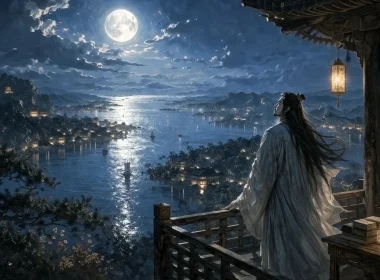
The streams of Yuan and Xiang — they have not ceased to run;
And his old sorrow, how it deepens with the sun.

Now the day drowns, and a wind takes the autumn’s part;
And the wood of maples mourns, with a sighing heart.
Original Poem
「过三闾庙」
戴叔伦
沅湘流不尽,屈子怨何深。
日暮秋风起,萧萧枫树林。
Interpretation
This poem was composed by the Mid-Tang poet Dai Shulun as he passed by the Temple of Three Lutes in Hunan. The temple was built to commemorate Qu Yuan, a minister of the State of Chu during the Warring States period. Qu Yuan, "erudite, strong-willed, and clear-eyed on order and chaos," was slandered by petty men, alienated by King Huai of Chu, and ultimately drowned himself in the Miluo River as his state fell, sacrificing his life for his country. For millennia, Qu Yuan has become a tragic symbol in Chinese culture of "being doubted despite one's loyalty, being slandered despite one's faithfulness," and an eternal mirror in which literati throughout the ages have seen reflections of their own lives and times.
Dai Shulun lived not long after the An Lushan Rebellion. The Tang Empire had declined from its peak, with regional warlords fragmenting the realm and court intrigues running rife. A common sentiment among scholars and officials was a feeling of "unfulfilled potential" and a profound yearning for clear-sighted governance. Standing on the ground associated with Qu Yuan, facing the rushing waters of the Yuan and Xiang rivers, the mists of history and the poet's personal reflections intertwined within him. He was not simply paying homage to an ancient figure; rather, in Qu Yuan he saw the shared fate of noble-minded individuals throughout history: a heart full of sincere devotion, yet helpless against a muddled world. It was precisely this emotional resonance across time and space that gave birth to this concise yet profoundly meaningful, timeless masterpiece.
First Couplet: "沅湘流不尽,屈子怨何深。"
Yuán Xiāng liú bù jìn, Qūzǐ yuàn hé shēn.
The Yuan and Xiang rivers flow on without end;
How deep, then, the bitterness of Master Qu!
The poem opens with remarkable grandeur. Instead of stating grief directly, the poet turns his gaze to the rivers before the temple. The three words "流不尽" (flow without end) are both a description of the actual scene and a superb metaphor: The waters of the Yuan and Xiang have flowed ceaselessly for millennia, just as Qu Yuan's sorrow and resentment, traversing the mists of history, still stir the hearts of later generations. The word "何" (how), seemingly a light question, is in fact a heavy sigh, transforming the intangible "怨" (bitterness/resentment) into the tangible rivers, giving it weight and substance. The poet skillfully juxtaposes the permanence of nature with the impermanence of human life. The rivers' endless flow precisely sets off the depth and enduring nature of Master Qu's bitterness—though his body perished, the pain of his spirit persists like the rivers, coeval with heaven and earth.
Second Couplet: "日暮秋风起,萧萧枫树林。"
Rìmù qiūfēng qǐ, xiāoxiāo fēngshùlín.
At sunset the autumn wind rises,
Soughing through the woods of maple trees.
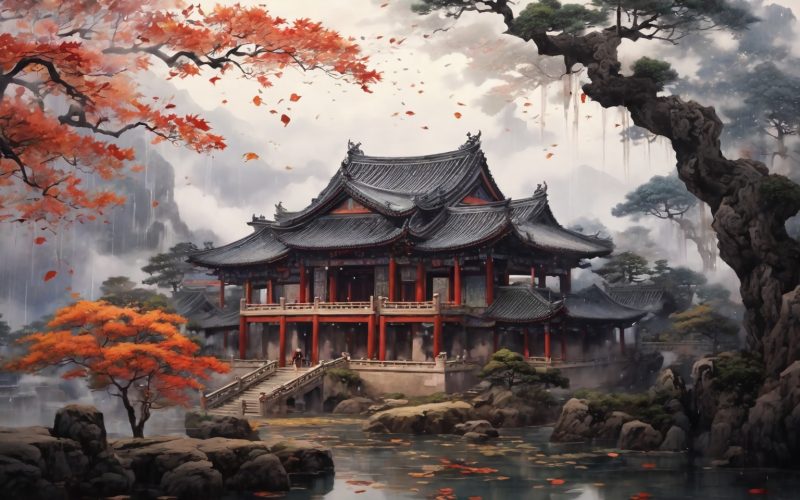
If the first two lines use water to symbolize bitterness, the last two conclude emotion with scene. The poet selects three layered images—"日暮" (sunset/dusk), "秋风" (autumn wind), and "枫林" (maple woods)—to render a vast, desolate picture of remembrance. Dusk, the fading of light, echoes the poet's somber mood as he pays his respects; the rising autumn wind, a prelude to the withering of all things, resonates with the end of Qu Yuan's life; and the "soughing maple woods" is a stroke of genius. The poet subtly evokes the imagery from the "Summons of the Soul" in the Songs of Chu: "On the deep blue river waves, above are maple woods, / The eye travels a thousand leagues, the spring heart grieves," allowing the scene before his eyes to overlap with the ancient sorrow. The maple trees still redden each year, but Master Qu is long gone; only the sound of the wind passing through the woods remains, plaintive and mournful, like a sigh from the depths of history. Without a single explicit word of sorrow, the poet lets grief permeate the universe.
Holistic Appreciation
The entire poem comprises only twenty characters, yet it constructs three layers of profound space: The first is the immediate physical space—the waters of Yuan and Xiang, the autumn wind and maple woods, tangible and real. The second is the spiritual space of history—the bitterness of Master Qu traversing a millennium to converse with the poet. The third is the emotional space of the reader—everyone who reads this poem will evoke within their own hearts their personal sense of "Master Qu's bitterness."
The first two lines begin with a reflective tone, yet embed reason within emotion, merging the rivers and the bitterness into one. The last two lines are purely descriptive of the scene, yet the scene is saturated with feeling, condensing the sorrow of ages into the soughing sound of wind through autumn maple leaves. The poet's brilliance lies in this: he does not let grief burst forth; rather, he restrains it within the description of the scene, allowing the reader to savor that deep desolation through repeated contemplation. This technique of "concluding emotion with scene" gives the poem an exceptionally far-reaching artistic conception, with a resonance that lingers.
Artistic Merits
- Superb Use of Metaphor and Evocation, Expressing Spirit Beyond Image: Using the "endlessly flowing" rivers to symbolize the "how deep" bitterness transforms the abstract into the concrete, granting Qu Yuan's grief and indignation a quality as enduring as heaven and earth. This technique blends the freshness of folk song with the depth and lasting flavor of literati poetry.
- Seamless Adaptation of Allusion, Nourishing the Present with the Past: The three words "枫树林" (maple woods) subtly contain the artistic conception of the "Summons of the Soul" from the Songs of Chu. The poet borrows from the classic without a trace, enhancing the poem's cultural depth while allowing an ordinary scene to bear the weight of a millennium's sorrow—truly "using allusion without being enslaved by it."
- Fusion of Feeling and Scene, Interplay of the Real and the Implied: The first two lines lean towards the "implied" expression of bitter feeling, the last two towards the "real" depiction of the autumn scene. Yet the implied contains the real (anchored by the rivers), and the real contains the implied (the autumn scene embodies sorrow). Between the implied and the real, the poet's commemorative feeling and the natural scene merge into one, reaching the aesthetic state of "forgetting both self and object."
- Extremely Concise Language, Extremely Rich Meaning: The entire poem does not use a single word to describe Qu Yuan's life, yet his presence is everywhere; not a word explicitly states grief, yet every character exudes desolation. This "writing by not writing" is the very essence of the classical Chinese poetic art of "encompassing much with little."
Insights
The reason this poem has been passed down for a thousand years lies not only in its successful homage to Qu Yuan, but more importantly in its touching upon an eternal sore point deep in human emotion: Why do integrity and loyalty so often encounter misunderstanding and harm? Qu Yuan's fate is not an isolated case. From Jia Yi's banishment to Changsha, to Du Fu's wandering the rivers and lakes, to the troubled experiences of countless men of ideals and integrity throughout history, "Master Qu's bitterness" has almost become the shared spiritual birthmark of China's finest intellectuals. This poem tells us: History's cruelty lies in that it often does not grant a smooth life to a person because of their nobility; but history's justice also lies in that it ultimately leaves an immortal name for those who hold fast to the right path.
"The Yuan and Xiang rivers flow on without end"—The waters have washed away how many emperors, kings, generals, and ministers, yet they cannot wash away the spiritual imprint left by one poet. This reveals to us: True value never depends on the glory or disgrace of one's own time, but on the ability to withstand the judgement of time. Qu Yuan sacrificed his life for his ideals. What he gained was not the restoration of Chu, but rather became a millennial, unextinguished beacon for the Chinese nation's spirit.
In today's era of pluralistic values and clamorous information, "Master Qu's bitterness" still holds powerful contemporary significance. It reminds us: Upholding integrity often requires enduring loneliness and misunderstanding; the pursuit of truth is often accompanied by sacrifice and pain. When we face injustice, do we choose to drift with the tide, or like Qu Yuan, declare "though I die nine times, I shall not regret"? Using the rushing rivers and the soughing autumn wind, this poem gives a silent yet resolute answer.
To understand "Master Qu's bitterness" is to understand the moral backbone of the Chinese scholar; to understand the waters of the Yuan and Xiang is to understand how Chinese civilization has endured unbroken through the tempests of history. This is the eternal gift classical poetry bestows upon the modern person.
About the Poet
Dai Shulun (戴叔伦), 732 - 789 AD, was a native of Jintan, Jiangsu Province. During the Anshi Rebellion, he lived in Poyang and studied behind closed doors, and was later recruited by Liu Yan to serve in the Transit House. Dai Shulun's poems mostly express the leisure of a secluded life, and there are also some poems exposing social contradictions and reflecting the people's hardships, with a broader content, and his poetic style is elegant and clear.