


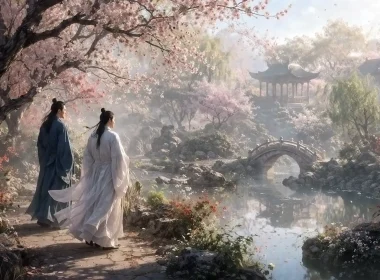

Your favor, like eastward-flowing water, has no stay;
Gaining it, I dread its loss; losing it, I pine away.
Before the cup, oh, do not play the tune “Flowers Fall” —
The cold wind waits already by the western palace wall.
Original Poem
「齐宫词」
李商隐
永寿兵来夜不扃,金莲无复印中庭。
梁台歌管三更罢,犹自风摇九子铃。
Interpretation
This poem by Li Shangyin belongs to the genre of palace laments, yet its significance extends far beyond typical boudoir grievances. It is deeply rooted in the poet’s keen observation of the political environment in the late Tang dynasty and his own career experiences. Having spent many years moving between various military governors’ offices and navigating the circles of the powerful, Li Shangyin had an intimate and sober understanding of the dependent relationships that defined officialdom—relationships centered on the unpredictable favor of the ruler or superior. Here, "the ruler’s favor" can refer literally to the emperor’s affection for his consorts, or metaphorically to the patronage and advancement bestowed by those in power upon their subordinates.
The poet skillfully fuses his personal experience of gaining and losing favor in his career, along with his observations of the unpredictability of official life, into the archetypal figure of the palace lady. Thus, the one who "fears its shift when favored, grieves when favor is lost" is both the woman in the inner palace and all scholars whose fate hangs on the whim of another within the hierarchy of power. Composed during the poet’s middle or later years, a period of deep experience, the poem’s language is incisive and austere. It transcends mere emotional expression, serving instead as a philosophical summation and a sharp allegory of the individual’s predicament within power structures.
First Couplet: 君恩如水向东流,得宠忧移失宠愁。
Jūn ēn rú shuǐ xiàng dōng liú, dé chǒng yōu yí shī chǒng chóu.
The ruler’s favor flows east like water, never to return;
In favor, one fears its shift; out of favor, only grief to earn.
Explication: The opening uses "water flowing east" as a metaphor, establishing the poem’s tone. "The ruler’s favor" is imbued with the properties of water—fluid, fickle, irreversible—precisely capturing its essence. The second line pivots on the character for "favor" (宠), creating a cyclical contrast between "in favor" and "out of favor." "Fears its shift" is the constant state of mind for the favored, revealing the fragility and insecurity of such grace; "grief" is the inevitable outcome for the one out of favor. With remarkable concision, the poet compresses the lifelong emotional arc of a palace lady into ten characters, presenting an inescapable paradox of existence.
Final Couplet: 莫向尊前奏《花落》,凉风只在殿西头。
Mò xiàng zūn qián zòu 《Huā Luò》, liáng fēng zhǐ zài diàn xī tóu.
Before the cup, play not the tune of "Falling Flowers," I plead;
The chilling breeze already stirs by the western halls, take heed.
Explication: This couplet shifts to a specific scene, its tone cold and laden with warning. "Falling Flowers" carries a double meaning: it refers literally to the melody "Plum Blossoms Fall" (《梅花落》), while also symbolizing the withering of glory and the fading of favor. "Play not" is the admonition of a clear-sighted observer, directed at a naive or willful blindness to one’s own circumstance. The "chilling breeze" is both an actual touch of autumn and, more significantly, a symbol of the cooling of imperial favor and waning affection. "The western halls" suggest the location of the neglected quarters; a slight shift in space corresponds to a world of difference in fate. Once the breeze arrives, none are spared; the tone carries a chill of inevitability.
Holistic Appreciation
The poem’s brilliance lies in its fusion of concrete scene and abstract reflection. The first couplet introduces a philosophical observation, stating the eternal "fear" and "grief" of the palace lady; the second couplet sketches the vivid image of a feast where a chilling breeze begins to stir, ensuring the reasoning never becomes abstract. The poem progresses through layers of "metaphor—reflection—scene—warning," its mood shifting from generalized lament to a specific, penetrating chill, culminating in the richly symbolic and foreboding image of the "chilling breeze." The words end, but the meaning lingers.
Li Shangyin does not settle for simple sympathy for the fate of palace women. Using this extreme context, he exposes the fundamental dilemma inherent in all relationships of dependency: when an individual’s worth and security are wholly tied to the inconstant "favor" of another (especially a superior), then anxiety and sorrow become the very fabric of life, whether one is temporarily "in" or "out" of favor. The phrase "fears its shift when favored" is especially profound, articulating the tragedy of being unable to find true peace even within favorable circumstances.
Artistic Merits
- Exquisite Metaphorical System: "Water" symbolizes the transience of favor; "falling flowers" symbolize the withering of fortune; "chilling breeze" symbolizes the harbinger of waning favor. Together, they form an organic chain of imagery, transforming the abstract dynamics of power and fate into tangible natural phenomena.
- Extreme Concentration of Psychology: Using "fears its shift" and "grief," the poet precisely captures the entire emotional spectrum of the dependent, behind which lies a lifetime of tension and a lack of autonomy.
- Dramatic Use of Warning: The interjection "Play not" in a conversational tone breaks the descriptive flow, lending the poem immediacy and a prophetic quality, enhancing its tension and didactic force.
Insights
This poem acts as a mirror transcending time, reflecting not only the tragic fate of women in the palace but also the universal predicament of the individual within any structure of dependency on power. From the ancient inner court and bureaucracy to modern arenas reliant on personal patronage, singular systems of evaluation, or the fleeting grace of influence, the psychological chains of "fearing shift when favored, grieving when out of favor" constantly re-emerge.
It compels us to examine whether we, too, exist within some invisible economy of "favor"—where our sense of value and security is excessively tied to external, inconstant validation, dooming us to a cycle of anxiety over potential loss. True clarity may begin with perceiving the subtle sign that "the chilling breeze already stirs." The true path forward may lie in awakening the inner self, whose worth is not contingent on external grant, before the logic of 'favor' wholly defines us. What Li Shangyin wrote a millennium ago is both a palace lament and an eternal fable of personal integrity and spiritual autonomy, reminding every generation that only by transcending the craving for "favor" and the dread of its loss can one attain genuine spiritual freedom.
About the poet
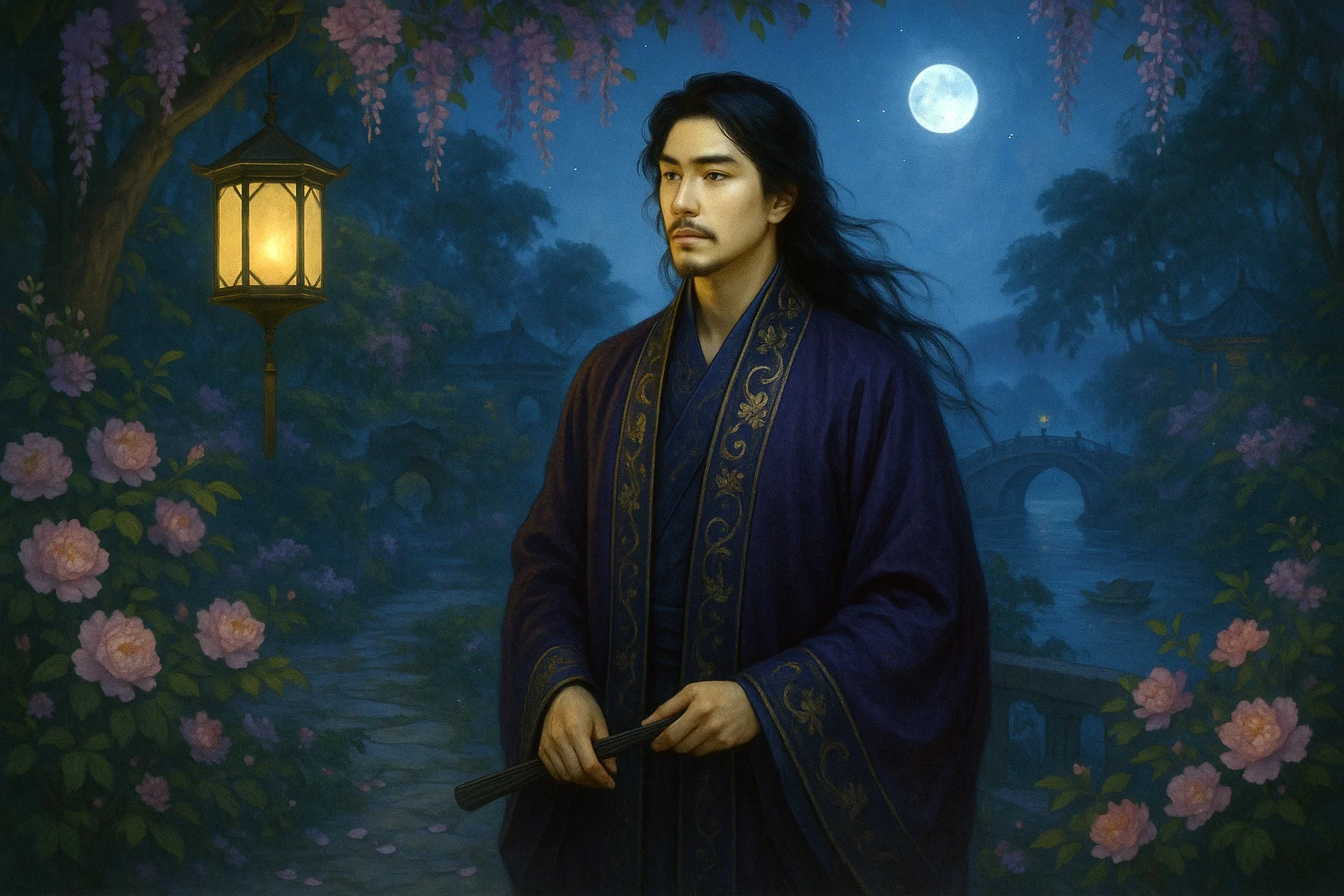
Li Shangyin (李商隐), 813 - 858 AD, was a great poet of the late Tang Dynasty. His poems were on a par with those of Du Mu, and he was known as "Little Li Du". Li Shangyin was a native of Qinyang, Jiaozuo City, Henan Province. When he was a teenager, he lost his father at the age of nine, and was called "Zheshui East and West, half a century of wandering".