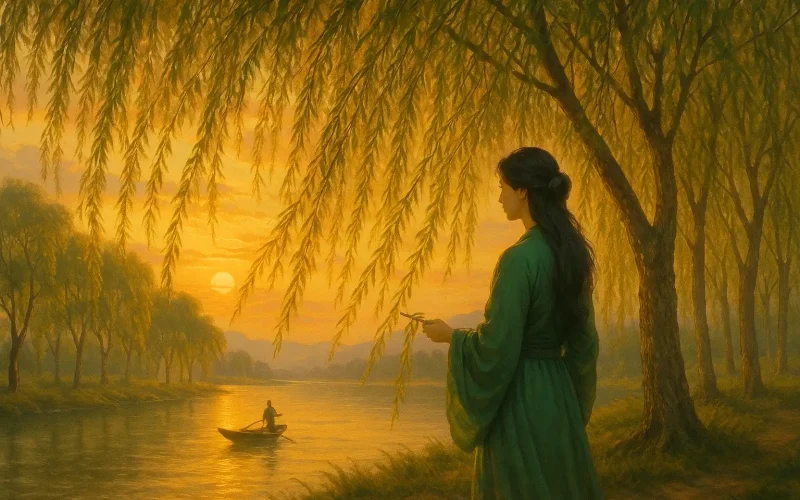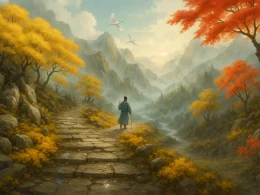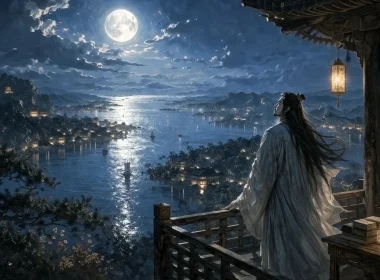
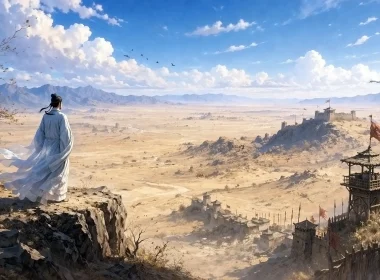
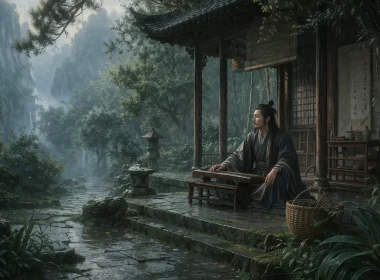
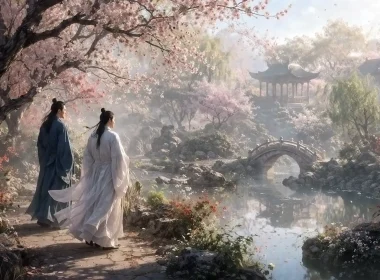
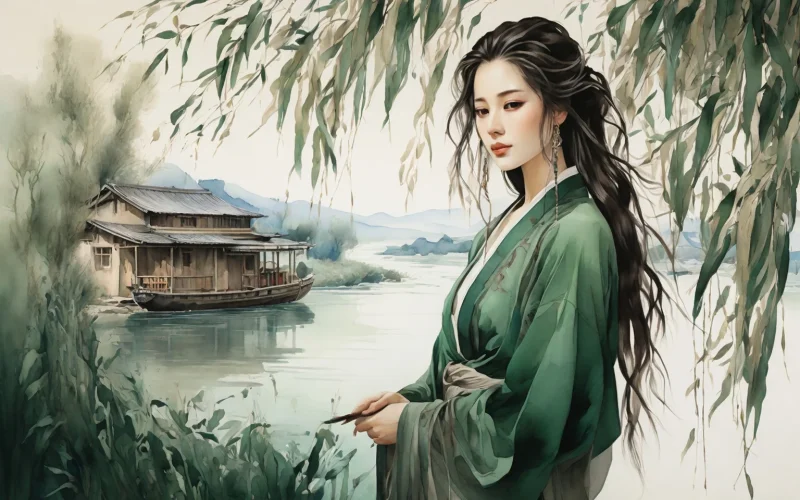
With wine I drown our grief awhile;
Your brows need not knit, waist not beguile.
Before death, parting is our lot —
Should spring grudge willow branch ne’er forgot?
Original Poem:
「离亭赋得折杨柳二首 · 其一」
李商隐
暂凭尊酒送无憀,莫损愁眉与细腰。
人世死前唯有别,春风争拟惜长条。
Interpretation
This poem is the opening work of Li Shangyin's two-part series, likely composed during a period of his life marked by itinerant official service and frequent separations. Centering on the classic farewell motif of "The Broken Willow at Farewell," the first poem focuses intensely on the subjective experience and emotional conflict of the parting individual. With remarkable conciseness, it delineates the profound tension between "consolation" and "agonizing realization" within the farewell scene. The poet does not linger on external description but pierces directly to the essence of parting, infusing the commonplace acts of offering wine and presenting the willow with a sorrowful meditation on the fate of separation in human life. It establishes the emotional tone for the series—one of poignant melancholy and piercing insight, where tenderness is underpinned by stark truth.
First Couplet: 暂凭尊酒送无憀,莫损愁眉与细腰。
Zàn píng zūn jiǔ sòng wú liáo, mò sǔn chóu méi yǔ xì yāo.
Let this cup of wine, for now, dispel our boundless gloom;
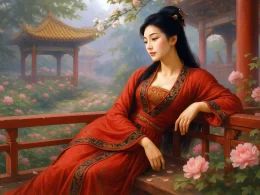
I beg you, do not let this parting sorrow waste your lovely form—the brows knit in grief, the waist slender and frail.
Explication: The opening offers strained solace amidst helplessness, where deep concern masks profound sorrow. The phrase "for now" reveals the impotence of the wine—it can only temporarily counter the "boundless gloom" (the emptiness and melancholy of parting), not truly dissolve the sorrow. The plea, "do not let… waste your lovely form," inversely confirms the cruel reality: the brows are already furrowed with grief, and the frail waist may well succumb to sorrow. "Brows knit in grief" and "waist slender" serve both as a realistic depiction of the beloved's delicate beauty and a subtle allusion to the willow metaphor (willow leaves like eyebrows, willow branches like a slender waist). Here, the human and the natural imagery quietly merge, laying subtle groundwork for the turn that follows. The more tender and considerate the consolation, the more it underscores the irrevocability of the parting and the deep anxiety for the other's well-being.
Final Couplet: 人世死前唯有别,春风争拟惜长条。
Rénshì sǐ qián wéi yǒu bié, chūnfēng zhēng nǐ xī cháng tiáo.
In this human world, before death comes, parting is the only true sorrow;
How, then, can the spring breeze bear to begrudge us these long, pliant boughs?
Explication: This couplet rises like a precipice, elevating the poem to a startling philosophical height. "In this human world… parting is the only true sorrow" is a devastating verdict on life itself. It places "parting" alongside "death," even suggesting that parting is a more common, yet equally piercing, pain inherent to the human condition. This line strips away the sentimental veneer of farewell, exposing its cold, existential core. The following line, "How, then, can the spring breeze bear to begrudge…?" is a poignant, rhetorical challenge to the natural order. The poet, personifying the breeze, questions: If you, spring breeze, know to cherish the willow's wholeness, how can you not comprehend the anguish of human parting, and the necessity of breaking a branch to convey that feeling? The words "how… bear to" are charged with a tense blend of grief and protest. Together, these lines form a profound paradox: the conflict between human feeling (necessitating the broken branch) and Nature's indifference (the breeze cherishing the branch). It further symbolizes the human predicament: the individual, facing an indifferent cosmos (the spring breeze, time itself), must commit a small "violation" to express profound affection.
Holistic Appreciation
This is a tightly structured, layered "existential meditation on parting." The first two lines offer "consolation," an attempt to buffer the pain emotionally; the final two pose a "challenge to heaven," confronting its cruelty philosophically. From the passive resistance of "Let this cup of wine… dispel," to the active preservation urged in "do not let… waste," to the absolute pronouncement of "parting is the only true sorrow," culminating in the desolate challenge of "How can the spring breeze bear…?"—the emotional logic unfolds seamlessly, each stage elevating the poem's conception.
Li Shangyin's genius lies in transcending personal sorrow. Through the minor act of "breaking the willow," he leverages a reflection on the nature of life, the value of emotion, and its relation to natural law. The act of breaking the willow, illuminated by the declaration that "parting is the only true sorrow," takes on an almost sacred, tragic weight—it becomes humanity's fragile yet stubborn ritualistic resistance against the fate of inevitable separation. The spring breeze's "cherishing the boughs" symbolizes a cold, indifferent natural law that maintains its own integrity. Humanity's "breaking" and the breeze's "cherishing" constitute an eternal confrontation between the world of feeling and the law of indifference, endowing this brief poem with startling intellectual force.
Artistic Merits
- Construction of Paradoxical Structures: The first paradox is "do not let… waste" (urging preservation) versus the inevitable "wasting" (breaking the willow for farewell). The second is "parting is the only true sorrow" (absolute human pain) versus "the spring breeze… begrudge" (natural indifference). Deep feeling resides in the paradox; truth emerges from the contradiction—a hallmark of Li Shangyin's profound poetic thought.
- Dual Nature of Imagery, Manifest and Latent: "Brows knit in grief" and "waist slender" are explicit human description, yet also latent willow imagery. "Long, pliant boughs" are explicit willow branches, yet implicitly echo the human form. This interpenetration and mutual metaphor between person and object greatly enriches the poem's layers and suggestiveness.
- The Shocking Effect of Philosophical Declaration: "Parting is the only true sorrow" inserts an unflinching, declarative statement into the poem's core, shattering the typically lingering, sentimental tone of farewell poetry. The cold rigor of philosophy intensifies the heat of emotion, achieving a groundbreaking artistic effect.
- Abrupt Shift from Gentle to Vehement Tone: The tone of the first couplet remains gently consoling, while the final couplet transforms into a grievous proclamation and an impassioned challenge. This rapid intensification of emotion and drastic tonal shift creates a powerful inner impact.
Insights
This work acts like a sharp blade, slicing through the tender surface of parting sentiment to reveal the inherent separateness and solitude at life's core. It suggests that the pain of parting is etched so deeply precisely because it is a rehearsal and miniature of "severed connection" that humans must experience repeatedly "before death."
In a modern society of accelerated change and constant meetings and separations, this poem holds sharp contemporary relevance. It prompts reflection: amidst our frequent "partings" (geographical, emotional, of life stages), are we, like the poet, aware of the cruel truth that "parting is the only true sorrow," yet still striving to perform our own ritualistic acts of "breaking the willow"—a call, a message, a gift—attempting to preserve feeling within transience? And that questioned "spring breeze" might be the relentless tide of our era, societal laws, or cold digital logic that "cherishes the boughs" (prizes systemic efficiency, rational order). Must we, and can we still, for the sake of a specific bond, make that seemingly "uneconomical" but profoundly human act of "breaking"?
With this poem, Li Shangyin elevates a specific farewell into a compassionate insight into the nature of all parting. It makes us feel, in the act of breaking the willow, not merely tenderness, but a solemn sense of tragedy and an unyielding warmth residing in the deepest strata of the human condition.
Poem translator
Xu Yuanchong (许渊冲)
About the poet
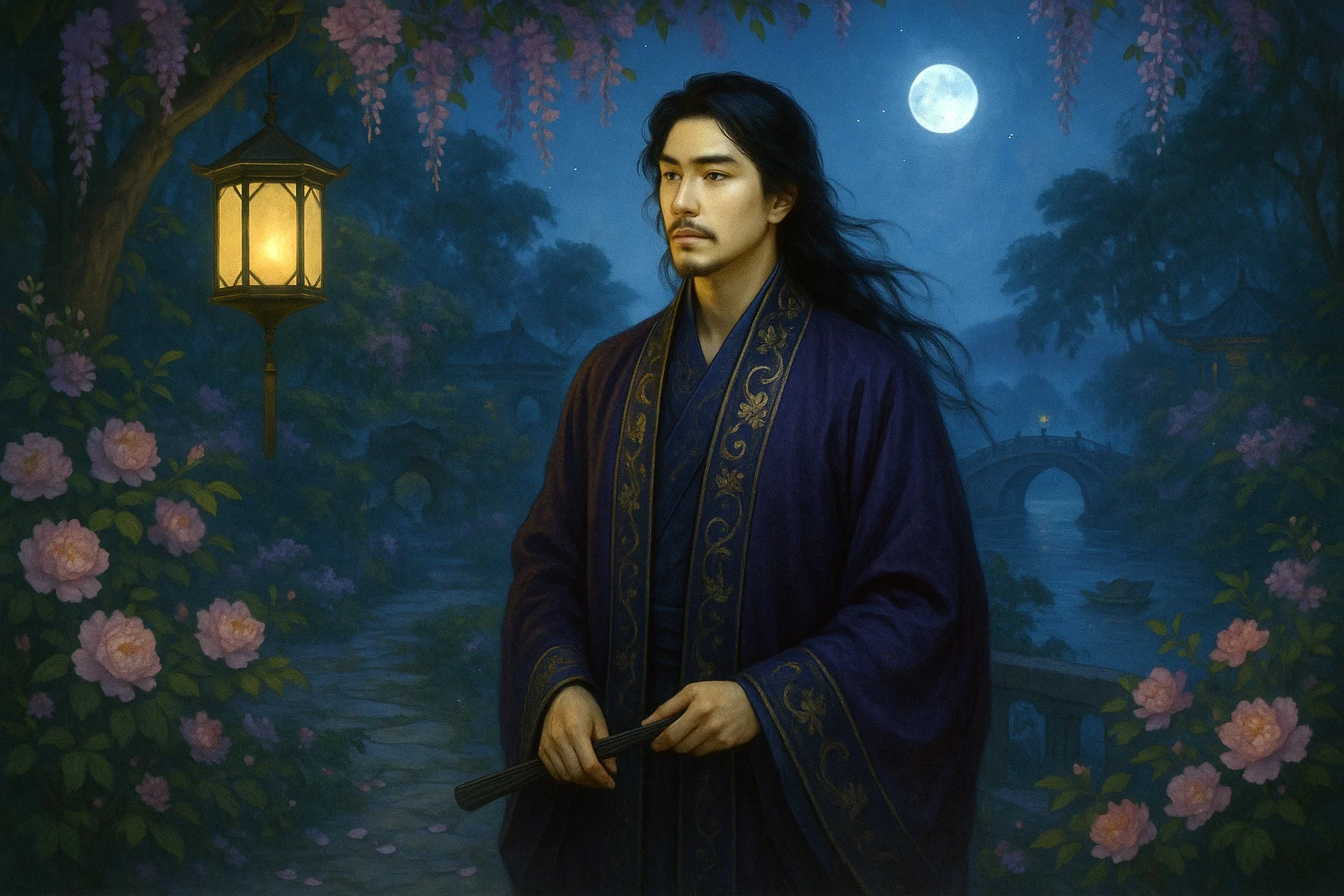
Li Shangyin (李商隐), 813 - 858 AD, was a great poet of the late Tang Dynasty. His poems were on a par with those of Du Mu, and he was known as "Little Li Du". Li Shangyin was a native of Qinyang, Jiaozuo City, Henan Province. When he was a teenager, he lost his father at the age of nine, and was called "Zheshui East and West, half a century of wandering".