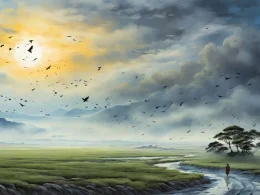

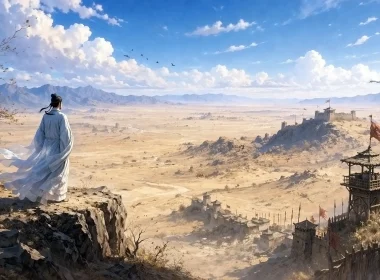
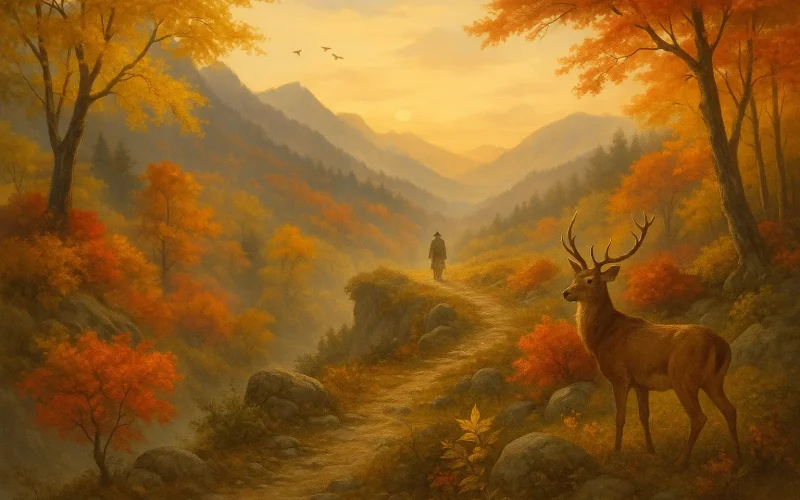
Birds vanish into endless flight on high;
Hills upon hills in autumn colors lie.
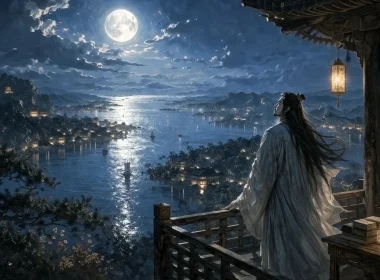
I tread up and down Huazi Ridge, and sigh —
How far and deep my lonely sorrows vie!
Original Poem
「华子岗」
王维
飞鸟去不穷,连山复秋色
上下华子冈,惆怅情何极。
Interpretation
This poem stands as one of the most overtly emotional yet profoundly contemplative pieces in Wang Wei's twenty-poem Wang River Collection. Composed during his later years of seclusion at Wangchuan, the poet repeatedly ascended this ridge to gaze upon the autumn landscape, merging the vast desolation, sense of transience, and existential melancholy of his personal life with the boundless natural expanse before him. In only twenty characters, the poem creates immense emotional resonance between its starkly simple imagery and its direct expression of sorrow, revealing a rare, almost translucent melancholy within Wang Wei's landscape oeuvre. It represents the most emotionally concentrated example of his art of "expressing feeling through scenery."
First Couplet: 飞鸟去不穷,连山复秋色。
Fēi niǎo qù bù qióng, lián shān fù qiū sè.
Birds in flight vanish toward the endless sky;
Range upon range of hills wear autumn's dye.
This couplet constructs, from the broad vantage of a high outlook, a cosmic vision where flux and permanence coexist. "Birds in flight vanish toward the endless sky" presents a dynamic, linear, forward-moving "departure"—each bird's flight is a small vanishing, and "endless" renders this vanishing a perpetually unfolding state, symbolizing the continual departure of time, opportunity, companions, and fragments of life itself. "Range upon range of hills wear autumn's dye" presents a static, pervasive, cyclical "presence"—the hills are spatial fixtures, and "autumn's dye" is time's imprint. The word "wear" (复) is deeply resonant, indicating both the repetitive continuity of the hills and hinting that autumn's hues return faithfully each year, as inescapable as fate. The birds' "vanish" and autumn's "dye"—one movement, one stillness; one vertical, one horizontal—weave together the poet's sense of minuteness and bewilderment before time and space.
Second Couplet: 上下华子冈,惆怅情何极。
Shàng xià huázi gāng, chóuchàng qíng hé jí.
Wandering up and down Huazi Ridge, forlorn—
This boundless sorrow, how was it born?
This couplet shifts directly from scene to emotion, a rare surge of feeling in Wang Wei's poetry. The phrase "up and down" signifies not merely physical movement but the mind's restless pacing and questioning—ascending perhaps in pursuit (gazing after the distant birds), descending perhaps having found nothing, a cycle reflecting the anxiety and entrapment of finding no answer. "This boundless sorrow, how was it born?" releases, in the most direct language, the emotional energy gathered in the preceding lines. The phrase "how was it born?" (何极) is spatial (as boundless as the hills), temporal (as endless as the birds' vanishing), and emotional (inexplicable, inescapable). The poet no longer conceals; he acknowledges and confronts this "sorrow," yet offers no specific source, allowing the emotion to attain a universality and metaphysical depth that transcends personal circumstance.
Holistic Appreciation
This is a philosophical poem about experiencing finitude within infinite space, perceiving life's desolation reflected in eternal nature. The poem's structure exhibits a remarkable balance of "expansion and contraction": the first two lines expand limitlessly, the gaze following birds to the horizon, autumn's hues clothing a thousand hills; the last two lines abruptly contract, focusing on the poet's solitary figure "wandering up and down" and the inner cry of "how was it born?" This rapid shift from cosmic vastness to individual smallness creates a jarring emotional transition, which is the very source of the "sorrow."
Here, Wang Wei momentarily sets aside the Zen-like detachment often found in his later work, revealing a more authentic, almost primordial human emotion. Are not the birds that "vanish toward the endless" the incessantly arising and ceasing thoughts and attachments within the poet's own heart? Are not the hills that "wear autumn's dye" the grand backdrop of life's cyclical stages, with their seasons of flourishing and decay? Ascending heights was meant to dispel care, yet all that is seen becomes a catalyst for sorrow. Yet, it is precisely this unflinching, unadorned melancholy that grants the poem powerful emotional authenticity and resonance. It shows us that Wang Wei's "emptiness and stillness" were not innate but a clarity arrived at after countless inner journeys like "wandering up and down Huazi Ridge" and profound anguish like "how was it born?"—not an original void.
Artistic Merits
- Emotionally-Charged Spatial Dynamics: The phrase "vanish toward the endless" suggests infinite horizontal extension, evoking feelings of vastness and loss; "range upon range… wear" implies layered vertical expansion, generating a sense of weight and oppressive mass; "up and down" describes a short, repetitive pacing, embodying a state of entrapment and anxiety. These three spatial dynamics correspond to three distinct psychological states, collectively constructing the emotional landscape of the poem.
- Emotional Resonance of Color: The term "autumn's dye" stands as the poem's solitary color descriptor, yet it is profoundly evocative. It simultaneously suggests the warm-toned withering of golds and crimsons and the cool-toned bleakness of grey-blues and dusky hues. This single, rich yet non-specific "autumn's dye" carries a sense of sorrow that permeates without explicit lamentation, becoming the perfect visual vehicle for the poem's melancholy.
- Rhetorical Power of Repetition and Progression: The words "endless" (不穷) and "wear" (复) imply cyclical repetition and boundlessness; "up and down" denotes the repetition of action; "how was it born?" (何极) expresses the boundlessness of emotion. Through this strategic repetition and progression of both vocabulary and imagery, the poet vividly portrays a cyclical, pervasive, and seemingly limitless emotional state with remarkable depth.
- Lyrical Mode of "Candid Reserve": The final couplet directly voices "sorrow," a seemingly plain confession. However, the open-ended nature of the question "how was it born?" and the foundation laid by the vast imagery preceding it transform this emotion into something grand and abstract, endowing it with the texture of philosophical inquiry. This exemplifies Wang Wei's characteristic reserve—he does not conceal the emotion's existence, but allows the emotion itself to become a profound enigma.
Insights
This work is a window, allowing a glimpse into the folds in Wang Wei's soul not entirely smoothed by Zen insight. It reveals that true awakening to life may not be a state of perpetual calm, but the ability to honestly face and bear those "how was it born?" moments of sorrow in life. Ascending heights to gaze afar does not always broaden the mind; sometimes it makes one's own limitations and solitude clearer. This "sorrow" is not weakness but proof of one's human depth.
In modern society, we are often encouraged toward "positivity" and "optimism," to avoid or deny emotions like "sorrow." Wang Wei's poem, however, offers a different courage: to permit oneself at times to "wander up and down Huazi Ridge," to allow oneself to feel that "boundless sorrow." Perhaps it is precisely in this confrontation and experience of life's desolate essence that we can more genuinely understand what it means "to be," and that when final peace arrives (if it can be reached), we know its weight and preciousness.
The poet provides no answer for the sorrow, nor points a way out. He simply eternalizes in the poem this image of "birds vanishing over hills, a man stands on the autumn ridge" along with that sigh of "how was it born?" And this, perhaps, is the answer itself: the meaning of life is sometimes contained within this unresolved wandering and endless gazing. Every one of us, searching "up and down" on the ridge of our lives, is a contemporary echo of Wang Wei's verse.
About the poet
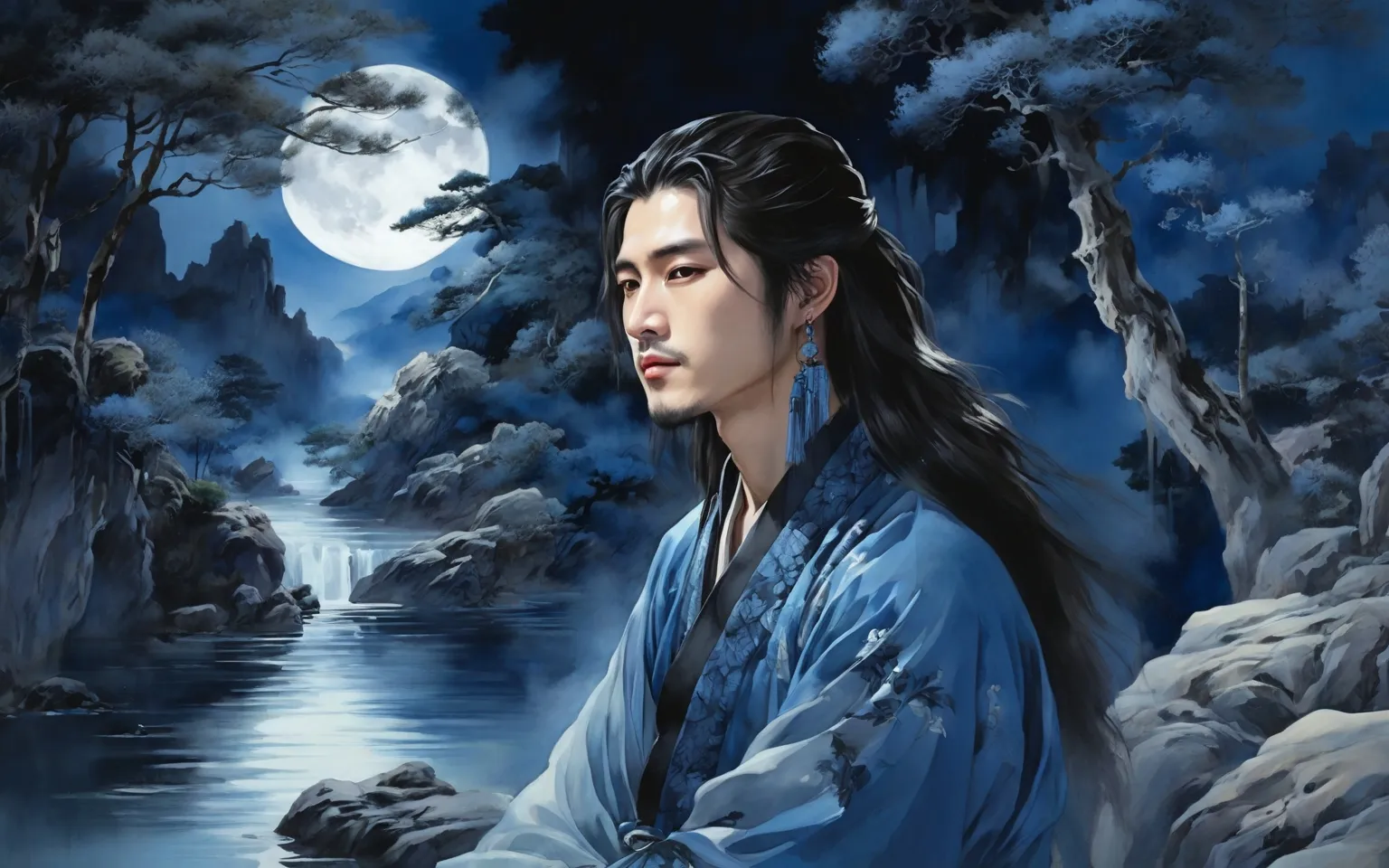
Wang Wei (王维), 701 - 761 A.D., was a native of Yuncheng, Shanxi Province. Wang Wei was a poet of landscape and idylls. His poems of landscape and idylls, with far-reaching images and mysterious meanings, were widely loved by readers in later generations, but Wang Wei never really became a man of landscape and idylls.