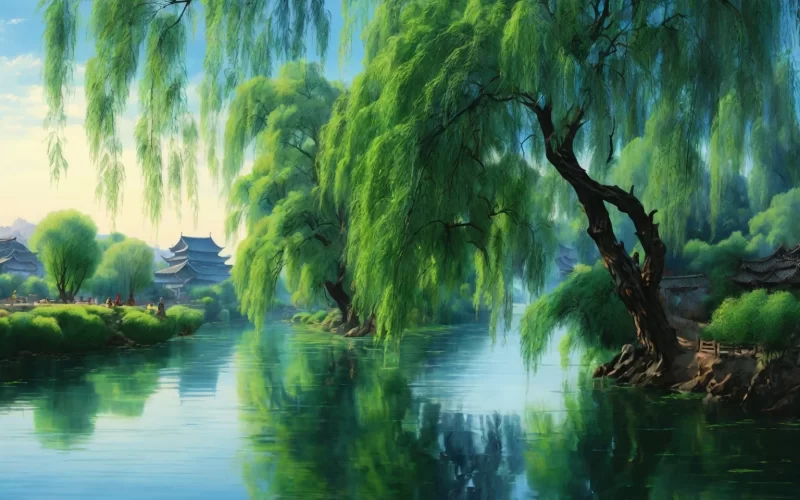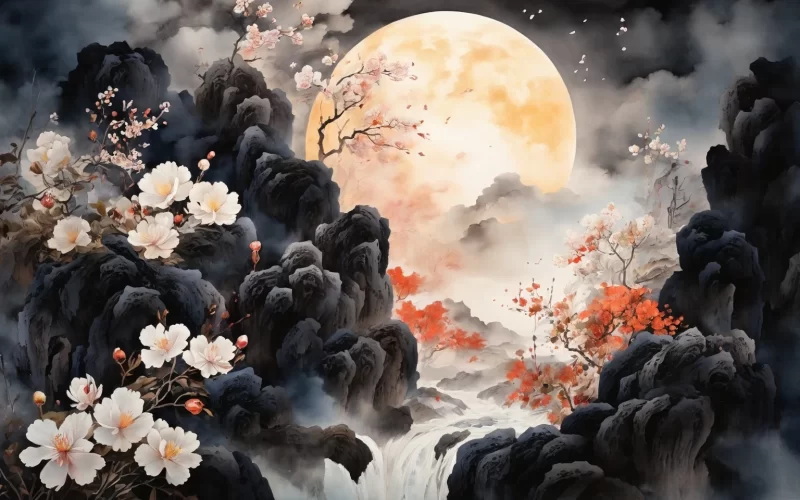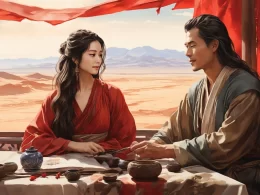

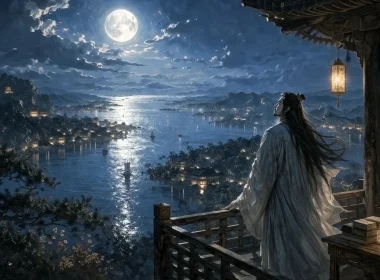
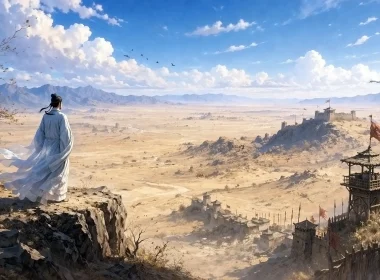
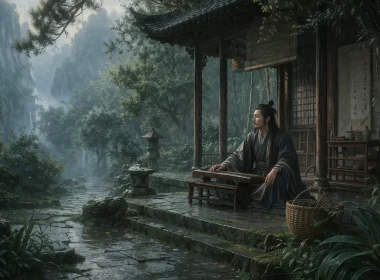
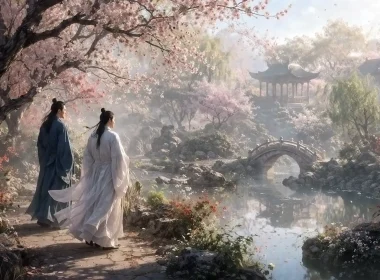
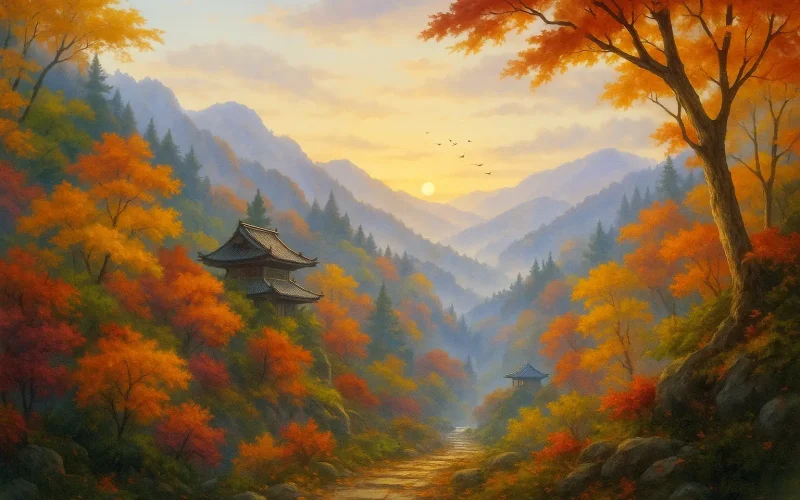
Autumn hills gather the day's last gleam;
Birds chase after their flock, a fleeting dream.
Colors shimmer, now clear, now softly blend;
Evening mist floats without start or end.
Original Poem
「木兰柴」
王维
秋山敛余照,飞鸟逐前侣。
彩翠时分明,夕岚无处所。
Interpretation
This poem is a celebrated work from Wang Wei's Wang River Collection, a series of twenty poems, composed during his mature creative period while living in retreat at Wangchuan. The title "Magnolia Fence" originally referred to a quiet mountain dwelling in Wangchuan enclosed by magnolia trees. Here, Wang Wei uses his poetic brush to capture the fleeting transformations of light, shadow, and living creatures in the mountains at dusk. Comprising only twenty characters, the poem is like a gradually diffusing ink-wash painting in soft colors. It not only precisely reproduces the visual layers of autumn mountains at sunset but also, more profoundly, conveys the poet's Zen-like state of mind where self and object merge, and one wanders with the transforming universe. It is a exemplary work embodying his trinity of artistic philosophy: poetry, painting, and Zen.
First Couplet: 秋山敛余照,飞鸟逐前侣。
Qiū shān liǎn yú zhào, fēi niǎo zhú qián lǚ.
Autumn mountains gather in the lingering sunset's glow;
In flight, birds chase their mates, as homeward they go.
This couplet opens the scene with a macro-perspective, containing cosmic rhythm within stillness and movement. The word "gather" (敛) is the poetic eye, endowing the autumn mountains with an active, gentle posture, as if the mountain were a composed collector slowly drawing the sky-wide evening glow into its embrace. The fading of light is no longer depressing but a solemn, tranquil ceremony. "In flight, birds chase their mates" injects vitality into this serene backdrop: the birds' "chase" conveys both the urgency of returning to their nests and the joy of companionship. The shadow of their wings cutting across the darkening sky becomes a flowing brushstroke. The one "gathering" and the other "chasing," one collecting and the other releasing, together outline the transitional moment at dusk when nature shifts from day to night, from activity to rest. Between movement and stillness, time and space flow.
Second Couplet: 彩翠时分明,夕岚无处所。
Cǎi cuì shí fēnmíng, xī lán wú chù suǒ.
In colored emerald, now vivid, now unclear;
The evening mist has vanished, leaving nowhere here.
This couplet focuses the gaze on the microscopic changes of light, color, and air, showcasing the poet's astonishing sensory acuity and philosophical contemplation. "In colored emerald, now vivid" captures the magical illumination of the last instant before sunset—when the oblique rays skim the forest at an extremely low angle, the layers and colors of plants are amplified and highlighted, becoming brilliant like jewels. The word "now" (时) emphasizes the brevity and serendipity of this visual miracle, a gift of nature that can be encountered but not sought. "The evening mist has vanished, leaving nowhere" then turns the brush lightly: the twilight haze that originally permeated the mountains has now imperceptibly dissipated, as if melting into the deepening night. The three words "leaving nowhere" (无处所), while describing the mist's traceless disappearance, also subtly contain the Zen idea of "form and emptiness as one, being and non-being giving rise to each other"—are not the vividly distinct "colored emerald" of a moment ago and the now-untraceable "evening mist" precisely a microcosm of the illusory, shifting phenomenal world?
Holistic Appreciation
This is a poem of the instant, concerning disappearance and appearance, capture and release. The poem's structure is exquisite, presenting a sequence of images: "gathering light—chasing birds—revealing color—dissolving mist." Yet, it subtly contains a profound cosmic perspective: the first couplet writes of "passing" (the lingering glow is gathered, the birds in flight depart), the second of "appearing" (the colored emerald is distinct) and "transforming" (the evening mist dissipates). Within a brief twenty characters, the poet leads us to experience a complete demonstration of nature's birth and decay.
Wang Wei again effaces the lyrical subject in this poem. He is no longer a mourner observing loss but becomes the very eye and breath of nature itself. Every image in the poem—the autumn mountains gathering the glow, the birds chasing mates, the distinct colored emerald, the vanishing evening mist—presents itself in its natural state, interconnected yet each complete. This method of "viewing things through things" allows the poetry to achieve a near-absolute objectivity and tranquility, yet within this objectivity resides a beauty and philosophy that profoundly moves the heart. That "now vivid" colored emerald is like what Zen calls the "eternal instant," illuminating the true face of existence within the flow of impermanence.
Artistic Merits
- The Spiritualization of Verbs and the Generation of Mood: The word "gather" (敛) personifies the mountain, turning the fading of light into a gentle ceremony; "chase" (逐) describes the birds, showing kinship and homeward impulse within movement; "vivid" (分明) and "leaving nowhere" (无处所) form a philosophical counterpoint of presence and disappearance. Each verb is a pivot generating the poetic mood.
- The Painterly Capture of Light and Color: Wang Wei, with the dual cultivation of poet and painter, handles light and color. "Lingering glow" is the retreat of warm colors; "colored emerald" is the highlight of cool colors; "evening mist" is the wash of mid-tones. Though the poem does not directly use color words like "red" or "gold," through terms like "lingering glow" and "colored emerald," it evokes the reader's imagination of rich color gradations and subtle light transitions.
- Layering and Compression of Temporal Perception: The four lines present different slices of time during the dusk period: from the remaining afterglow, to the birds returning home, to the momentary vividness of color, and finally the dissipation of the mist. The poet compresses linear time into juxtaposed moments of perception, giving the short poem a thickness and tension of time.
- The Technique of "Immediate Appearance and Disappearance" in Mood Creation: All the beautiful scenes in the poem are on the verge of vanishing or transforming: the "lingering glow" is being gathered; the "birds in flight" are departing; the "colored emerald" is only "now vivid"; the "evening mist" has already "left nowhere." This capture of the vanishing present is precisely the core of the charm of Wang Wei's landscape poetry—it does not cling to eternity but witnesses eternity within the instant.
Insights
This work is like a window of the mind opening onto an autumn mountain at dusk, letting us glimpse Wang Wei's way of being with the world: not resisting flux, but appreciating the beauty of flux itself; not grasping for eternity, but recognizing eternity within every instant of "vividness." That "now vivid" colored emerald is perhaps a metaphor for our own lives: the most brilliant, most authentic moments are often brief and contingent, and precisely because of their brevity, they demand our wholehearted seeing and treasuring.
In our present era, which pursues efficiency and fears disappearance, this poem invites us to learn Wang Wei's "gathering" and "chasing"—to learn to "gather" the excessive pursuit of external radiance and return to inner tranquility; to learn, like the birds in flight, to "chase" life's true companions and destinations. More importantly, it invites us to learn, within the dissipation and emptiness where "the evening mist has vanished, leaving nowhere," not to feel panic, but to experience the revelation of "in colored emerald, now vivid": true clarity and beauty often appear after we let go, when we cease trying to grasp.
Wang Wei's work is not merely a landscape poem; it is a lesson for the soul on how to see and how to be. It tells us that true peace comes from resonance with nature's rhythms, from acceptance of disappearance, and from trusting and awaiting the next arrival of "now vivid" within every blank space of "leaving nowhere."
About the poet
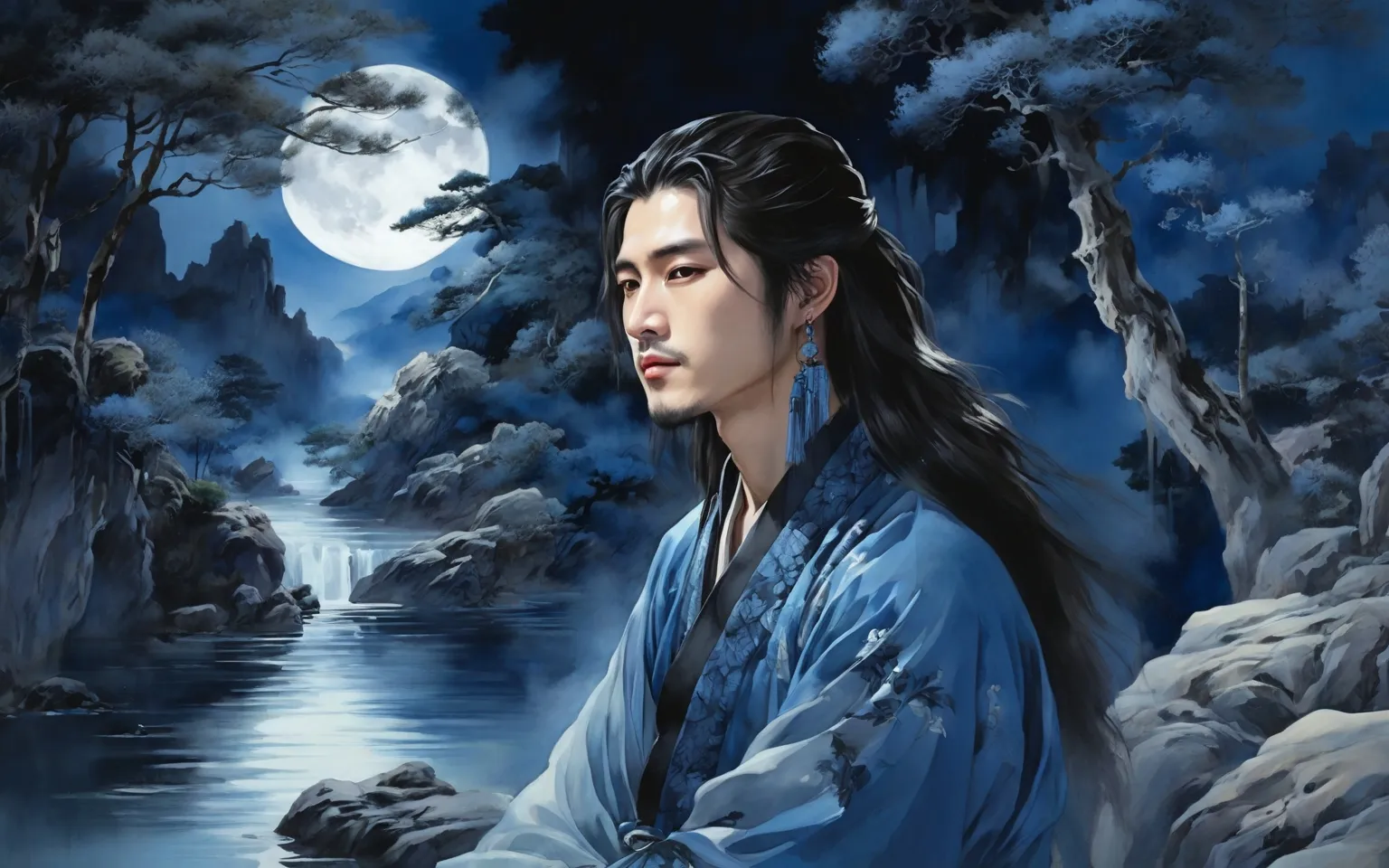
Wang Wei (王维), 701 - 761 A.D., was a native of Yuncheng, Shanxi Province. Wang Wei was a poet of landscape and idylls. His poems of landscape and idylls, with far-reaching images and mysterious meanings, were widely loved by readers in later generations, but Wang Wei never really became a man of landscape and idylls.