


We meet, a smile is all we keep;
We part, and silent tears we weep.
The farewell feast but deepens pain;
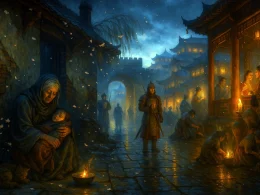
The bleak town adds to sorrow’s strain.
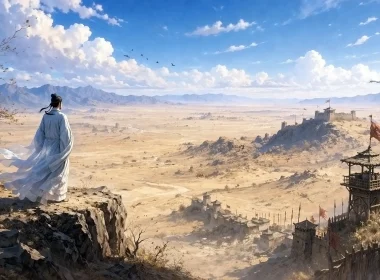
Cold mountains stand in clarity;
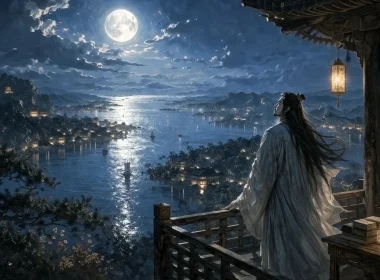
At dusk the mighty river runs free.
Your boat is gone, far out of sight —
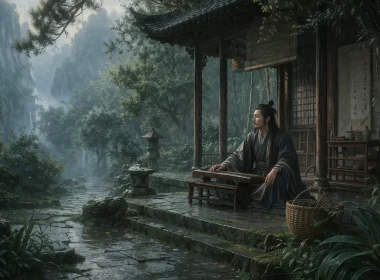
I stand and gaze till fall of night.
Original Poem
「淇上送赵仙舟」
王维
相逢方一笑,相送还成泣。
祖帐已伤离,荒城复愁入。
天寒远山净,日暮长河急。
解缆君已遥,望君犹伫立。
Interpretation
This poem was composed around 727 CE, during the Kaiyuan era, when Wang Wei held the minor post of Registrar in Jizhou after a demotion. At this time, the poet's career had suffered its first setback; far from the capital Chang'an, his state of mind was inevitably lonely and somber. Zhao Xianzhou (possibly Zu Yong, or perhaps someone named Zhao with the courtesy name Xianzhou) was an old friend. This reunion followed by sudden parting triggered in Wang Wei not only the sorrow of farewell but also a personal grief over his own rootless wandering and uncertain future. The poem places the instant emotions of meeting and parting against the vast backdrop of a cold sky and a desolate city. With the most concise and pure language, it outlines the complete process of emotion shifting from joy to sorrow, from gathering to dispersal. It is a masterpiece of five-character farewell poetry, remarkable for its high emotional intensity and powerful visual imagery.
First Couplet: 相逢方一笑,相送还成泣。
Xiāngféng fāng yī xiào, xiāng sòng huán chéng qì.
We met, and had just broken into smiles; / We part, and now these parting tears start.
Explication: The opening strikes directly at the heart with a powerful contrast in time, space, and emotion. "Had just… smiles" and "now these… tears" seem to have no transition; the warmth of the smile has not yet faded before tears well up. This "just" and "now" convey the brevity of the meeting and the suddenness of the parting, condensing the helplessness and sorrow of life's unpredictable meetings and farewells into ten characters. The burst of emotion from the very first line establishes the poem's poignant tone.
Second Couplet: 祖帐已伤离,荒城复愁入。
Zǔ zhàng yǐ shāng lí, huāng chéng fù chóu rù.
The farewell tent—grief at parting's hold. / The desolate town—sadness to re-enter, manifold.
Explication: This couplet projects emotion onto concrete space, creating a double weight of feeling. The "farewell tent" is the scene of parting, already fraught with sorrow; "grief at parting's hold" is the immediate pain. The "desolate town" is where the poet is stranded, the reality he must face alone after the farewell; "sadness to re-enter" is the anticipation and dread of future lonely days. The words "already" and "to" extend the feeling from the present into the future. The shift in space (from the farewell site to the place of solitary return) deepens the sense of prolonged time, giving the parting sorrow a heavier, more enduring texture.
Third Couplet: 天寒远山净,日暮长河急。
Tiān hán yuǎn shān jìng, rì mù cháng hé jí.
Sky cold, distant peaks stand stark and clear; / Sun sets, the long river runs swift and sheer.
Explication: The brushstroke swings outward to depict scenery, yet the scene is imbued with feeling, using the grand vista of heaven and earth to write of inner solitude. "Sky cold" and "Sun sets" specify the season and time of parting while also enhancing the environment's chill and the mood's gloom. "Distant peaks stand stark and clear" presents a static scene of vastness and loneliness; "the long river runs swift" presents a dynamic scene of flux and indifference. The clear peaks and swift river—one still, one moving; one constant, one fleeting—seem like nature's silent commentary on this parting: the eternal, serene hills appear indifferent to human meetings and partings; the hurried eastward flow of the river mirrors the friend's departing boat and the unstoppable passage of time. The lines are perfectly parallel, the意境 desolate and vast, intensely pictorial.
Fourth Couplet: 解缆君已遥,望君犹伫立。
Jiě lǎn jūn yǐ yáo, wàng jūn yóu zhùlì.
Your mooring rope's cast off, you're far away. / I watch you, standing rooted here, I stay.
Explication: The final couplet concludes the poem with close-ups of two actions, bringing the parting to its climax and freezing it in a moment. "Your mooring rope's cast off" is the physical act of separation; "you're far away" is the spatial distance created instantly; the word "already" conveys the speed of the boat and the suddenness of parting. "I watch you" is the unchanging posture of the one left behind; "standing rooted here" emphasizes the duration and focus of that gaze. The contrast between "already" and "still," movement and stillness, stretches the tension between traveler and stayer, departure and remaining, change and steadfastness to its limit. Though the figure is already distant, the gaze has not left. That posture of "standing rooted" becomes the poem's most profound emotional sculpture, containing boundless concern, desolation, and blessing.
Holistic Appreciation
This poem is a "parting lament that uses the momentary to depict the eternal." Its structure is tight, the emotional flow like waves building upon each other: the first couplet is the emotional explosion, capturing the abrupt shift from meeting to parting; the second couplet is the emotional extension, projecting sorrow from the present into the future; the third couplet is the emotional backdrop, using the scene of heaven and earth to deepen the sense of isolation; the final couplet is the emotional crystallization, using action to freeze an eternal gaze of longing. Across four couplets, moving from people to scene and back to people, the poem completes a full cycle from inner emotion to outer scenery, and back to an inner stance. With his poet's eye and painter's brush, Wang Wei writes not only the "pain" of parting but also the "realm" of parting—that boundless emptiness and prolonged sorrow permeating the cold sky, dusk, desolate town, distant peaks, and rushing river. The emotion in the poem is sincere and intense, yet its expression is reserved and concise, embodying the High Tang poetic ideal of "feelings deep and subtle, yet atmosphere grand and complete."
Artistic Merits
- Powerful Tension in Temporal/Spatial Contrast: "Meeting" vs. "parting," "had just… smiles" vs. "now these… tears," "farewell tent" vs. "desolate town," "you're far away" vs. "standing rooted here"—the poem is filled with contrasts of instantaneous time and of near/far space. In this strong antithesis, the tragedy of parting and the depth of emotion are powerfully intensified.
- Precision of Diction and Emotional Weight: The skillful use of function words like "just," "now," "already," "to," and "still" acts as emotional pivots, precisely controlling the verse's rhythm and emotional turns. The descriptive words "clear" and "swift" depict scenery but are entirely in service of feeling; the clearer the peaks, the emptier and lonelier they seem; the swifter the river, the more keenly one feels time's haste and parting's ruthlessness.
- Cinematic Quality of Visual Editing: The entire poem reads like a series of storyboard shots: the first couplet is a close-up of expressions (smiles and tears); the second is a scene shift (tent and town); the third is an establishing shot (cold peaks, dusk river); the final couplet is a frozen long take (gazing into the distance, standing rooted). The transitions and contrasts between these shots create a powerful visual and emotional impact.
- Layered and Restrained Emotional Expression: Though the sorrow is deep, the expression is not excessive. The poet conveys it indirectly through actions (smile, weep, re-enter, stand), scenes (farewell tent, desolate town), and scenery (cold peaks, dusk river), finally crystallizing it in the static posture of "standing rooted." This is subtle, profound, and lingering, avoiding the flaw of being overly explicit.
Insights
This work shows us that the deepest pain of parting often lies in how it connects to broader feelings of loneliness and impermanence in an individual's life. Wang Wei's sadness springs not only from his friend's departure but also from his own stranded existence in the "desolate town," and from his recognition of a life circumstance akin to the "sky cold… sun sets." It reveals that: Parting is profound because it is a mirror, reflecting our own situation, our dependence on connection, and our sense of drifting in the flow of time.
On life's journey, we constantly experience the cycle of "we met, and had just broken into smiles; / we part, and now these parting tears start." This poem teaches us to cherish the warmth of each "meeting" and to face the inevitability of each "parting." When parting comes, perhaps we can, like the poet, pour our emotions into the broader vista of heaven and earth ("sky cold, distant peaks… sun sets, the long river…") to settle them, ultimately assuming a stance of deep affection—"standing rooted"—to watch the departure, transforming that friendship into an eternal inner landscape. This ability to maintain a steady gaze within sorrow, to preserve beauty within parting, is precisely the precious power poetry grants us.
About the poet

Wang Wei (王维), 701 - 761 A.D., was a native of Yuncheng, Shanxi Province. Wang Wei was a poet of landscape and idylls. His poems of landscape and idylls, with far-reaching images and mysterious meanings, were widely loved by readers in later generations, but Wang Wei never really became a man of landscape and idylls.