
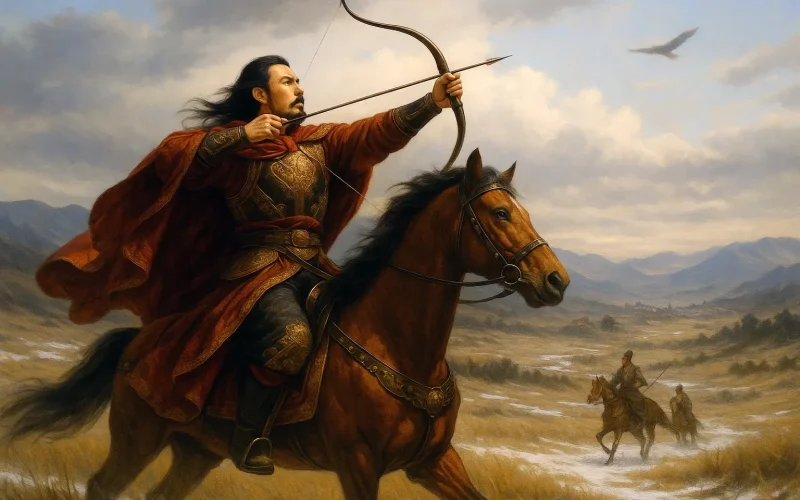
The wind blows hard, horn-bow ringing;
The general hunts, round Weicheng winging.
On dried grass, falcon’s eye’s keen and bright;
On snowless plain, horse’s trot is light.
Past Xinfeng Market he flies like wind;
To Willow Camp he’s back in a grin.
He looks back where his arrow left its trail —
Miles and miles of dusk clouds, calm and pale.
Original Poem
「观猎」
王维
风劲角弓鸣,将军猎渭城。
草枯鹰眼疾,雪尽马蹄轻。
忽过新丰市,还归细柳营。
回看射雕处,千里暮云平。
Interpretation
This poem is a representative work of Wang Wei's early poetic style. While its exact date of composition is uncertain, the vigorous spirit, robust brushwork, and soaring energy that fill its lines suggest it belongs to his youth or middle age, when his state of mind was still closely connected to the enterprising ethos of the High Tang era. Although titled "Watching the Hunt," it is far from a coolly detached sketch by an onlooker. Instead, the poet injects his own heroic spirit into the scene, using his poetic pen as a lens to capture and reconstruct a general's winter hunt. Through masterful shifts between movement and stillness, speed and pace, proximity and distance, it composes a majestic symphony interweaving strength and beauty, speed and space, and is hailed as the crowning masterpiece of Tang dynasty hunting poetry.
First Couplet: 风劲角弓鸣,将军猎渭城。
Fēng jìn jiǎo gōng míng, jiāngjūn liè Wèichéng.
The wind blows keen, the hornbound bowstrings sing; / The general hunts beyond Weicheng's walls, commanding.
Explication: The opening is like a cinematic close-up, seizing attention first through sound. Before showing the people, it presents the "keen wind" and the "sing[ing]" bowstrings, using auditory impact and tactile harshness to instantly immerse the reader in a tense, frigid hunting scene. "The hornbound bowstrings sing" describes the twang of the bow, yet also resembles a whinnying in the wind, piercingly vivid. Only then does the second line reveal the subject, "The general," and the location, "Weicheng." The narration is crisp and decisive, the atmosphere vast and heroic, the robust frontier-poem ethos of the High Tang palpable from the first breath.
Second Couplet: 草枯鹰眼疾,雪尽马蹄轻。
Cǎo kū yīng yǎn jí, xuě jìn mǎ tí qīng.
Grass sere, the falcon's gaze strikes sharp and fast; / Snow gone, the charger's hooves tread fleet and light.
Explication: This couplet is a paradigm of refined diction, using minute observation to convey grand motion. "Grass sere" and "Snow gone" are classic signs of late winter/early spring, indicating the season and, more importantly, providing the perfect stage for the protagonists (falcon, horse). "The falcon's gaze strikes sharp and fast"—the word "fast" captures the swift, precise locking onto prey. "The charger's hooves tread fleet and light"—the word "light" describes the nimble, effortless gallop on the now firm ground. The lines are perfectly parallel. Not a word directly describes the general, yet through the exceptional performance of his falcon and steed, they indirectly highlight the hunter's supreme skill and lightning-like speed.
Third Couplet: 忽过新丰市,还归细柳营。
Hū guò Xīnfēng shì, huán guī Xìliǔ yíng.
They flash past markets of Xinfeng Town in a breath, / Then turn, already heading back to their Willow Camp's berth.
Explication: The space leaps dramatically, using place names to sketch the hunt's whirlwind journey. The words "flash past" and "already heading back" condense the traversal of a great distance into a moment, emphasizing their incredible speed. The choice of place names is deliberate: "Xinfeng Town" was a bustling Tang district of wine shops, hinting the hunt may have passed through or near such liveliness; "Willow Camp" was the garrison of the famed Han general Zhou Yafu. Using it to refer to the general's camp not only suggests his disciplined command, worthy of the ancients, but also adds historical gravitas and solemnity.
Fourth Couplet: 回看射雕处,千里暮云平。
Huí kàn shè diāo chù, qiānlǐ mù yún píng.
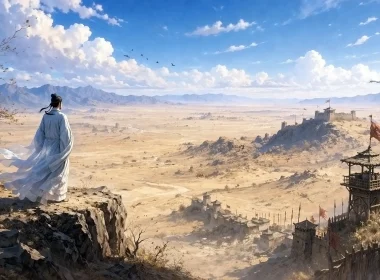
He looks back where the giant eagle was struck from the sky; / A thousand leagues of evening clouds merge with the plains, wide and high.
Explication: The final couplet is like a long shot slowly pulling back, shifting from motion to stillness, the vista suddenly expanding. "Looks back" is both an action and a settling of emotion. The hunt's fierce clamor is now past; "where the giant eagle was struck" remains only as a spatial memory filled with glory. "A thousand leagues of evening clouds merge with the plains" concludes the poem with the vast image of boundless evening clouds meeting the level wilderness. It places the lightning-brief hunt just concluded within an eternal, vast, and tranquil backdrop of time and space. The contrast between motion and stillness, tension and release, is masterful, leaving a long, resonant aftertaste.
Holistic Appreciation
This regulated verse is a "dynamic epic that uses speed to depict space, and the momentary to condense the eternal." Its structure unfolds like an exquisite short film: the first couplet is a stunning audio-visual opening; the second couplet is a brilliant detailed close-up (falcon's eye, horse's hooves); the third couplet is a fluid spatial montage (Xinfeng, Willow Camp); the final couplet is a distant, atmospheric freeze-frame (evening clouds over a thousand leagues). Across the four couplets, the rhythm shifts from urgent vigor to serene vastness, the emotion from ardent outward energy to deep inward resonance. Wang Wei captures not just the "process" of the hunt, but its very "essence"—that power, speed, precision, and heroic spirit—and ultimately sublimates it into a vast realm where history and nature blend. The figure of the "general" is the poetic embodiment of the High Tang's martial ethos and ideal of achieving merit.
Artistic Merits
- Indirect Evocation and Telling Detail: The poet rarely describes the general directly. Instead, he uses peripheral elements and actions—"bowstrings sing," "falcon's gaze… fast," "charger's hooves… light," "flash past," "already heading back"—to indirectly evoke his heroism, speed, and boldness. The technique is masterful.
- Exquisite Diction, Each Word Resonant: Words like "keen," "sing," "fast," "light," "flash," "already," "merge" are all precise, concentrated, and highly expressive. Particularly "fast" and "light," which vividly capture the state of falcon and horse in that specific environment, can be considered the poem's "eyes."
- Artful Handling of Time and Space: The poem compresses the entire hunt temporally and spatially leaps across three locations: Weicheng, Xinfeng, Willow Camp. It culminates by infinitely expanding space with "a thousand leagues of evening clouds." This high degree of artistic distillation and combination creates a majestic poetic realm that feels both real and transcendent.
- Assimilation of Allusion and Infusion of Spirit: The allusion to "Willow Camp" is used naturally and seamlessly, adding historical depth. The entire poem is vibrant in spirit, brisk in rhythm, perfectly parallel without being rigid, embodying the High Tang regulated verse's characteristic balance of formal discipline and vital energy.
Insights
This work reveals a side of Wang Wei's poetry that is vigorous, unrestrained, and full of masculine beauty. It teaches us that: True artistic power stems from the precise capture of a dynamic moment, a profound grasp of its inner spirit, and the extraordinary ability to elevate a specific event into a universal artistic conception. Through his brilliant depiction of a hunt, the poet not only praises human valor and vitality but also places this momentary brilliance against the eternal backdrop of "a thousand leagues of evening clouds," prompting reflection on the dialectic between life and nature, passion and peace.
In today's world of rapid pace and fragmented information, this poem might offer a different kind of insight: Can we, like the poet, still concentrate on a "process" (like the hunt), keenly capture its details (the falcon's eye, the horse's hooves), and ultimately, in looking back, attain a transcendent, peaceful perspective ("evening clouds merge with the plains")? It encourages us, amidst busy lives, to retain an appreciation for strength and beauty, to experience speed and passion, yet not lose that capacity for "looking back" with composure and the wisdom of reflection. With its enduring artistic charm, Wang Wei's poem demonstrates how the vibrant vitality of human life and the vast breath of heaven and earth can achieve perfect harmony within a short verse.
About the poet
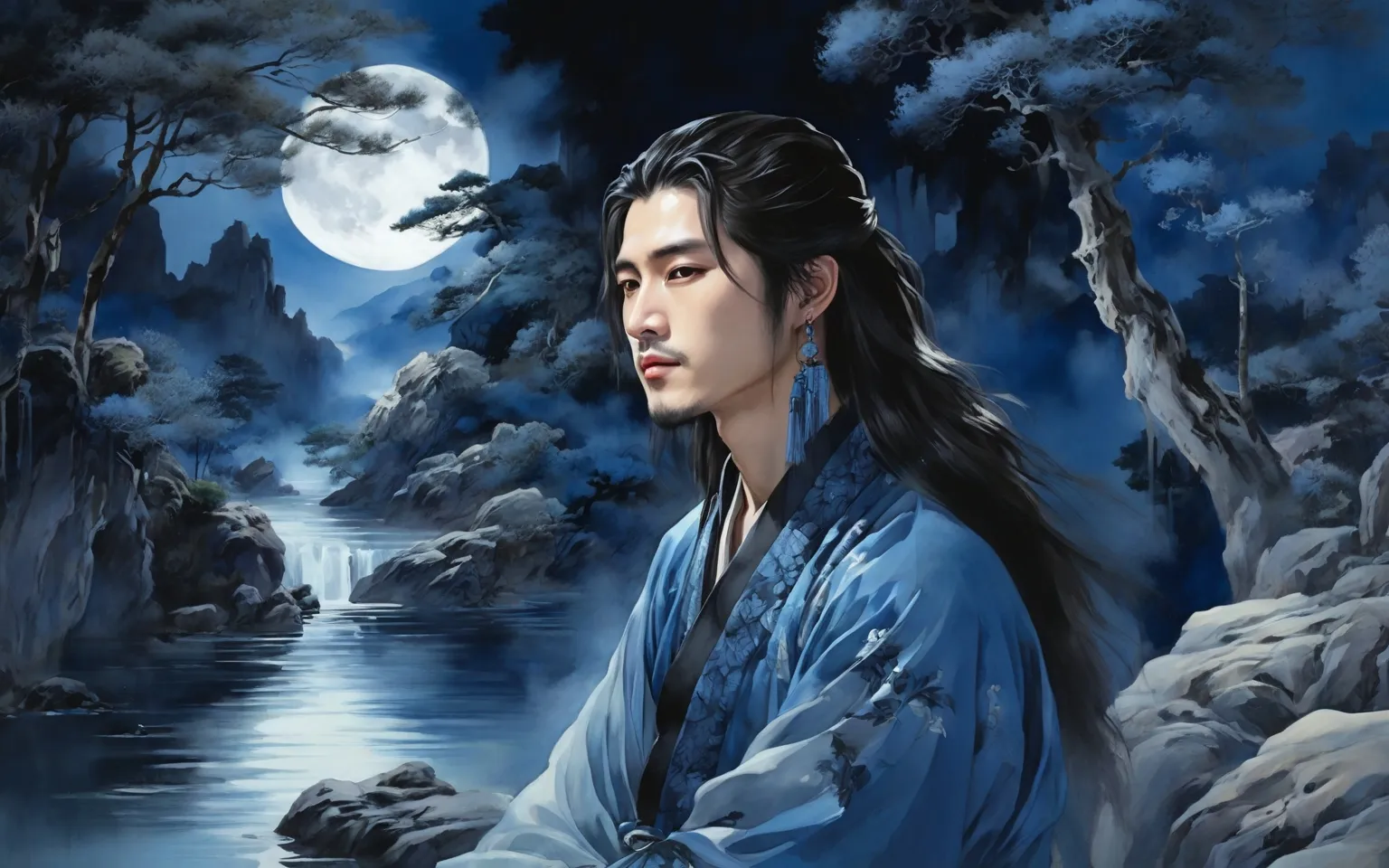
Wang Wei (王维), 701 - 761 A.D., was a native of Yuncheng, Shanxi Province. Wang Wei was a poet of landscape and idylls. His poems of landscape and idylls, with far-reaching images and mysterious meanings, were widely loved by readers in later generations, but Wang Wei never really became a man of landscape and idylls.