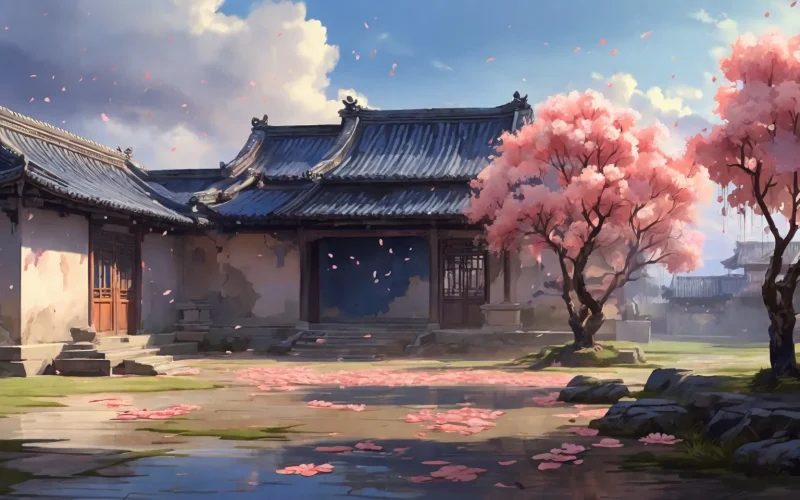

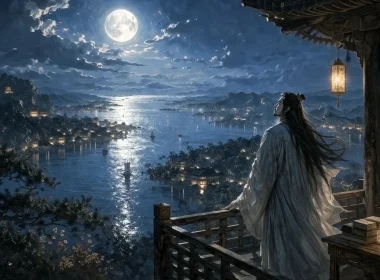
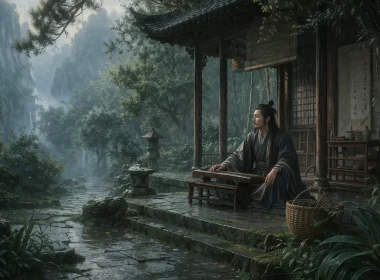
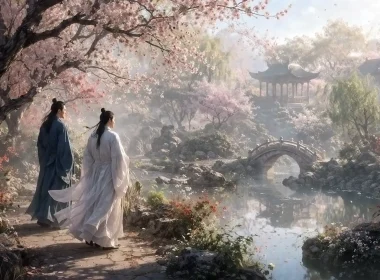
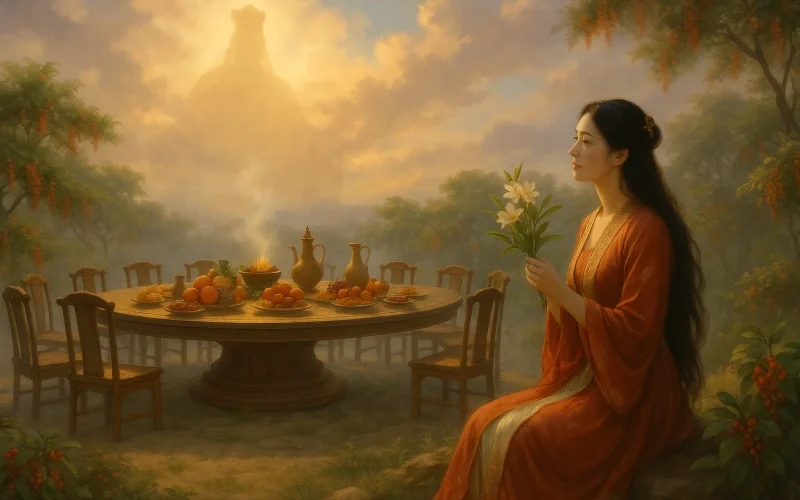
With laurel wine we greet the royal sprite;
Sweet herbs we give to the lady bright.
Spiced ale on jade mat laid with care —
For the Cloud God from the air.
Original Poem
「椒园」
王维
桂尊迎帝子,杜若赠佳人。
椒浆奠瑶席,欲下云中君。
Interpretation
This poem is the seventeenth of the twenty in Wang Wei's Wang River Collection, composed in response to a matching-title poem by his friend Pei Di. It does not depict a real landscape of the estate but constructs a pure, sacred, ritualistic space using highly condensed imagery modeled on the Songs of Chu, particularly the "Nine Songs." In his later years, deeply immersed in Buddhist philosophy, Wang Wei also demonstrated a keen affinity for the spirit-communion ethos of Chu shamanistic culture. In this poem, he deftly adapts archetypes from Xiang-Chu mythology, elevating a corner of Wangchuan—the "Garden of Peppers"—into a spiritual altar for communion between humanity and the divine. It reveals a rare dimension of mysticism and classical ritual beauty in his poetry.
First Couplet: 桂尊迎帝子,杜若赠佳人。
Guì zūn yíng dì zǐ, dù ruò zèng jiā rén.
With a cassia-wood cup, we welcome the Princess, the River Lord's bride; / We offer the asarum flower, a gift for the radiant goddess.
Explication: The opening juxtaposes two sets of rare objects with mythological figures, instantly transporting the reader into the marvelous context of the "Nine Songs." "Cassia-wood cup" and "asarum flower" are both extraordinary: cassia is fragrant, a wood for making ritual vessels, highlighting the sanctity of the ceremonial object; asarum is an aromatic plant, given to the goddess, conveying a subtle sentiment of admiration and longing. Mentioning both "the Princess" (the Goddess of the Xiang River) and "the radiant goddess" (the God of the Xiang River or another deity) continues the "Nine Songs" theme of tender, yearning affection between mortals and immortals. The poem does not describe the worshippers, yet through the actions of "welcome" and "offer… a gift," it implies a sacred rite prepared with reverent hearts.
Second Couplet: 椒浆奠瑶席,欲下云中君。
Jiāo jiāng diàn yáo xí, yù xià yún zhōng jūn.
Pepper-infused wine libation poured upon the jade-inlaid mat— / It seems the Lord Amid the Clouds might now descend to this place.
Explication: This couplet shifts from the preparatory acts of "welcoming" and "offering" to the core ritual of "libation poured," elevating the poetic feeling to a climactic moment of sensed communion. "Pepper-infused wine" is the aromatic libation unique to Chu rituals; "the jade-inlaid mat" is the splendid, pure furnishing. Their combination concentrates the beauties of scent (pepper aroma), taste (rich wine), and sight (jade gleam) into the ceremony's central act. The concluding line, "It seems the Lord Amid the Clouds might now descend to this place," is the soul of the poem. The words "might now descend" create a tension of imminent, suspended arrival, as if the worshipper's sincerity has reached the divine ear, and the descent of the "Lord Amid the Clouds" (the Cloud God, or a general term for celestial beings) is but a moment away. Using the subjunctive mood, this line eternally captures the most moving, most mysterious instant of the rite—the threshold state of human-divine communion—leaving a lasting resonance and infinite space for reverie.
Holistic Appreciation
This pentasyllabic quatrain is a "miniature ritual poem" that achieves great complexity through extreme simplicity. Its structure clearly outlines the ceremonial sequence: the first line prepares the ritual vessel to welcome the god; the second prepares the gift to please the goddess; the third performs the central libation; the fourth anticipates the deity's descent. The four lines complete a full ritual cycle from material preparation to spiritual communion. Wang Wei's artistry lies in discarding all environmental description and direct expression of personal emotion. He selects only the most representative images from the "Nine Songs" (cassia, asarum, pepper-wine, jade mat) and figures (the Princess, the goddess, the Lord Amid the Clouds) and, through exquisite combination and connection, resurrects the entire gorgeous imagination and pious atmosphere of Chu ritual culture within twenty characters. The poetic mood is ethereal and serene, yet within that silence surges a profound undercurrent of emotion flowing between the human and divine realms.
Artistic Merits
- The Classical Nature and Symbolic System of Imagery: All objects and figures in the poem originate from the Songs of Chu, forming a self-contained classical symbolic system. They do not point to reality but collectively point to a sacred, fragrant, and pure otherworld, reflecting Wang Wei's deep understanding and poetic reconstruction of ancient cultural spirit.
- The Ritualistic Force and Tension of Verbs: The four verbs—"welcome," "offer… a gift," "libation poured," and the subjunctive "might… descend"—precisely correspond to different stages of the ritual, imbuing static images with solemn, ceremonial movement. Particularly the word "might" in "might now descend" uses uncertainty to intensify the suspense and anticipation of the moment of communion, creating great artistic tension.
- A Concentrated Dramatic Scene: The entire poem resembles a highly condensed ritual drama, possessing props (cassia cup, asarum, pepper-wine, jade mat), characters (the Princess, the goddess, the Lord Amid the Clouds), a sequence of actions, and emotional expectation (might descend). Within an extremely concise form, it contains a complete dramatic structure.
- The Mysterious and Pure Atmosphere: By selecting images of aromatic plants, beautiful jade, and deities, the poem is permeated with an atmosphere that is both mysteriously marvelous and immaculately pure. This forms a subtle contrast with the natural, fresh charm of other poems in the Wang River Collection, revealing a profound, abstruse dimension within Wang Wei's poetic world.
Insights
This work demonstrates how poetry can become a ritual of the spirit. Amidst the landscape of Wangchuan, using words as ritual vessels and allusions as offerings, Wang Wei reconstructed a pure space for dialogue with the ancient gods. This reveals that a truly poetic dwelling lies not only in appreciating natural scenery but also in the ability to create and maintain a transcendent spiritual dimension within oneself, engaging in deep dialogue with the sages of the past and the sublime imagery of cultural tradition.
In an era dominated by pragmatism, this poem serves as an elegant reminder: the human spirit needs a sense of ritual, needs to establish a connection with an existence above the mundane. This connection need not be religious; it can be reverence for classical culture, steadfastness in holding to noble ideals, or preserving for oneself, amidst the clamor, a tranquil "jade-inlaid mat" for profound reflection. Through his poetic craft, Wang Wei shows us that through the refinement of language and the distillation of imagery, we can clear a spiritual "Garden of Peppers" within the mortal world. There, with the most reverent heart, we may await the descent of our own personal "Lord Amid the Clouds." This pursuit of attaining the sacred through art is the most moving force within cultural transmission.
About the poet
Wang Wei (王维), 701 - 761 A.D., was a native of Yuncheng, Shanxi Province. Wang Wei was a poet of landscape and idylls. His poems of landscape and idylls, with far-reaching images and mysterious meanings, were widely loved by readers in later generations, but Wang Wei never really became a man of landscape and idylls.