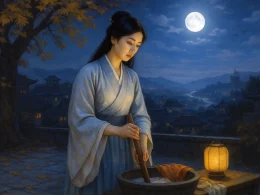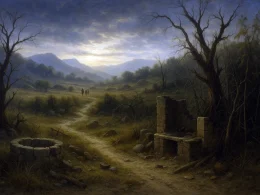

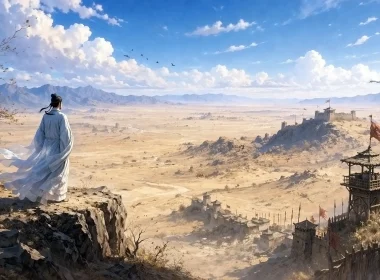
Frost-bleached grass, vast and grey; insects chirping sharp and clear.
To the south and north of the village, no traveler appears.
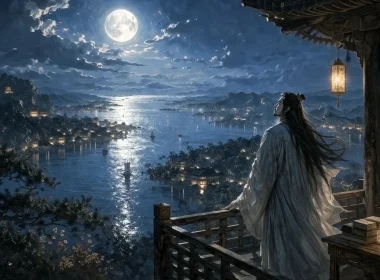
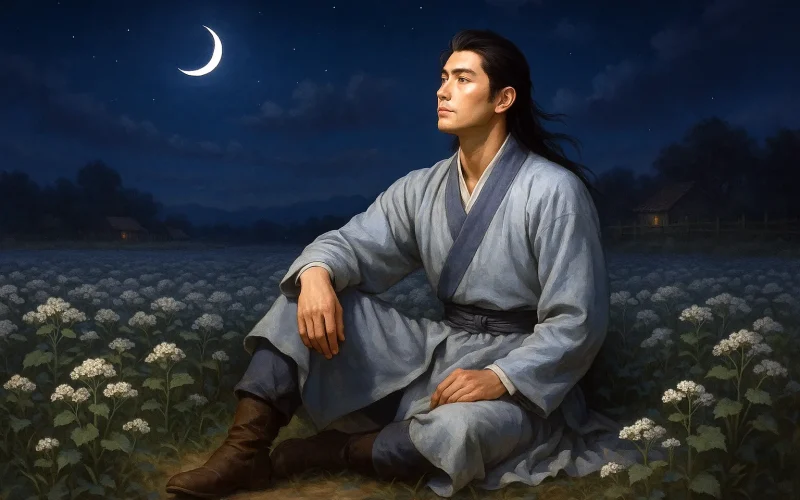
Alone, I step outside the front gate and gaze over the wild fields;
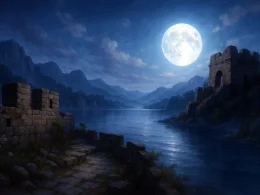
Under the bright moon, buckwheat blossoms look like a fall of snow.
Original Poem
「村夜」
白居易
霜草苍苍虫切切,村南村北行人绝。
独出前门望野田,月明荞麦花如雪。
Interpretation
This poem was written in the autumn of 814 CE, during the Yuanhe reign of Emperor Xianzong. At the time, Bai Juyi was observing a period of mourning for his deceased mother, living in retirement in his hometown of Weicun, Xiagui (present-day Weinan, Shaanxi). Grieving a profound personal loss and removed from the life of the court, the poet found himself at a low ebb, enveloped in immense solitude and a sense of emptiness. It was in this state of mind that he recorded an ordinary, solitary walk on an autumn night. With remarkably spare and precise language, the poet traces the transformation of the village nightscape from the desolate chill of "frost-bleached grasses and shrill insects" to the crystalline clarity of "flowers gleaming like snow in the moonlight." Within this quiet progression of imagery lies an implicit narrative: the subtle journey of a heart seeking solace in isolation and ultimately finding a serene accord with the natural world.
First Couplet: "霜草苍苍虫切切,村南村北行人绝。"
Shuāng cǎo cāngcāng chóng qièqiè, cūn nán cūn běi xíngrén jué.
Grasses, frost-bleached, stretch bleak and vast; insects keen a shrill, thin sound. / To the south, to the north, throughout the village, not a soul is to be found.
Explication: The opening couplet, in perfect parallelism, establishes the quintessential desolation of a country autumn night through stark visual and auditory details. "Grasses, frost-bleached, stretch bleak and vast" presents a wide, static, and cold-toned visual field, where vegetation lies withered under a bleak sky. "Insects keen a shrill, thin sound" provides a minute, persistent, yet profoundly isolating auditory layer to the stillness. The descriptors "bleak and vast" and "shrill, thin"—one expansive, the other piercing—together weave a boundless tapestry of cold solitude. "Not a soul is to be found" pushes this isolation to its absolute limit, depicting a world devoid of human presence. The poet here is both the observer of this silence and seemingly absorbed into this "deserted" realm, his being immersed in its boundless loneliness.
Second Couplet: "独出前门望野田,月明荞麦花如雪。"
Dú chū qiánmén wàng yětián, yuè míng qiáomài huā rú xuě.
Alone, I step past the front gate, gaze on wild fields, open and wide; / Moonlight bathes the earth—on buckwheat flowers lies a fall of snow, a silvery tide.
Explication: This couplet marks the poem’s pivotal turn and its moment of emotional and aesthetic elevation. The act of "Alone, I step past the front gate" deliberately breaks the static confinement of the previous scene, revealing the poet’s conscious effort to move beyond his solitude. His gaze shifts from the immediate, narrow village environs to the expansive "wild fields, open and wide," suddenly unlocking both physical and psychic space. The vision that follows, "Moonlight bathes the earth—on buckwheat flowers lies a fall of snow," serves as the poem’s symbolic moment of clarity and consolation. The clear moonlight washes away the night’s heaviness, illuminating a transfigured world. The buckwheat, an autumn crop, covers the ground with a profusion of tiny white blossoms that, under the moon’s glow, coalesce into a seamless expanse, creating the luminous visual illusion of a snowfall. This "snow" is not winter’s cold shroud, but a radiant, vibrant "blossom-snow" born of the autumn night. The chromatic shift from the ashen, lifeless hue of "frost-bleached grasses" to the luminous, vital whiteness of "flowers gleaming like snow" subtly mirrors the poet’s inner transition from melancholy to a cleansed tranquility.
Holistic Appreciation
This pentasyllabic quatrain is a "meditative nocturne, using landscape to chart the heart’s course." Its structure is finely calibrated, with emotion flowing powerfully beneath a composed surface. The first two lines depict "isolation" in its extreme form, using frost-seared grass, shrill insects, and absent human life to construct a closed, chilling, almost suffocating sensory world that functions as the precise objective correlative for the poet’s inner desolation. The final two lines narrate a "deliberate departure" and a "discovery"; through the conscious acts of stepping out and gazing afar, he encounters the crystalline vision of the moonlit buckwheat field, achieving a moment of emotional self-redemption and aesthetic transcendence. The four lines trace a complete psychological arc from being "trapped within solitude" to "emerging from it," finding peace and unexpected beauty in the wider embrace of nature. Not a word directly voices personal feeling, yet the poet’s profound grief, the uncertainty of his suspended official life, and—amidst this hardship—his undimmed sensitivity to natural beauty and capacity for self-solace are all richly are all richly and implicitly contained within the imagery.
Artistic Merits
- Contrast and Transformation of Imagery: A stark visual and emotional contrast is drawn between the sere, fading "frost-bleached grasses" and the luminous, abundant "buckwheat flowers." Similarly, an auditory and atmospheric disparity exists between the faint, desolate "insects’ shrill sound" and the vast, cleansing "moonlight." This deliberate shift in imagery subtly externalizes the poet’s inner movement from oppressive sorrow to serene release.
- Symbolic Use of Color and Light: The poem’s dominant palette shifts from the "bleak" (grayish-white) of the first couplet to the "silvery" light of the moon and the "snow"-white of the flowers in the last. Though all variations of white, the transition carries profound symbolic weight: from a "frost-color" representing decay and lifelessness to a "moonlight" and "blossom-color" representing illumination, purity, and latent vitality.
- Movement Disrupts Stillness, Expanding the Poetic Realm: The line "Alone, I step past the front gate, gaze on wild fields…" is the crucial hinge. The verbs "step past" and "gaze" signify a deliberate physical and visual journey, breaking the stagnant tableau of the opening and leading the poetic perspective from the confined village lanes into the boundless fields. This creates the necessary spatial and psychological opening for the epiphanic vision that concludes the poem.
- The Epiphanic Power of the Closing Simile: "Moonlight bathes the earth—on buckwheat flowers lies a fall of snow" functions with the arresting clarity of a revelatory image. The simile is fresh and apt; "a fall of snow" captures not only the monochromatic whiteness but also the seamless, glimmering quality of the flower field under the moon. The resulting image is one of pristine beauty and ethereal calm, possessing remarkable evocative power.
Insights
The profundity of this poem lies in its quiet revelation of a path through profound loneliness and sorrow: not to remain confined within the prison of one’s own grief, but to find the resolve to "step past the front gate" alone, to cast one’s being into the wider world, and to allow nature’s inherent beauty to console and illuminate the spirit. In the depths of mourning, Bai Juyi retained the capacity to discover the wondrous vision of "flowers gleaming like snow" on a commonplace village night. This speaks to the resilient vitality of his inner life and the indomitable nature of his poetic sensibility.
This poem offers a deeply relevant insight for the modern psyche. When besieged by personal troubles, anxiety, or a sense of existential emptiness (akin to the suffocating atmosphere of "frost-bleached grasses and shrill insects"), we might emulate the poet’s example and enact a conscious "removal"—even if merely stepping outside, looking up at the night sky, or walking through an open space. True solace may not be found in relentless introspection, but might await beyond a simple, deliberate act of looking, within an unforeseen moment of clarity akin to "flowers gleaming like snow in the moonlight." It reminds us that beauty and peace are perpetually present; the key lies in our willingness and ability to walk forward through our personal darkness to encounter them.
About the Poet
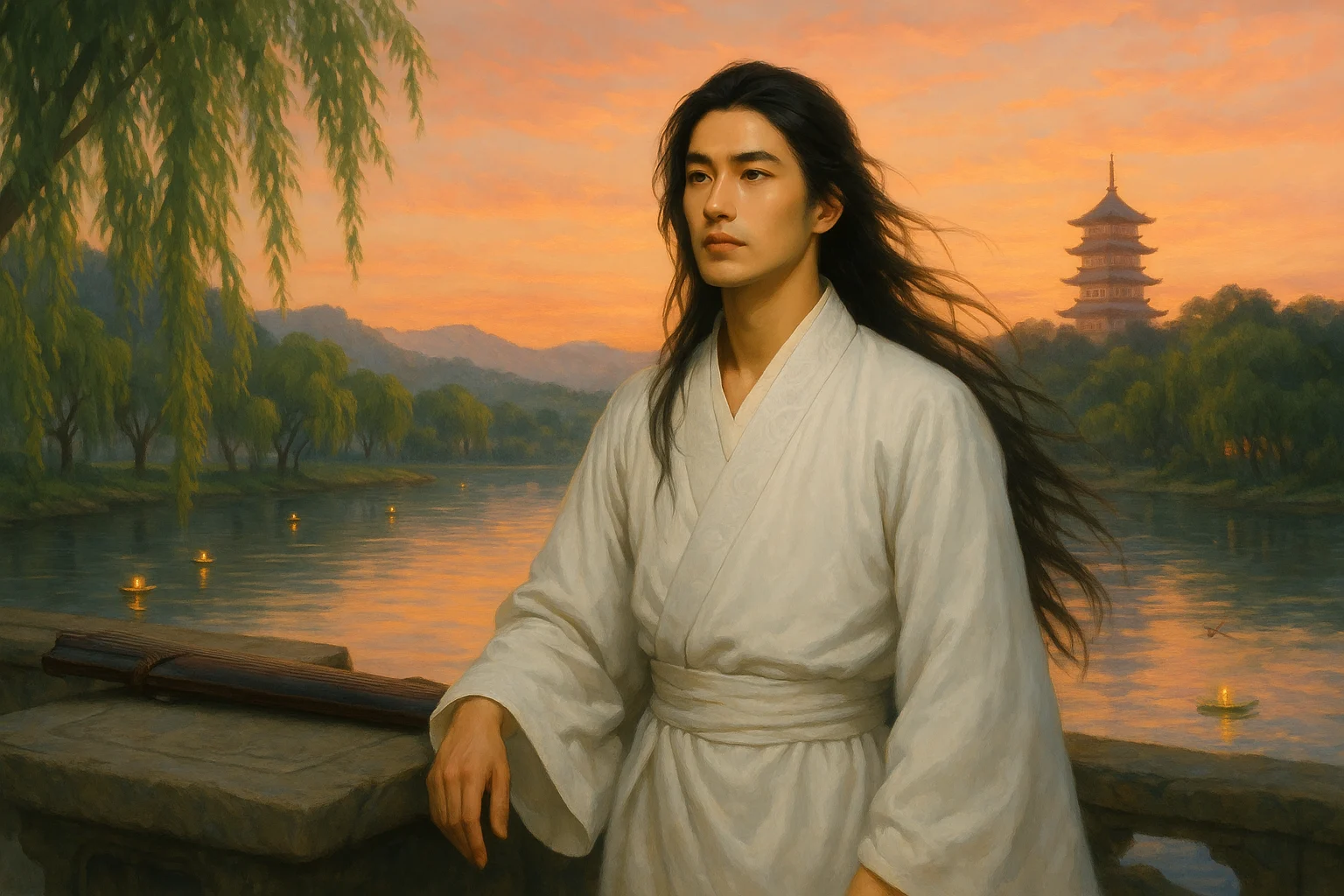
Bai Juyi (白居易), 772 - 846 AD, was originally from Taiyuan, then moved to Weinan in Shaanxi. Bai Juyi was the most prolific poet of the Tang Dynasty, with poems in the categories of satirical oracles, idleness, sentimentality, and miscellaneous rhythms, and the most influential poet after Li Bai Du Fu.