



Long separated, we meet by chance, and start —
Both doubting whether we’re in a dream.
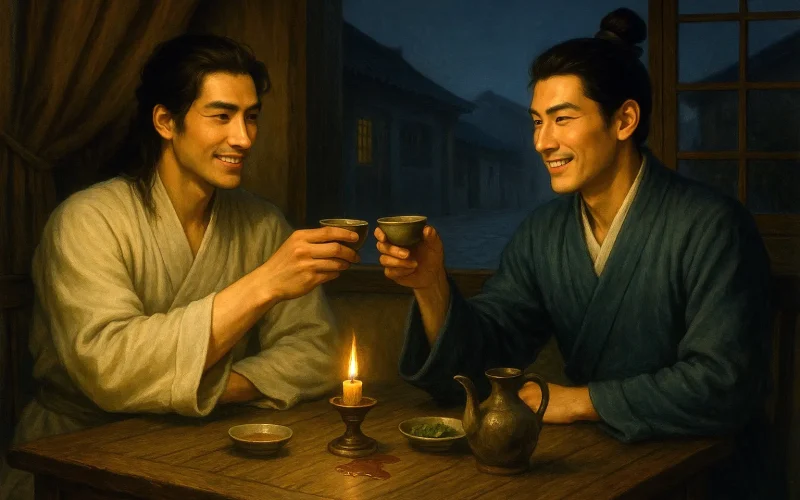
Now raising cups to this glad moment’s heart…
But setting them down, it fades like a gleam.
Original Poem
「逢旧」
白居易
久别偶相逢,俱疑是梦中。
即今欢乐事,放盏又成空。
Interpretation
This poem is undoubtedly the work of Bai Juyi’s middle to later years, a period marked by a deep familiarity with life’s vicissitudes. The poem captures a moment of high dramatic tension yet mundane universality—an unexpected encounter with someone from the past. With the most economical brushstrokes, it penetrates the surface delight of reunion to probe the fundamental questions of existential illusion and temporal desolation that lie beneath. It transcends simple nostalgia, becoming a miniature philosophical parable about all meetings and partings.
First Couplet: “久别偶相逢,俱疑是梦中。”
Jiǔ bié ǒu xiāng féng, jù yí shì mèng zhōng.
Long parted, by chance we meet; / Both suspect this a dream, a phantom sweet.
The opening ten characters precisely capture a surreal instant. "Long parted" and "by chance we meet" form the first layer of contradiction: the lengthy separation and the accidental encounter highlight the preciousness and incredibility of the meeting. "Both suspect this a dream" is the direct psychological reaction born from this tension. The word "both" indicates this is not one person’s delusion but a shared state of bewilderment, emphasizing the universally resonant power of the scene. The metaphor of the "dream" expresses not only surprise but, on a deeper level, reveals the profound doubt about the authenticity of one’s own memories and the present moment, eroded by the torrent of time. The long years of separation themselves have been like a dream; is the meeting before one’s eyes now a dream within a dream?
Second Couplet: “即今欢乐事,放盏又成空。”
Jí jīn huānlè shì, fàng zhǎn yòu chéng kōng.
Even this present joy, this merry event we hold, / Once cups are laid down, turns to emptiness, to naught, we’re told.
This couplet pushes the emotion to a deeper level, foreseeing the nothingness of parting at the very height of reunion. "Even this present joy" is an affirmation of the gathering, an effort to grasp a sense of reality. However, "once cups are laid down, turns to emptiness" falls like cold water, revealing a cruel temporal logic: while the feast is in progress, the "joy" seems to exist; but the moment the action pauses ("cups are laid down"), that temporary "reality" constructed by shared drink and conversation instantly dissipates, as if it never happened. The brilliance of this line lies in how the minute action of "cups are laid down" becomes the tipping point for the passage of time and the shift in circumstance, a philosophical switch from "being" to "emptiness." The word "turns" is especially poignant, suggesting this sense of dissolution is not a one-time occurrence but a recurrent experience in the cycle of life.
Holistic Appreciation
This five-character quatrain resembles a highly condensed four-act play, perfectly enacting the emotional and intellectual undulations of the entire process of "meeting someone old." Act I (Long parted) is the lengthy background. Act II (by chance we meet) is the sudden plot twist and emotional peak, yet presented in the dazed state of "suspect this a dream." Act III (Even this present joy) is the attempt to confirm and savor this hard-won reality. Act IV (turns to emptiness) is the abrupt finale and ultimate reflection following the climax. The entire poem wavers repeatedly between the "substantial" (meeting, merrymaking) and the "insubstantial" (suspecting a dream, turning to emptiness), ultimately allowing the experience of "insubstantiality" to overlay and deconstruct the joy of the "substantial." It profoundly conveys a certain essential loneliness and transience in human life—even in the most fervent gatherings, the shadows of parting and nothingness are never far away.
Artistic Merits
- A Highly Condensed, Dramatic Structure: The four lines contain a complete narrative arc (parting-meeting-gathering-dispersal) and psychological upheaval (longing-doubt-joy-emptiness), with a exceptionally clear progression, showcasing the quatrain form’s capacity to hold "a thousand miles within a foot."
- The Philosophical Distillation of Mundane Detail: "Suspect this a dream" is a common psychological experience; "cups are laid down" is the most ordinary action at a feast. The poet elevates these two details into pivots touching on questions of existence and time, achieving a leap from the trivia of daily life to metaphysical contemplation, demonstrating superb skill in "revealing principle through event."
- Restrained yet Deepening Emotional Expression: The poem contains not a single word directly about feeling, yet it layers immense surprise, profound doubt, fleeting joy, and vast emptiness within calm narration and plain description. The more restrained the emotion, the more turbulent its core appears.
- A Cyclical Sense of Time: "Long parted" is the drawn-out past, "this present" is the instantaneous now, and "turns to emptiness" points to the inevitable future and the resigned acknowledgment of this pattern. The lines create a suffocating sense of temporal recurrence, where joy is but a brief fissure in a vast expanse of nothingness.
Insights
This poem elevates a specific reunion into an insight about the nature of all gatherings in life. It reveals a disquieting yet undeniable truth: The tangible quality of existence in many of life’s joys depends intensely on the "in-progress" present moment. The moment one attempts to step back and examine it or move into the next moment, it is like a pattern on the sand, easily smoothed by the tide of time, leaving only the experience of "emptiness."
Yet, Bai Juyi’s greatness lies in not steering towards utter nihilism or passivity. The poem still contains the preciousness of the "by chance we meet," the engagement with the "present joy." This teaches us that the wisdom of life may be this: Knowing full well that "once cups are laid down, turns to emptiness," one still does not abandon the "present joy." Knowing we are ultimately guests in a "dream," we still cherish the heart-stirring warmth of the moment we "both suspect." Acknowledging the brevity and illusoriness of meetings is not to negate them, but to immerse oneself with clearer awareness and attentiveness in the "this moment" of the present encounter, making this limited "dream" as real and as full as possible.
In an age where human connection is increasingly convenient yet also increasingly superficial, this poem acts like an ancient mirror, reflecting the modern psyche’s deep-seated yearning for genuine encounter and its latent anxiety about the rapid decay of relationships. It reminds us that every sincere "meeting" is a small yet vital effort against the desolation of time. Even if it will ultimately "turn to emptiness," the momentary brightness of "both suspect this a dream" is enough to illuminate a stretch of the dim path on life’s journey.
About the Poet

Bai Juyi (白居易), 772 - 846 AD, was originally from Taiyuan, then moved to Weinan in Shaanxi. Bai Juyi was the most prolific poet of the Tang Dynasty, with poems in the categories of satirical oracles, idleness, sentimentality, and miscellaneous rhythms, and the most influential poet after Li Bai Du Fu.