
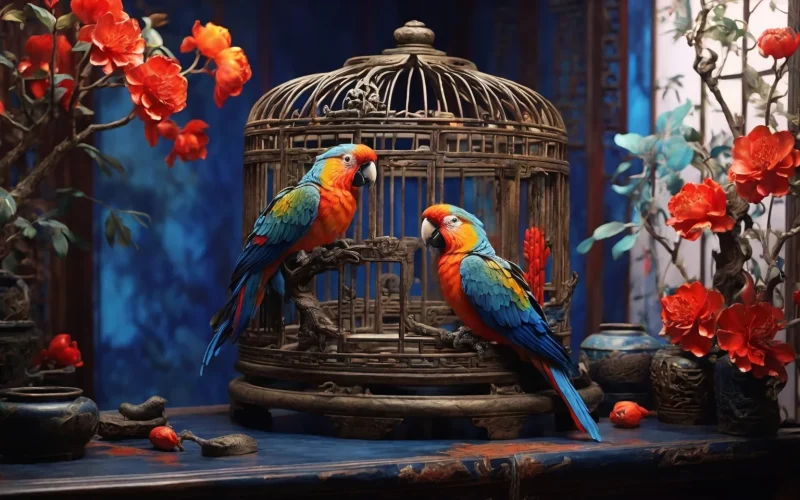
From Annam, afar, they presented a scarlet parrot;
Its hue rivals peach blooms, its speech mimics man.
Yet for all its patterned wit and cleverness —
In cage and bars, what year shall it win freedom?
Original Poem
「红鹦鹉」
白居易
安南远进红鹦鹉,色似桃花语似人。
文章辩慧皆如此,笼槛何年出得身。
Interpretation
This poem was composed during the Yuanhe reign period of Emperor Xianzong, though the precise year is uncertain. Its critical sharpness and satirical spirit, however, align perfectly with the period when Bai Juyi served as Reminder and later as Hanlin Academician (808-815 AD), a time of prolific output in his "satirical poetry." In this role, the poet took as his mission "singing only of the people's sufferings, hoping the Son of Heaven might know," often using objects as allegories for blunt remonstrance. The red parrot in this poem, a tribute gift from Annan (present-day northern Vietnam), is not merely an exotic bird. It becomes a precise lens through which the poet examines imperial politics and the fate of talented individuals. While praising the creature's extraordinary beauty and skill, the poem directly points to the tragic core of its lost freedom, accomplishing a sharp turn from "celebrating an object" to "lancing the ills of the world."
First Couplet: “安南远进红鹦鹉,色似桃花语似人。”
Ān nán yuǎn jìn hóng yīngwǔ, sè sì táohuā yǔ sì rén.
From Annan, far away, a tribute parrot, crimson-red, they bring; / Its color rivals peach blossoms, its speech can mimic a man's uttering.
The opening lines, with plain narration, establish the bird's political identity—it is a "tribute" from afar. Hailing from the empire's southern frontier, it symbolizes the far-reaching might and virtue that draw all states to court; its primary value is political. "Its color rivals peach blossoms" describes its external beauty, comparing it to the most gorgeous flower of spring, dazzling in the extreme. "Its speech can mimic a man's" describes its internal marvel—crossing species boundaries to imitate human speech. These two traits set it apart from common fowl, making it a rare treasure. Yet, this very "peach-blossom" color and "human-like" speech are the precise reasons for its captivity and display. Praise here already contains a latent scrutiny, foreshadowing the reversal to come.
Second Couplet: “文章辩慧皆如此,笼槛何年出得身。”
Wénzhāng biànhuì jiē rúcǐ, lóng jiàn hé nián chū dé shēn.
Those gifted with fine patterns, quick wit, and eloquence—their case is just the same; / Trapped behind cage bars, in what year will they escape, and freedom reclaim?
This couplet is the soul of the poem. It shifts from the object to the person, from the phenomenon to the essence, posing a question that rings out with startling force. The four words "fine patterns, quick wit, and eloquence" are the pivotal, double-edged点睛之笔. On the surface, they continue praising the parrot: the patterning of its feathers resembles "fine patterns" ("patterns" and "literary composition" share the same word, wenzhang, in classical Chinese), and its clever mimicry displays "wit and eloquence." But the deeper aim is to use the parrot as a metaphor for the empire's talented scholars—is not their elegant literary composition and intelligent discourse just like the parrot's "color" and "speech"? The three words "their case is just the same" carry immense weight, elevating an individual case to a universal rule: whether parrot or talented scholar, once their "fine patterns" and "eloquence" are noticed, summoned, and co-opted by power, the outcome is often confinement within an invisible "cage." This "cage" might be the strife of officialdom, the binds of the system, or the fate of becoming a domesticated "pet" for display, losing independent spirit and freedom of action. The rhetorical question, "in what year will they escape?" is both a sigh of despair and contains a fervent desire for changed fortunes, serving as a profound warning to the rulers.
Holistic Appreciation
This heptasyllabic quatrain is a model of allegorical poetry (fengyu shi) in Bai Juyi's oeuvre, embodying his clear creative aim of "each recitation lamenting one specific ill." The poem's structure follows a clear progression of "narrate—praise—reverse—satirize." The first two lines narrate the parrot's origin and praise its uniqueness, serving as preparation. The final two lines execute a sudden reversal, turning praise into lament, shifting from object to person, and directly satirizing contemporary ills. The poet cleverly exploits the parrot's dual nature as both "tribute" and "plaything." The bird's "color" and "speech"—the very traits for which humans value it—correspond directly to the "literary talent" and "rhetorical skill" upon which scholars depend for advancement. Thus, the poem sharply reveals the cruel reality that within the power structure, talent becomes the capital for which one is kept and confined, not the wings for realizing one's aspirations. The poem's language is plain as speech, yet its conception is profound and austere. Through stark contrast and precise metaphor, it accomplishes a deep exposure and critique of the societal predicament of talented individuals.
Artistic Merits
- The Skillful Use of Punning Metaphor: The phrase "fine patterns, quick wit, and eloquence" is the poem's linchpin. Superficially describing the bird, it actually describes people. The parrot's "fine patterns" (feather markings) and the literati's "fine patterns" (literary compositions); the parrot's "wit and eloquence" (mimicry) and the literati's "wit and eloquence" (discourse and thought)—form a marvelous, punning correspondence. The fusion of vehicle and tenor is seamless, allowing the寓意 to flow forth naturally.
- Profound Meaning Revealed Through Contrast: The extreme beauty of "color rivals peach blossoms… speech can mimic a man's" stands in powerful contrast with the extreme lack of freedom in "trapped behind cage bars… will they escape." The more its preciousness and charm are emphasized, the more its pitiable situation is highlighted; the more outstanding the talent, the more the weight of its bondage is thrown into relief. This contrast greatly amplifies the poem's critical tension.
- Elevation from the Particular to the Universal: From a single, specific tribute parrot, the poet swiftly leaps to the universal phenomenon of "their case is just the same." This expands the scope of critique from the folly of treasuring mere playthings to the flaws of the entire system for selecting and employing talent, giving the poem broad social relevance and historical penetrating power.
- A Concluding Question that Resonates with Force: Ending with the unanswered question, "in what year will they escape?" leaves the heavy thinking to the reader (especially those in power). This open-ended conclusion possesses more force than direct criticism and is more thought-provoking. It embodies the classic technique of satirical poetry: "meaning lies beyond the words," "hoping the ruler might hear."
Insights
This work reveals a timeless dilemma: When an individual's exceptional talent (a color rivaling peach blossoms, speech mimicking man's) is recognized and absorbed by a system or authority, does it gain a larger stage, or is it tamed into an ornament or a tool, thereby losing its original freedom and wildness? Using the parrot's plight, Bai Juyi is, in truth, probing the contradiction between the intellectual's independence and their instrumentality.
The poem's insight remains profound today. In any era, the question of how to prevent talent from being trapped in a "cage," how to create an environment where "fine patterns and eloquence" can grow freely and truly serve society rather than merely please those in power, is a fundamental issue related to a society's vitality and civilizational progress. It reminds us that truly respecting talent lies not only in appreciating and utilizing its "color" and "speech," but in granting it the right and possibility to break free from the "cage" and soar in a vaster sky. This is a challenge for institutions and a matter of conscious choice for all, whether inside or outside the "cage."
About the Poet
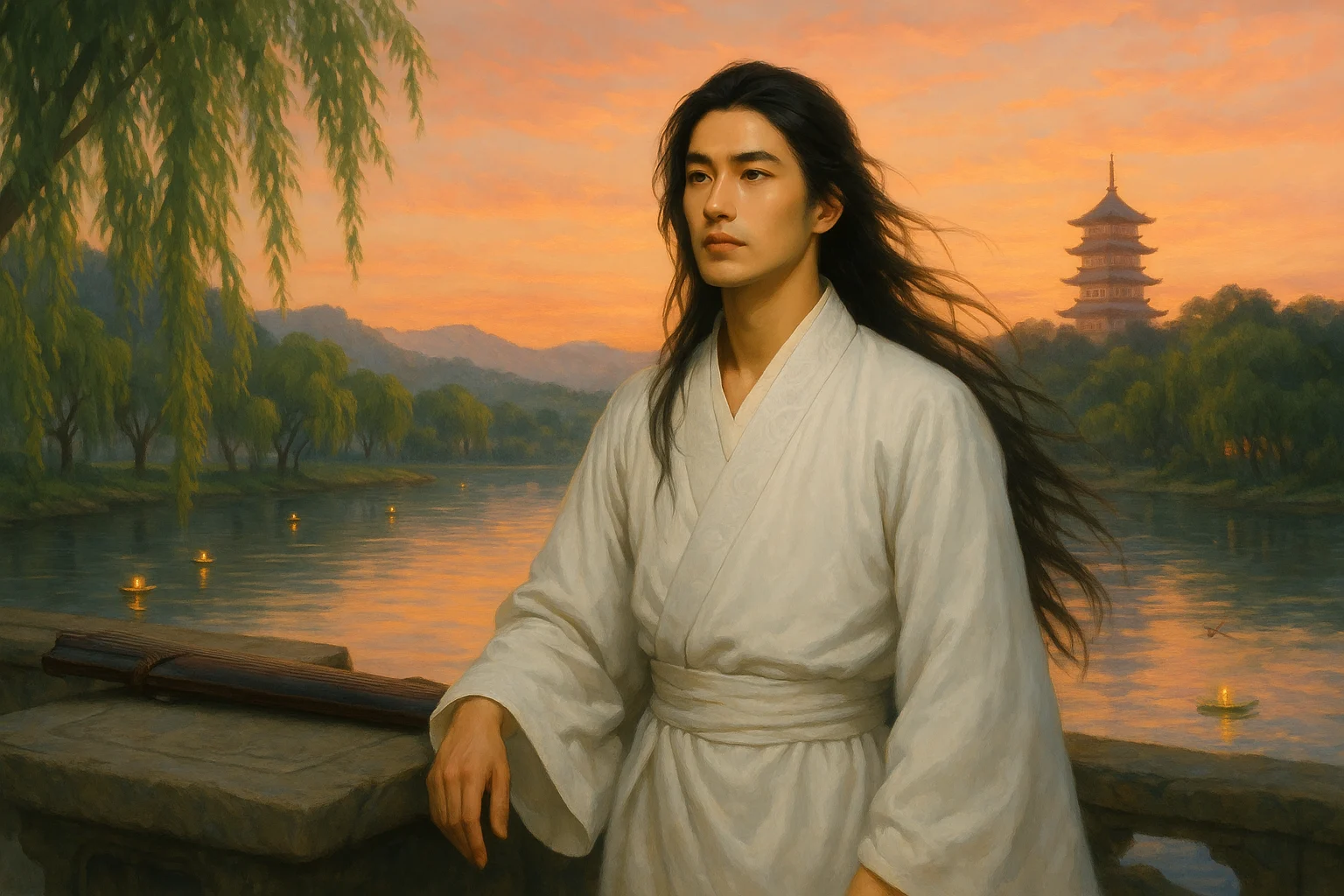
Bai Juyi (白居易), 772 - 846 AD, was originally from Taiyuan, then moved to Weinan in Shaanxi. Bai Juyi was the most prolific poet of the Tang Dynasty, with poems in the categories of satirical oracles, idleness, sentimentality, and miscellaneous rhythms, and the most influential poet after Li Bai Du Fu.