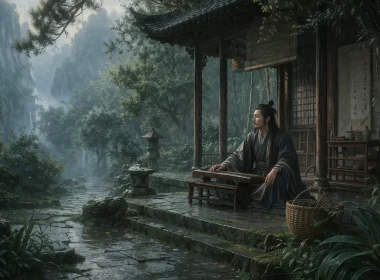
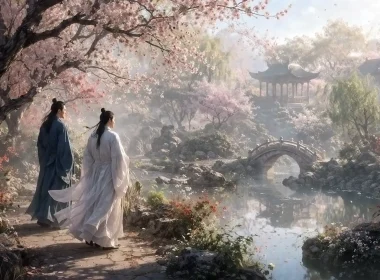

My cot’s secluded where the limpid river winds;
My wicket gate is near the ancient roadway.
The town’s screened by overgrown grass of all kinds;
In lonely place I am slack in my array.

The branches of each elm look frail and slight;
Each loquat tree’s in fragrant flower.
Cormorants stand in western sunset bright,
Drying wings on weir from hour to hour.
Original Poem
「田舍」
杜甫
田舍清江曲,柴门古道旁。
草深迷市井,地僻懒衣裳。
榉柳枝枝弱,枇杷树树香。
鸬鹚西日照,晒翅满鱼梁。
Interpretation
This poem was composed in 761 CE, the second year of the Shangyuan era under Emperor Suzong. Having endured years of displacement during the An Lushan Rebellion, Du Fu had finally found a temporary haven at his thatched cottage by the Huanhua Stream in Chengdu. Facing a shattered nation and a difficult livelihood, the scenery of this riverside village became a sanctuary where he could heal his wounds and settle his body and spirit. The poem depicts not only the landscape surrounding his cottage but also the poet’s nearly reverent gaze upon and record of ordinary life in the aftermath of catastrophe.
First Couplet: “田舍清江曲,柴门古道旁。”
Tián shè qīng jiāng qū, chái mén gǔ dào páng.
The cottage where the clear stream makes a bend; / The wicket gate that by the ancient way finds its end.
The opening unfolds like a slowly unrolling scroll. "Where the clear stream makes a bend" outlines the secluded serenity of the winding waters; "by the ancient way" suggests the historical remoteness of the place, far from worldly bustle. The "wicket gate" is not merely a physical object but a spiritual symbol of the poet’s chosen life of simple, rustic toil. Though no person is mentioned, a human presence is felt within the scene; though no emotion is stated, a sense of peaceful contentment already permeates every element of the landscape.
Second Couplet: “草深迷市井,地僻懒衣裳。”
Cǎo shēn mí shìjǐng, dì pì lǎn yīshang.
The grass grows tall, the path to town is lost to sight; / Remote, I grow less careful of my dress, this place so quiet.
The word "lost" is wonderfully apt. It describes the overgrown path obscured by plants but also implies the poet’s conscious separation from the noise and strife of his past. "Grow less careful of my dress" is the poem’s stroke of genius. It is not negligence but a sense of ease, the unwinding of body and mind from social conventions—a signal that the spirit can finally breathe. This "less careful" attitude represents a redefinition of "normal life" after the chaos of war and displacement.
Third Couplet: “榉柳枝枝弱,枇杷树树香。”
Jǔ liǔ zhī zhī ruò, pípá shù shù xiāng.
The zelkova willows, tree on tree, seem frail; / The loquat trees with scent of fruit regale.
The perspective shifts from the general to a keen, micro-focused observation. The reduplicated "tree on tree" captures the delicate, drooping grace of the willow branches, seemingly reflecting the poet’s own gentle, unguarded state of mind. "With scent of fruit" conveys a sense of abundant fruition, nature’s testament to a life of stability. The poet chooses not to describe flowers or grand vistas, but fruit, tenderness, and fragrance—a profound recognition of the beauty inherent in the ordinary.
Fourth Couplet: “鸬鹚西日照,晒翅满鱼梁。”
Lúcí xīrì zhào, shài chì mǎn yúliáng.
Cormorants bask in the light of the setting sun; / Their wings spread out to dry, the fish-weir’s every section.
The poem concludes with a dynamic, everyday scene. The detail of "wings spread out to dry" is rich with lively charm. The relaxed posture of the cormorants is precisely a projection of the poet’s inner state—like these waterbirds, he has endured the storms of wandering and finally, in this moment, attained a peaceful dusk where he too can "spread [his] wings." The word "every" describes the number of birds but also暗喻 the fullness of peace that now fills the poet’s heart.
Holistic Appreciation
This poem resembles an ink-wash sketch—sparse in brushwork yet deep in resonance—that fully presents the spiritual world of Du Fu during his cottage years. Centered on the cottage, the gaze moves from far to near, from outer to inner, finally focusing on the定格 of a moment of peace in the "wings spread out to dry." Not a single word directly expresses emotion, yet every scene is tinged with the poet’s own colors.
Its moving quality lies in the "abundance found within wilderness." The location is remote, the plants grow wild, life is simple, even tinged with a sense of neglect. Yet, it is precisely in this seemingly forgotten corner that the poet perceives the willow’s tenderness, the loquat’s fragrance, and the cormorant’s leisure, tasting from them the most fundamental flavor of life. This is an attitude toward life that is recovered after loss, carefully gathered together after breaking.
Artistic Merits
- Profound Meaning in Plain Description, State of Mind Revealed in Detail
The entire poem employs a plain descriptive technique, its language simple as speech. Lines like "The grass grows tall, the path to town is lost to sight; / Remote, I grow less careful of my dress" seem like plain statement, yet words like "lost" and "less careful" conceal subtle insight, accurately merging the seclusion of the environment with the unfettered state of mind. This achieves the artistic effect of "revealing the person through the event, revealing feeling through the scene." - The Rhythm and Imagery of Reduplication
The line "The zelkova willows, tree on tree, seem frail; / The loquat trees with scent of fruit regale" uses two sets of reduplicated words. "Tree on tree" intensifies the visual impression of the willows’ delicate density; "with scent of fruit" emphasizes the spatial pervasiveness of the fragrance. This not only gives the lines a flowing, rhythmic cadence but also constructs a detailed, rich, almost tangible panorama of pastoral life. - Depicting Settlement Through Common Scenes, Transforming Motion into Stillness
The final couplet, "Cormorants bask in the light of the setting sun; / Their wings spread out to dry, the fish-weir’s every section," captures the daily motion of cormorants drying their wings at dusk. Placed within the tranquil light of the "setting sun," this minor action becomes a symbol of stillness. By fixing a moment of peace within a dynamic detail, the poet objectifies his own state of unfurling after long wandering into this vivid, leisurely picture. - The Temporal-Spatial and Lived-in Quality of Juxtaposed Imagery
The juxtaposition of images like "clear stream" and "ancient way," "wicket gate" and "cottage" sketches the contours of a reclusive life in space, while blending nature’s eternity with human simplicity in time. This juxtaposition is unforced, yet it naturally creates an atmosphere of stability—far from the dusty world, rooted in an ancient rhythm of life—granting the simple pastoral scene a profound temporal and spatial depth.
Insights
This work reveals a precious capacity in Du Fu: amidst a tumultuous, fractured age, to carve out a spiritual garden for himself. He was not unaware of the world’s suffering, but within his limited means, he firmly grasped the specific, minute stability before him—a wicket gate, a few loquat trees, a weir full of returning birds—and from them affirmed the resilience of existence.
This poem reminds us: true peace often comes not from a perfectly serene environment, but from a heart that, even after weathering storms, can still regard the world with attentive care and tenderness. It teaches us how, in times of displacement and hardship, to find our own "fish-weir" like the poet, and in the setting sun, to calmly "spread our wings," gathering the warmth and strength needed to journey on.
About the poet

Du Fu (杜甫), 712 - 770 AD, was a great poet of the Tang Dynasty, known as the "Sage of Poetry". Born into a declining bureaucratic family, Du Fu had a rough life, and his turbulent and dislocated life made him keenly aware of the plight of the masses. Therefore, his poems were always closely related to the current affairs, reflecting the social life of that era in a more comprehensive way, with profound thoughts and a broad realm. In his poetic art, he was able to combine many styles, forming a unique style of "profound and thick", and becoming a great realist poet in the history of China.