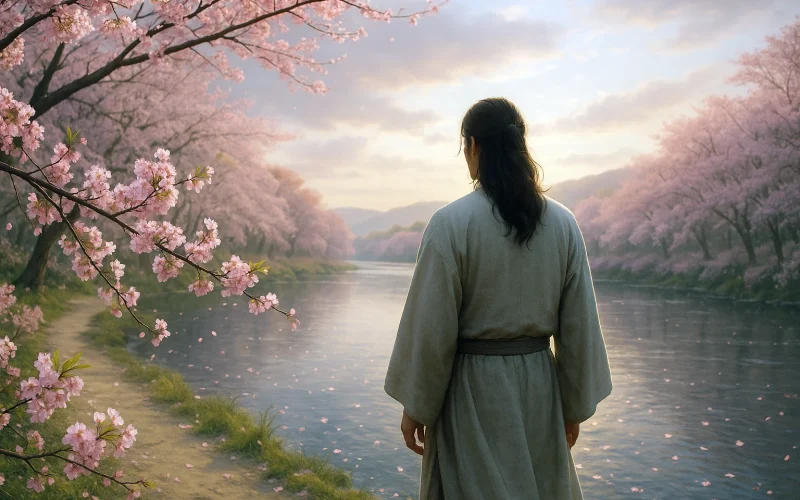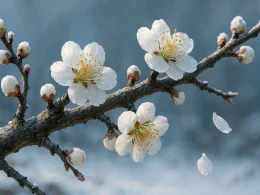

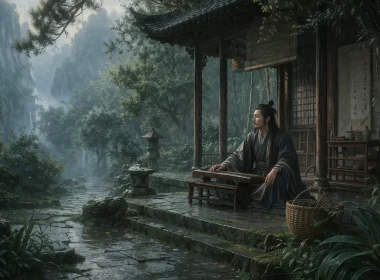
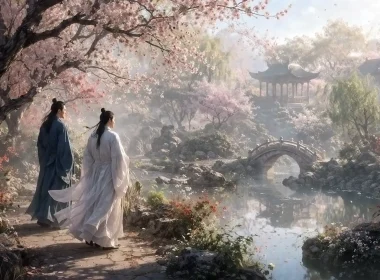
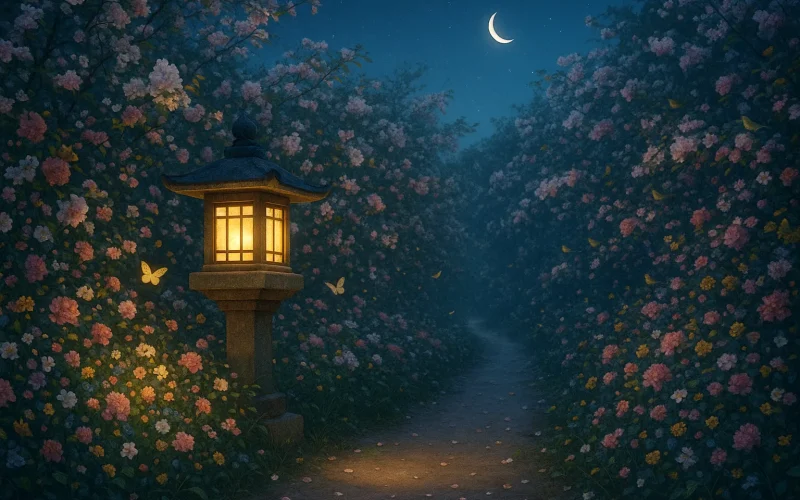
At the fourth Huang’s wife’s house, flowers overflow the shore;
Thousands of branches bend with blossoms in their full blow.
Seeing butterflies in flight, I linger more and more;
I’m glad to hear among sweet flowers orioles sing hello.
Original Poem
「江畔独步寻花 · 其六」
杜甫
黄四娘家花满蹊,千朵万朵压枝低。
留连戏蝶时时舞,自在娇莺恰恰啼。
Interpretation
This work is the sixth poem in the series Along the River for Flowers Alone, likely composed in the spring of 762 CE, the first year of the Baoying era under Emperor Daizong, while Du Fu was residing in his thatched cottage by the Huanhua Stream in Chengdu. Having endured a long period of warfare and displacement, the poet was finally enjoying a rare spell of stability. This poem records the sights and feelings that stirred him while strolling along the flower-lined path near the home of a neighbor, Lady Huang the Fourth. It functions like a vivid snapshot of spring's minute world, employing imagery of near-sensory saturation to crystallize a moment of pure, exuberant joy within Du Fu's life of hardship, revealing a brilliant, untroubled instant rarely seen in his work.
First Couplet: “黄四娘家花满蹊,千朵万朵压枝低。”
Huáng sì niáng jiā huā mǎn xī, qiān duǒ wàn duǒ yā zhī dī.
At Lady Huang the Fourth's, the path with blooms is overflowed; / A thousand, ten thousand blossoms bow the branches with their load.
The opening immediately immerses the reader in the scene. The mention of the neighbor, "Lady Huang the Fourth," instantly roots the poem in the familiar soil of daily life, filling it with a warm, earthly intimacy. The phrase "the path with blooms is overflowed" captures the path's state of being utterly inundated, nearly impassable with flowers. The following line, "A thousand, ten thousand blossoms bow the branches with their load," uses unadorned repetition and hyperbolic number to render the concept of "overflowed" concrete and extreme. The image of blossoms "bow[ing] the branches" is a powerful visual arrest, lending the floral profusion a tangible sense of weight and the visual impact of life brimming to the point of excess. Here, the spectacle of the blossoms reaches a sensory peak.
Second Couplet: “留连戏蝶时时舞,自在娇莺恰恰啼。”
Liúlián xì dié shíshí wǔ, zìzài jiāo yīng qiàqià tí.
Lingering, frolicking butterflies in ceaseless dance are seen; / At ease, the lovely orioles pipe forth a note timely and keen.
The focus shifts from the overwhelming, static abundance of flowers to the delicate, vibrant life of spring. "Lingering, frolicking butterflies in ceaseless dance" describes constant visual motion, their "lingering" suggesting an intoxication with the blooms, their reluctance to leave, thereby indirectly attesting to the flowers' allure. "At ease, the lovely orioles pipe forth a note timely and keen" introduces auditory delight. The phrase "a note timely and keen" is the poem's climactic point. "Timely" (恰恰) is onomatopoeic, mimicking the oriole's bright, melodious call, while also conveying a sense of perfect timing—as if this delightful song were uttered precisely for the poet in this very moment. The butterflies' "dance" and the orioles' "note"—one a silent spectacle, the other an audible clarity—together weave a vibrant symphony of spring that engages both sight and sound.
Holistic Appreciation
This quatrain stands as one of the most beloved and immediately affecting poems in Du Fu's corpus. Its power lies in "presenting a joy in life of perfect purity, through imagery of remarkable intensity and density." The poem comprises a mere twenty-eight characters, yet it incorporates a proper name (Lady Huang the Fourth), a path, masses of flowers, branches, butterflies, and orioles. Through precise, active verbs—"overflowed," "bow… with their load," "dance," "pipe forth"—it weaves these elements into a tightly-knit whole, creating a sense of lavish, almost dizzying abundance and delight.
Its structure is simple and potent: the first couplet renders the extreme "profusion" of the flowers (a static density), the second captures the extreme "animation" of spring (a dynamic vitality). This "animation," however, is not clamor but the vibrant commotion of life freely unfolding in harmony. The poet expresses no emotion directly, yet his sense of wonder and his state of rapture are wholly infused in the exclamation of "a thousand, ten thousand," the fixed gaze upon the "lingering butterflies," and the attentive ear turned to the "oriole's note." This is an aesthetic experience of total absorption, where observer and scene merge. It represents a great soul, amidst a turbulent age, embracing and celebrating peace, tranquility, and nature's beauty with profound tenderness.
Artistic Merits
- The Seamless Blending of the Ordinary and the Poetic: Introducing the neighbor "Lady Huang the Fourth" grounds the poem firmly in concrete, daily life, while through artistic distillation, a common path is elevated into a sanctuary of beauty. This achieves a perfect unity of the mundane and the sublime, the real and the transcendent.
- The Artful Use of Reduplication and Colloquial Diction: Phrases like "a thousand, ten thousand," "ceaseless," and "timely" possess the lively immediacy of spoken language. Through repetition, they amplify the imagery's density and the emotion's intensity, creating a bright, resonant rhythm rich in musicality.
- Indirect Suggestion and Synesthetic Layering: The flowers' fragrance is implied not directly, but through the "lingering butterflies"; the poet's inner state is reflected not explicitly, but in the "at ease" quality of the orioles. Furthermore, "bow the branches with their load" translates a visual impression into a tactile sense of weight; "a note… keen" transforms an auditory sensation into an emotional perception, thereby greatly enriching the poem's sensuous depth.
- The Perfectly Timed, Eternally Resonant Conclusion: The line "At ease, the lovely orioles pipe forth a note timely and keen" captures the most delightful sound at the most felicitous moment ("timely"), freezing flowing time into a moment of eternal poetry. The poem concludes within the lingering resonance of that birdsong, inviting endless reflection.
Insights
This work offers a core insight concerning "how to discover, and lose oneself in, consummate beauty within the fabric of the ordinary and everyday." Du Fu did not seek out famous landscapes; merely on a neighbor's garden path, he encountered spring's lavish feast. He shows us that beauty often resides not in the distant, but lies hidden along the "overflowed" paths of our daily rounds; that happiness consists not in how much we possess, but in whether we possess a heart as sensitive as his—one that can marvel at "blossoms bow[ing] the branches," pause for "butterflies in ceaseless dance," and listen intently for the "oriole's… timely note."
For our hurried, distracted modern existence, this poem is a bracing tonic. It invites us, like Du Fu, to occasionally take a "solitary stroll," to quiet our thoughts, open all our senses, and truly behold those "blossoms bow[ing] the branches," to truly hear those orioles and their "timely note." Authentic abundance and peace may spring precisely from this wholehearted immersion in, and sincere love for, the present moment and the concrete life immediately before us. This brief lyric safeguards a poetic capacity—essential in any age—for intimate, skin-close contact with life itself.
About the poet

Du Fu (杜甫), 712 - 770 AD, was a great poet of the Tang Dynasty, known as the "Sage of Poetry". Born into a declining bureaucratic family, Du Fu had a rough life, and his turbulent and dislocated life made him keenly aware of the plight of the masses. Therefore, his poems were always closely related to the current affairs, reflecting the social life of that era in a more comprehensive way, with profound thoughts and a broad realm. In his poetic art, he was able to combine many styles, forming a unique style of "profound and thick", and becoming a great realist poet in the history of China.