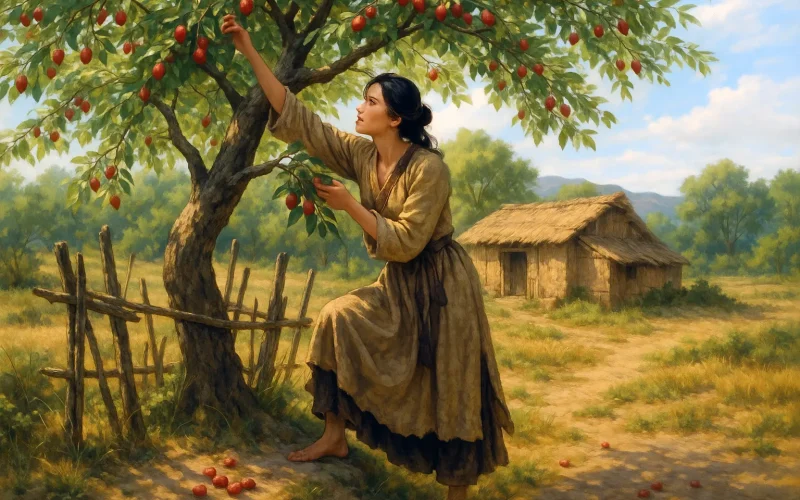






Beside the city gate my pavilion stands;
It commands a distant view o'er lonely lands.
The river's brimming water kisses the shores green;
The shady trees are late and laden with flowers seen.

The rain invites fish to bob out of the stream;
The breeze coaxes swallows to slant o'er it to skim.
The town is packed with hundred thousand houses fine;
Here only two or three are seen to shade the shrine.
Original Poem
「水槛潜心 · 其一」
杜甫
去郭轩楹敞,无村眺望赊。
澄江平少岸,幽树晚多花。
细雨鱼儿出,微风燕子斜。
城中十万户,此地两三家。
Interpretation
This work was composed in the spring of 761 CE, the second year of the Shangyuan era under Emperor Suzong, while Du Fu was living in his thatched cottage by the Huanhua Stream in Chengdu. Having endured prolonged warfare and displacement, the poet had finally secured a period of relative stability. He repaired the cottage, built a waterside railing, and, though his life remained simple, enjoyed a temporary peace. This poem is a direct lyrical response to the tranquil scenery surrounding his cottage, born from this state of mind. It reveals a brighter, more serene, and lucid facet of Du Fu's poetry—a cherished pastoral idyll within the larger narrative of his hardship-filled life.
First Couplet: “去郭轩楹敞,无村眺望赊。”
Qù guō xuān yíng chǎng, wú cūn tiàowàng shē.
Far from the town, with open eaves and pillars tall; / No village blocks the view—my gaze takes in its all.
The opening lines establish the poem's expansive, airy tone by focusing on the cottage's architecture and location. The phrase "Far from the town" signifies not merely physical distance but a conscious psychological withdrawal from worldly clamor. "With open eaves and pillars tall" describes the dwelling's own spaciousness, subtly reflecting the poet's unburdened state of mind. "No village blocks the view" and "my gaze takes in its all" complement each other, depicting an environment both secluded and serene, while simultaneously presenting a vast, unobstructed panorama that sets the spatial stage for the scenery to follow.
Second Couplet: “澄江平少岸,幽树晚多花。”
Chéng jiāng píng shǎo àn, yōu shù wǎn duō huā.
The clear stream's waters full, its banks are scarcely seen; / In twilight's hush, the shaded trees with blooms are keen.
This couplet shifts from the general setting to specific natural features: the river and the trees—one conveying openness, the other depth. "The clear stream's waters full, its banks are scarcely seen" captures the classic late-spring scene of a brimming river. The words "banks are scarcely seen" not only describe the ample water but cleverly imply the poet's wide field of vision and expansive mood. "In twilight's hush, the shaded trees with blooms are keen" seizes the particular beauty of trees appearing denser and their blossoms more pronounced in the evening light. The word "keen" (多) reveals the poet's attentive observation of nature's vitality and his sincere delight in it.
Third Couplet: “细雨鱼儿出,微风燕子斜。”
Xì yǔ yúr chū, wēi fēng yànzi xié.
Through fine rain, fish rise up, breaking the water's face; / In gentle wind, the swallows fly on sloping grace.
This couplet is the soul of the poem and stands among the most vividly descriptive nature passages in Du Fu's work. With a naturalist's precision and a poet's sensitivity, he captures the quintessential movement of two creatures under specific conditions: in "fine rain," fish surface ("rise up"); in a "gentle wind," swallows tilt in flight ("on sloping grace"). The verbs "rise up" and "on sloping grace" (出 and 斜), while seemingly simple, are distilled expressions born of a profound understanding of natural behavior, achieving an artistic effect where the scene feels present and alive. This is not mere description; it is a portrait of the poet's mind in deep resonance with natural life, utterly settled and at peace.
Fourth Couplet: “城中十万户,此地两三家。”
Chéng zhōng shí wàn hù, cǐ dì liǎng sān jiā.
The city holds a hundred thousand homes in its sprawl; / Here, but two or three cottages compose this all.
The conclusion employs a stark numerical contrast to bring the poetic reflection from nature back to human society, achieving a thematic elevation. "The city holds a hundred thousand homes" symbolizes worldly bustle and human entanglement; "Here, but two or three cottages" represents the poet's chosen lifestyle—one of simplicity, quiet, and closeness to nature. This contrast does not disparage the city but highlights the poet's consciously affirmed values: after experiencing the turbulence of the "city," the peace of "Here" constitutes the true haven for his spirit. The language is understated yet the meaning far-reaching, filled with a sense of contentment and calm born of deliberate choice.
Holistic Appreciation
This five-character regulated verse is a gem among Du Fu's pastoral poems, presenting a Du Fu who is lucid and warm—distinct from the poet of "deep poignancy and powerful control." The poem's structure is clear, with the perspective shifting seamlessly: from the dwelling's surroundings (first couplet) → to distant natural vistas (second couplet) → to nearby living creatures (third couplet) → to a reflective juxtaposition of values (fourth couplet). The viewpoint moves from the large to the small, then from the small back to the large, achieving a harmonious unity between external space and the poet's inner world.
The poem's core charm lies in its perfect fusion of "ultimate tranquility" and "vibrant vitality." The poetic space contains the stillness built by "far from the town," "no village," and "two or three cottages," yet it also overflows with the lively spirit conveyed by "the clear stream," "the shaded trees," "fish rise up," and "swallows fly on sloping grace." This is a tranquility pulsating with life's rhythms, the gaze of loving admiration the poet casts upon the world after finding mental anchorage in nature. Here, Du Fu demonstrates that a great poet can not only chronicle an era's suffering but also give form to the peace of the soul and the beauty of the natural world.
Artistic Merits
- Exquisite, Natural Parallelism: The parallelism in the two central couplets is masterful. "The clear stream" parallels "the shaded trees" (openness vs. depth); "fine rain" parallels "gentle wind" (subtle weather changes); "fish rise up" parallels "swallows fly on sloping grace" (precise capture of movement). The parallelism is not only structurally balanced but also creates harmonious imagery and rhythm in terms of content.
- The Potent Precision of Verbs and Adjectives: Adjectives like "open," "takes in its all," "full," "scarcely seen," "shaded," "keen" accurately outline the state of the scenery. The verbs "rise up" and "on sloping grace" become the poetic "eye" of the entire work, animating stillness and imbuing the scene with a soul, showcasing Du Fu's relentless dedication to perfecting his diction.
- The Profound Significance of Numerical Contrast: The concluding contrast between "a hundred thousand homes" and "two or three cottages" uses the most economical means to reveal the tension between material prosperity and spiritual peace, between crowded society and solitary reflection. It implicitly expresses the poet's life choices and value orientation.
- Deep Feeling within Plain Description: The poem employs almost pure descriptive language, unadorned and free of allusions, merely stating plainly what is before the eyes. Yet, within this plainness and truth resides the poet's deepest affection for and satisfaction with life and nature, achieving the artistic realm where "ostentation falls away to reveal pure authenticity."
Insights
This work demonstrates the wisdom of finding "vitality within stability" and "abundance within simplicity." After enduring hardship, Du Fu's time at the Chengdu cottage was a precious practice of embracing ordinary life and savoring nature's beauty with attentive care. He shows us that peace and happiness of the heart do not necessarily depend on external achievement or grandeur, but can spring from cherishing a place with "open eaves and pillars tall," and from the contemplative gaze fixed upon a subtle spectacle like "fish rise up, breaking the water's face."
For us in a fast-paced modern age, this poem is a gentle remedy. It invites us to occasionally withdraw from the clamor of the "hundred thousand homes" in our own cities, to seek out or create our own "two or three cottages." More importantly, it teaches us, as Du Fu did, to discover and take joy in life's expansive moments and agile beauties, armed with keen perception and deep affection. The true way to "settle the heart" may not lie in distant travels, but in allowing the heart to find its dwelling and its joy in the present moment, within the smallest of details.
About the poet

Du Fu (杜甫), 712 - 770 AD, was a great poet of the Tang Dynasty, known as the "Sage of Poetry". Born into a declining bureaucratic family, Du Fu had a rough life, and his turbulent and dislocated life made him keenly aware of the plight of the masses. Therefore, his poems were always closely related to the current affairs, reflecting the social life of that era in a more comprehensive way, with profound thoughts and a broad realm. In his poetic art, he was able to combine many styles, forming a unique style of "profound and thick", and becoming a great realist poet in the history of China.