
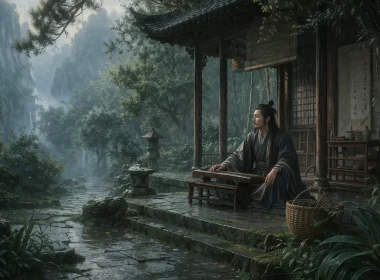
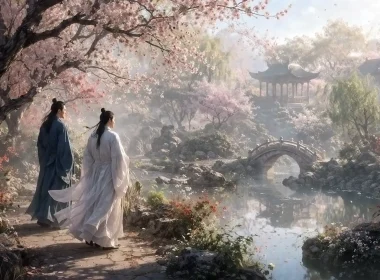
A commoner from Duling, with years my mind grows plain,
To pledge myself as sage like Ji or Xie—how vain!
Yet though my hopes lie shattered, white-haired I remain,
And till the coffin’s lid, this heart shall strive again.
Year after year I grieve for people’s bitter plight,
My sighs like burning embers in the depth of night.
Though laughed at by old friends, my song burns ever bright,
Not that I love not freedom’s boundless, wild delight.
But meeting now a sovereign wise and just,
How could I leave and vanish in the dust?
The court has timber fit to build its frame,
Yet sunflowers ever turn to sun’s bright flame.
The ant seeks but its humble, narrow cave;
Why yearn to roam where mighty oceans wave?
Thus knowing life’s true way, I scorn to beg or bend,
And drift till now—shall I in silence meet my end?
I shame to quit as hermit pure and free,
So drown my thoughts in wine’s dark melody.


When winter strips the earth and winds blast high,
Through glooming skies I journey ‘neath midnight’s sigh.
My belt snaps in the frost, numb fingers strive in vain;
At dawn I pass Mount Li, where royal joys remain.
War-mists of old now choke the freezing air,
Where treacherous paths cling to the cliff’s despair.
There warm steam curls from jade pools, dense and white,
Where guards in polished armor gleam in tight array.
The sovereign and his lords revel through the night,
Their music shakes the rocks till break of day.
The silks bestowed in court, each broidered fold,
Were woven by poor girls who shudder in the cold.
Their men are lashed for tax, their anguish told,
To heap the palace stores with coerced gold.
Our ruler grants these gifts with generous hand,
That state and folk may thrive throughout the land.
If ministers ignore this truth profound,
Are royal gifts but trash on barren ground?
So many crowd the court, yet few are true—
Should not the just in fear their duty view?
I hear the inner palace’s plates of gold
Now grace the homes of nobles, proud and bold.
There fairy-like damsels dance in misty light,
Their gauzy robes like jade in marble bright.
Guests wrapped in sables feel no winter’s sting,
While pipes and strings in piercing harmony sing.
They feast on camel’s hoof in spiced delight,
With frost-picked oranges surpassing sweet.
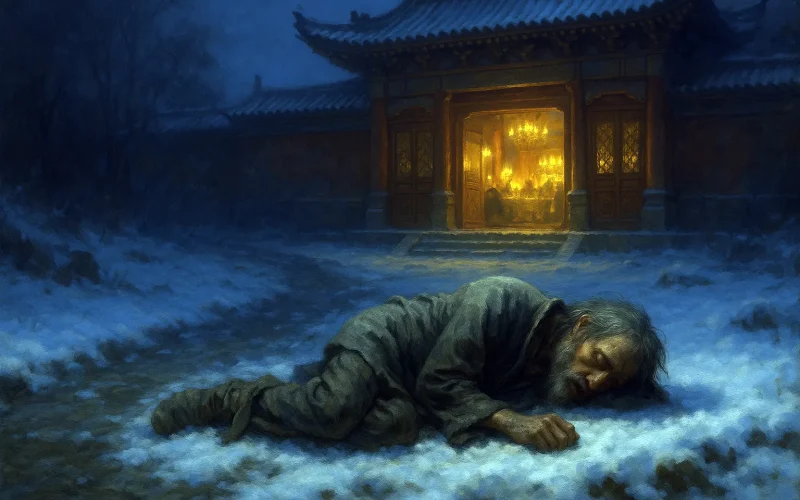
Behind red gates, meat rots and wine turns sour;
On the road, frozen bones mark every hour.
An inch divides such bliss from mortal pain—
This anguish words can scarcely render plain.

Northward I urge my cart to rivers wide,
Where shifting ferries change their course with tide.
Great ice-floes westward crash in roaring might,
As if from Kongtong Mountain taking flight.
They seem to strike the pillars of the sky;
The trembling bridge groans as the waves roar by.
Wayfarers cling together, pale with dread;
The broad stream cannot yet by steps be tread.
My wife and children wait in distant town,
Ten mouths parted by wind and snow’s cold frown.
How long can I leave them in want and fear?
I haste to share their hunger, draw them near.
I enter—wails assail my stricken ear:
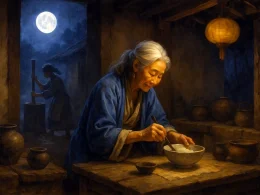
My youngest son has died of hunger here.
Could I but check one sob? The neighbors weep.
As father, shame runs through my heart like knife—
No food to save this tiny, precious life!
Who knew the autumn harvest, lean and brief,
Would bring to poor men such unending grief?
My name’s exempt from tax and conscript’s plight,
Yet thinking on these things, my soul grows white.

The common folk must bear yet darker fate—
I think of those who roam, bereft and late,
And soldiers guarding frontiers, desolate.
My sorrow towers like the Southern Hill,
A flood no hand can stay or ever still.
Original Poem
「自京赴奉先县咏怀五百字」
杜陵有布衣,老大意转拙。许身一何愚,窃比稷与契。居然成濩落,白首甘契阔。盖棺事则已,此志常觊豁。穷年忧黎元,叹息肠内热。取笑同学翁,浩歌弥激烈。非无江海志,潇洒送日月。生逢尧舜君,不忍便永诀。当今廊庙具,构厦岂云缺。葵藿倾太阳,物性固莫夺。
顾惟蝼蚁辈,但自求其穴。胡为慕大鲸,辄拟偃溟渤。以兹悟生理,独耻事干谒。兀兀遂至今,忍为尘埃没。终愧巢与由,未能易其节。沈饮聊自适,放歌颇愁绝。岁暮百草零,疾风高冈裂。天衢阴峥嵘,客子中夜发。霜严衣带断,指直不得结。凌晨过骊山,御榻在嵽嵲。蚩尤塞寒空,蹴蹋崖谷滑。瑶池气郁律,羽林相摩戛。君臣留欢娱,乐动殷樛嶱。赐浴皆长缨,与宴非短褐。彤庭所分帛,本自寒女出。鞭挞其夫家,聚敛贡城阙。
圣人筐篚恩,实欲邦国活。臣如忽至理,君弃此物。多士盈朝廷,仁者宜战栗。况闻内金盘,尽在卫霍室。中堂舞神仙,烟雾散玉质。暖客貂鼠裘,悲管逐清瑟。劝客驼蹄羹,霜橙压香橘。朱门酒肉臭,路有冻死骨。荣枯咫尺异,惆怅难再述。北辕就泾渭,官渡又改辙。群冰从西下,极目高崒兀。疑是崆峒来,恐触天柱折。河梁幸未坼,枝撑声窸窣。行旅相攀援,川广不可越。老妻寄异县,十口隔风雪。谁能久不顾,庶往共饥渴。入门闻号啕,幼子饥已卒。吾宁舍一哀,里巷亦呜咽。所愧为人父,无食致夭折。岂知秋未登,贫窭有仓卒。生常免租税,名不隶征伐。抚迹犹酸辛,平人固骚屑。
默思失业徒,因念远戍卒。忧端齐终南,澒洞不可掇。
杜甫
Interpretation
This immortal, epic masterpiece was composed in the eleventh month of 755 CE, the fourteenth year of the Tianbao era under Emperor Xuanzong. Du Fu had recently been appointed to the minor post of Armory Officer of the Imperial Guards. He was leaving the capital to visit his family, who were residing in Fengxian County (present-day Pucheng, Shaanxi). His journey coincided with the eve of the cataclysmic An Lushan Rebellion. Beneath a surface of extravagant prosperity, the Tang Empire was already riddled with crises, a storm gathering on the horizon. Melding all he witnessed, felt, pondered, and suffered along the way, the poet forged this five-hundred-character magnum opus, achieving a grand narrative and profound dissection of personal ideals, social reality, and the destiny of an age. It is not merely a personal spiritual epic but a precise microcosm of an empire at its zenith beginning its precipitous decline. This poem marks the full maturity of Du Fu's defining "poetic history" style.
Section 1: 杜陵有布衣,老大意转拙。许身一何愚,窃比稷与契。居然成濩落,白首甘契阔。盖棺事则已,此志常觊豁。穷年忧黎元,叹息肠内热。取笑同学翁,浩歌弥激烈。非无江海志,潇洒送日月。生逢尧舜君,不忍便永诀。当今廊庙具,构厦岂云缺。葵藿倾太阳,物性固莫夺。顾惟蝼蚁辈,但自求其穴。胡为慕大鲸,辄拟偃溟渤。以兹悟生理,独耻事干谒。兀兀遂至今,忍为尘埃没。终愧巢与由,未能易其节。沈饮聊自适,放歌颇愁绝。
Dùlíng yǒu bùyī, lǎodà yì zhuǎn zhuō. Xǔ shēn yī hé yú, qiè bǐ Jì yǔ Xiè.
Jūrán chéng huòluò, báishǒu gān qìkuò. Gài guān shì zé yǐ, cǐ zhì cháng jì huō.
Qióng nián yōu líyuán, tànxī cháng nèi rè. Qǔxiào tóngxué wēng, hàogē mí jīliè.
Fēi wú jiānghǎi zhì, xiāosǎ sòng rìyuè. Shēng féng Yáoshùn jūn, bùrěn biàn yǒngjué.
Dāngjīn lángmiào jù, gòu shà qǐ yún quē. Kuíhuò qīng tàiyáng, wùxìng gù mò duó.
Gù wéi lóuyǐ bèi, dàn zì qiú qí xué. Húwéi mù dà jīng, zhé nǐ yǎn míngbó.
Yǐ zī wù shēnglǐ, dú chǐ shì gānyè. Wùwù suì zhìjīn, rěn wéi chén'āi méi.
Zhōng kuì Cháo yǔ Yóu, wèi néng yì qí jié. Shěn yǐn liáo zìshì, fànggē pō chóu jué.
A commoner from Duling, my mind with age but duller grown; / To pledge myself so foolishly, to Ji and Xie, those sages, privately I've known. / A failure, as it turned out, white-haired, content in hardship to remain; / Only the coffin's lid will end it, this hope I still entertain. / Year after year I grieve for the people, sighing, my bowels with heat aglow; / Laughed at by my old schoolmates, my wild songs with fiercer passion grow. / It's not I lack the will for rivers and lakes, to pass my days in carefree ease; / Born in the time of a Sage-King's reign, I cannot bear to take my leave. / The court today has timber enough, to build its halls—could it lack me? / But sunflowers turn toward the sun, a fixed nature none can free. / Consider but the ants and mites, who only seek their holes to keep; / Why should I long to be a mighty whale, to sport within the ocean deep? / From this I grasp the truth of life, and shame alone to fawn and plead; / Toiling away till now, could I endure to vanish like a weed? / In the end, I'm shamed by Chao-fu, Xu-You, my resolve I could not trade; / Drowning in drink to soothe myself, singing aloud, yet sorrow won't fade.
The opening section is itself a highly concentrated "spiritual autobiography." In a tone both self-deprecating and self-assertive, the poet lays bare the central conflict of his life: the vast chasm between his lofty Confucian ideal—"to privately compare himself to Ji and Xie" (legendary sage ministers)—and the harsh reality of being "a failure." He declares, "Year after year I grieve for the people, sighing, my bowels with heat aglow," thereby establishing the ethical foundation for the entire poem, indeed for his life's work: a profound, enduring concern for the common populace. Torn between the desire for a "life on rivers and lakes" (reclusion) and the duty to serve a "Sage-King" (engagement in public life), he chooses the latter. The metaphor "sunflowers turn toward the sun" expresses this loyalty as an inalienable, innate quality. Contrasting himself with the self-serving contentment of "ants and mites" and the grandiose freedom of the "mighty whale," he clings to the integrity of finding it "shameful… to fawn and plead," preferring to "toil away" and risk oblivion rather than compromise his principles. Ultimately, in the painful tension between feeling "ashamed" before the legendary hermits Chao-fu and Xu-You (for failing to renounce the world entirely) and seeking temporary solace in "drowning in drink" and "singing aloud," he completes a solemn, tragic affirmation of his idealistic character. This establishes the emotionally complex, lofty, and indignant tone from which he will observe the social reality that follows.
Section 2: 岁暮百草零,疾风高冈裂。天衢阴峥嵘,客子中夜发。霜严衣带断,指直不得结。凌晨过骊山,御榻在嵽嵲。蚩尤塞寒空,蹴蹋崖谷滑。瑶池气郁律,羽林相摩戛。君臣留欢娱,乐动殷樛嶱。赐浴皆长缨,与宴非短褐。彤庭所分帛,本自寒女出。鞭挞其夫家,聚敛贡城阙。圣人筐篚恩,实欲邦国活。臣如忽至理,君岂弃此物。多士盈朝廷,仁者宜战栗。况闻内金盘,尽在卫霍室。中堂舞神仙,烟雾散玉质。暖客貂鼠裘,悲管逐清瑟。劝客驼蹄羹,霜橙压香橘。朱门酒肉臭,路有冻死骨。荣枯咫尺异,惆怅难再述。
Suì mù bǎi cǎo líng, jí fēng gāo gāng liè. Tiān qú yīn zhēngróng, kèzǐ zhōng yè fā.
Shuāng yán yīdài duàn, zhǐ zhí bùdé jié. Língchén guò Líshān, yù tà zài dìniè.
Chīyóu sāi hán kōng, cùtà yá gǔ huá. Yáochí qì yùlǜ, yǔlín xiāng mó jiá.
Jūnchén liú huānyú, yuè dòng yīn jiū kě. Cì yù jiē cháng yīng, yǔ yàn fēi duǎnhè.
Tóng tíng suǒ fēn bó, běn zì hán nǚ chū. Biāntà qí fūjiā, jùliǎn gòng chéngquè.
Shèngrén kuāng fěi ēn, shí yù bāngguó huó. Chén rú hū zhìlǐ, jūn qǐ qì cǐ wù.
Duō shì yíng cháotíng, rénzhě yí zhànlì. Kuàng wén nèi jīn pán, jǐn zài Wèi Huò shì.
Zhōngtáng wǔ shénxiān, yānwù sàn yù zhì. Nuǎn kè diāoshǔ qiú, bēi guǎn zhú qīng sè.
Quàn kè tuótí gēng, shuāng chéng yā xiāng jú. Zhū mén jiǔròu chòu, lù yǒu dòng sǐ gǔ.
Róngkū zhǐchǐ yì, chóuchàng nán zài shù.
Year's end, all plants lie dead; fierce wind would cleave the ridge. / The sky-road darkly towers; the traveler starts at midnight from his ledge. / Frost bites, my belt-string snaps; fingers too stiff to tie. / At dawn I pass by Li Mountain, where the royal couches high. / A Chiyou-fog chokes the cold sky; I tread the slippery, stony ground. / At Jade-Flower Palace, steam hangs thick; Imperial Guards clash arms around. / Lords and sovereign linger in joy; music resounds, makes gorge and hill resound. / Those granted baths all wear long tassels; at the feast, no coarse cloth is found. / The silks bestowed in the scarlet court from poor girls' hands were wrung; / Their menfolk flogged, goods gathered up, to grace the palace they were flung. / The Sage, with baskets, grants his grace, to make the state alive and strong; / If his lords neglect this deepest sense, does the King waste gifts so long? / The court is packed with learned men; the humane should quake with dread. / I've heard besides the palace's gold plates in the houses of the Weys and Hos are spread. / In the central hall, immortals dance, through hazy gauze their jade flesh gleams; / For warming guests, there's sable, marten; sad pipes race with clear zither themes. / They press on guests camel-hoof soup; frost-chilled oranges crowd fragrant tangerines. / By vermilion gates, the stench of meat and wine; on the road, bones of the frozen, a stark scene. / Glory and decay a foot apart; this anguish is too deep to tell, I ween.
The shift from introspection to the physical journey brings an immediate desolation to the imagery. The line "Year's end, all plants lie dead" functions on two levels: as a literal description of the winter season and as a potent metaphor for the withering fate of the empire itself. The poet makes the traveler's hardship viscerally real through acutely observed physical detail: a "belt-string snaps"; "fingers [are] too stiff to tie." This intimate, bodily suffering stands in stark relief to the scene that unfolds upon reaching Li Mountain, site of the Huaqing Palace, the emperor's luxurious retreat.
Here, the poet's focus pivots sharply to depict a world diametrically opposed to that of the cold, weary wayfarer. Inside, the sovereign and his court are immersed in revelry; steamy vapors rise, and music resonates through the valleys. With the incisiveness of a historian, Du Fu constructs a damning series of exposures and contrasts: the absolute social segregation of the privileged and the commoner ("long tassels" versus "coarse cloth"); the true, brutal origins of imperial largesse and the plunder that funds it (the "silks" bestowed in court originate from "poor girls" and are obtained through the "flogging" of their menfolk and ruthless "gathering"); the profound divergence between the ruler's professed, benevolent ideal ("to make the state alive") and the officials' cynical, self-serving reality ("lords neglect this deepest sense"); and the corrupt concentration of state wealth in private hands ("the palace's gold plates" ending up in the mansions of the "Weys and Hos"—the powerful consort clans).
Following this lavish, sensory depiction of the imperial banquet, the poet delivers the ten immortal, epoch-defining words: "By vermilion gates, the stench of meat and wine; on the road, bones of the frozen, a stark scene." This is not merely a stark economic contrast but a shocking, almost biological juxtaposition of two separate existences; it is the raw, bloody truth stripped bare beneath the myth of imperial prosperity. The section concludes with the devastating observation, "Glory and decay a foot apart," merging mere spatial proximity with an unbridgeable chasm of fate. The poet's immense indignation and sorrow are ultimately distilled into a single, resonant sigh of "anguish."
Section 3: 北辕就泾渭,官渡又改辙。群冰从西下,极目高崒兀。疑是崆峒来,恐触天柱折。河梁幸未坼,枝撑声窸窣。行旅相攀援,川广不可越。老妻寄异县,十口隔风雪。谁能久不顾,庶往共饥渴。入门闻号啕,幼子饥已卒。吾宁舍一哀,里巷亦呜咽。所愧为人父,无食致夭折。岂知秋未登,贫窭有仓卒。生常免租税,名不隶征伐。抚迹犹酸辛,平人固骚屑。
Běi yuán jiù Jīng Wèi, guān dù yòu gǎi zhé. Qún bīng cóng xī xià, jímù gāo zú wù.
Yí shì Kōngtóng lái, kǒng chù tiānzhù zhé. Hé liáng xìng wèi chè, zhī chēng shēng xīsū.
Xínglǚ xiāng pānyuán, chuān guǎng bùkě yuè. Lǎo qī jì yì xiàn, shí kǒu gé fēngxuě.
Shuí néng jiǔ bùgù, shù wǎng gòng jīkě. Rùmén wén háotáo, yòu zǐ jī yǐ zú.
Wú níng shě yī āi, lǐxiàng yì wūyè. Suǒ kuì wéi rénfù, wú shí zhì yāozhé.
Qǐzhī qiū wèi dēng, pínjù yǒu cāngcù. Shēng cháng miǎn zūshuì, míng bù lì zhēngfá.
Fǔ jī yóu suānxīn, píngrén gù sāoxiè.
North my cart turns toward Jing and Wei; the official ford has changed its place. / A host of ice flows from the west, towering masses that fill the space. / As if from Kongtong Mountain borne, I fear they'll break the pillars of the sky. / The bridge, thank fortune, holds yet fast, its struts and braces whispering, a sigh. / Travelers help each other climb; the stream's too wide to cross, it seems. / My old wife stays in another town; ten mouths are cut off by wind and snow-streams. / Who could long ignore their plight? I'll go to share their hunger and their thirst. / I enter, hear a wailing sound; my youngest child has died of hunger first. / How could I stifle my own grief? The very lane sobs in despair. / I am ashamed to be a father, with no food, I brought this death to bear. / Who'd guess, before the autumn's yield, the poor know such a sudden blow? / My life's been free of tax and levy, my name's not on conscription's roll, I know. / Tracing my steps, my heart turns sour; the common folk must face yet worse, this hour.
Departing from the charged, symbolic space of Li Mountain, the poet's physical journey and emotional landscape descend into even more treacherous terrain. The river-crossing scene is dense with implication: the fact that the "official ford has changed" speaks to a broader national disarray and the unreliability of public institutions. The massive, surging ice floes evoke a cosmic dread—the fear they might "break the pillars of the sky" serves as a potent metaphor for the empire's fractured foundations, a palpable foreboding of systemic collapse. The collective, precarious effort of "Travelers help[ing] each other climb" poignantly mirrors the fragile, interdependent state of the society itself.
Within this vast, threatening landscape, the poet's anxious thought for his family—"ten mouths are cut off by wind and snow"—stands as the only ember of human warmth. Yet this very thought leads him to the heart of domestic catastrophe: "I enter, hear a wailing sound; my youngest child has died of hunger." The profound grief of this moment is conveyed through the barest, most unadorned narration, a stylistic choice that makes the line devastating in its weight. The poet's ensuing, visceral self-condemnation—"ashamed to be a father"—immediately transforms an abstract social ill (famine) into the most intimate and harrowing of ethical failures.
Then, in a stroke of devastating intellectual and moral clarity, the poet performs a crucial extrapolation. He reasons from his own specific case: as a minor official, he possessed the significant buffers of "tax and levy" exemption and freedom from "conscription." If he, with these privileges, could not avert such a tragedy, what unimaginable desperation must be the daily reality for the "common folk" who lack any such protection? In this moment of stark deduction, the private tragedy of a single household is irrevocably framed by the harsh, glaring light of social inequity. The poem's gaze completes its essential turn, moving from the depths of "personal sorrow" to a conscious, aching contemplation of "the suffering of the multitude."
Section 4: 默思失业徒,因念远戍卒。忧端齐终南,澒洞不可掇。
Mò sī shīyè tú, yīn niàn yuǎn shù zú. Yōu duān qí Zhōngnán, hòngdòng bùkě duō.
In silence, think of those who've lost their land, and then of soldiers on the far-flung strand. / My care, a towering mass, as high as Mount Zhongnan stands; / A vast and shoreless flood no hand can stay or bind within its hands.
At the very climax of personal and familial tragedy, the poet's consciousness resists the inward pull of self-pity and instead executes its most profound and expansive leap. The figures of "those who've lost their land"—peasants dispossessed by war, exploitation, and chaos—and "soldiers on the far-flung strand"—conscripts enduring privation and death on distant, desperate frontiers—are identified as the two primary social groups upon whom the era's misrule and conflict exert their most crushing force. The poet's concern, therefore, expands exponentially, radiating outward from the confines of his own stricken household to encompass the entire, terrible panorama of anguish that constitutes the base of society.
Ultimately, the totality of his observation, direct experience, moral indignation, and boundless compassion coalesces into the two majestic, imagery-saturated lines that conclude the epic: "My care, a towering mass, as high as Mount Zhongnan stands; / A vast and shoreless flood no hand can stay or bind within its hands." Here, personal sorrow and the pervasive crisis of the age are fused into a single, overwhelming entity. Its dimension is expressed through two ultimate natural forms: its vertical, immovable height is that of the great mountain south of the capital; its horizontal, inexorable breadth is that of a primordial, boundless deluge. This "care" (忧) is no longer a passing mood but the very condition of his being—inescapable, uncontainable, and definitive. It represents both the ultimate state of the poet's own capacious spirit and the most profound, enduring spiritual portrait of that perilous, crumbling age itself.
Holistic Appreciation
This five-hundred-character epic is a monument to Du Fu's poetic craft and to the spirit of the Confucian scholar-official. Its structure is grand yet meticulously ordered. Using the physical journey as its narrative spine and the progression of emotion as its vital thread, it weaves a vast tapestry intertwining personal ideals, social reality, and the destiny of an age. The poem follows a rigorous, four-part logical progression: Introspection (Lamenting the Self) → Observation (Lamenting the World) → Homecoming (Lamenting Personal Loss) → Sublimation (Lamenting Universal Sorrow). The emotional tenor shifts from somber, measured self-examination to sharp, impassioned social critique, plummets into the depths of intimate, piercing grief, and finally ascends to a state of vast, boundless, and profound existential concern.
The poem's most fundamental achievement is its perfect synthesis of "poetic history" and "a history of the heart." It contains both epic, definitive summaries of the era's essence, such as "By vermilion gates, the stench of meat and wine; on the road, bones of the frozen," and searingly personal records of experience, like "my youngest child has died of hunger." Du Fu placed his own flesh, blood, and family without reservation into the crucible of his time, allowing personal misfortune to become the clearest possible lens refracting society's darkness. He not only recorded historical phenomena but exposed the underlying logic of power ("flogged" and "gathered") and the systemic nature of suffering endured by "those who've lost their land" and "soldiers." This ability to embed individual fate deeply within historical structures for critical examination grants the poem a profound, timeless insight.
Artistic Merits
- Synthesis of Grand Architecture and Exquisite Detail: The entire poem uses the spatiotemporal journey as its structural framework, achieving both grandeur and rigorous logic. Yet it is also filled with tangible, minute sensory experiences—a "belt-string snaps;" "struts and braces whispering"—that give the epic narrative the palpable reality of flesh, blood, and lived experience.
- The Pinnacle of Contrast as an Artistic Technique: The work is woven through with multiple, intensifying layers of contrast: ideal versus reality; the opulent escapism of Li Mountain versus the bitter hardship of the road; the vermilion gates versus the frozen bones; personal privilege versus common suffering. These are not simple juxtapositions but carefully staged, escalating layers that generate immense, incisive critical power.
- Poetic Fusion of Discursive Thought and Narrative: Passages of reflection, such as on the purpose of the "Sage's… grace," do not appear as abstract moralizing. They arise organically and inevitably from the preceding narrative of "silks bestowed in the scarlet court," creating a seamless blend of reason and deep emotion that vastly enriches the poem's intellectual and philosophical depth.
- Precise Mastery of Emotional Rhythm: The poem's emotional movement unfolds with the powerful, controlled dynamics of a symphony: the measured, somber depths of self-statement; the fierce, rising indignation of social exposure; the devastating, piercing sorrow of personal loss; and finally, the vast, boundless solemnity of the conclusion. The rhythm is masterfully modulated, creating an overwhelming emotional force.
- Highly Condensed Language and Startlingly Original Imagery: From the grand, spatial metaphor of care piling "as high as Mount Zhongnan" to the eerily mythic image of a "Chiyou-fog chok[ing] the cold sky," to the stark, unforgettable visual and olfactory contrast of the "vermilion gates" and the "bones of the frozen," Du Fu's language achieves both supreme concision and fierce originality. This combination forms the unshakable foundation of the poem's enduring power.
Insights
This work has endured through the centuries because it embodies the very exemplar of a great soul: how to sustain the fervor of ideals, the courage of moral conviction, and the expansive breadth of compassion within an imperfect, often cruel world. Du Fu demonstrates that the true worth of an intellectual consists not merely in cherishing the lofty ambition to emulate a “Ji or Xie,” but in transmuting that ambition into the sustained, active commitment to “grieve for the people year after year;” into the unflinching courage to face the reality of “vermilion gates reeking of meat and wine” while “on the road lie bones of the frozen;” and into the magnanimity of heart that, even after enduring the devastating personal tragedy of a child dead from hunger, can still “think of those who have lost their land… and then of soldiers on the far‑flung frontier.”
The poem teaches us that the most profound humanistic concern must spring from a visceral perception of concrete suffering and must finally be oriented toward a critical understanding of unjust structures and an ardent longing for a more righteous order. Du Fu’s “vast and shoreless flood” of care is not passive lament; it is a formidable form of spiritual energy, charged with immense moral responsibility and a latent, potent impulse toward action. In every age, this spirit—which consciously binds personal fate to the suffering of all beings, and which stubbornly, courageously shines the light of reason and conscience into the gathering dark—remains the precious, vital seed from which civilization itself survives, endures, and may yet advance.
About the poet
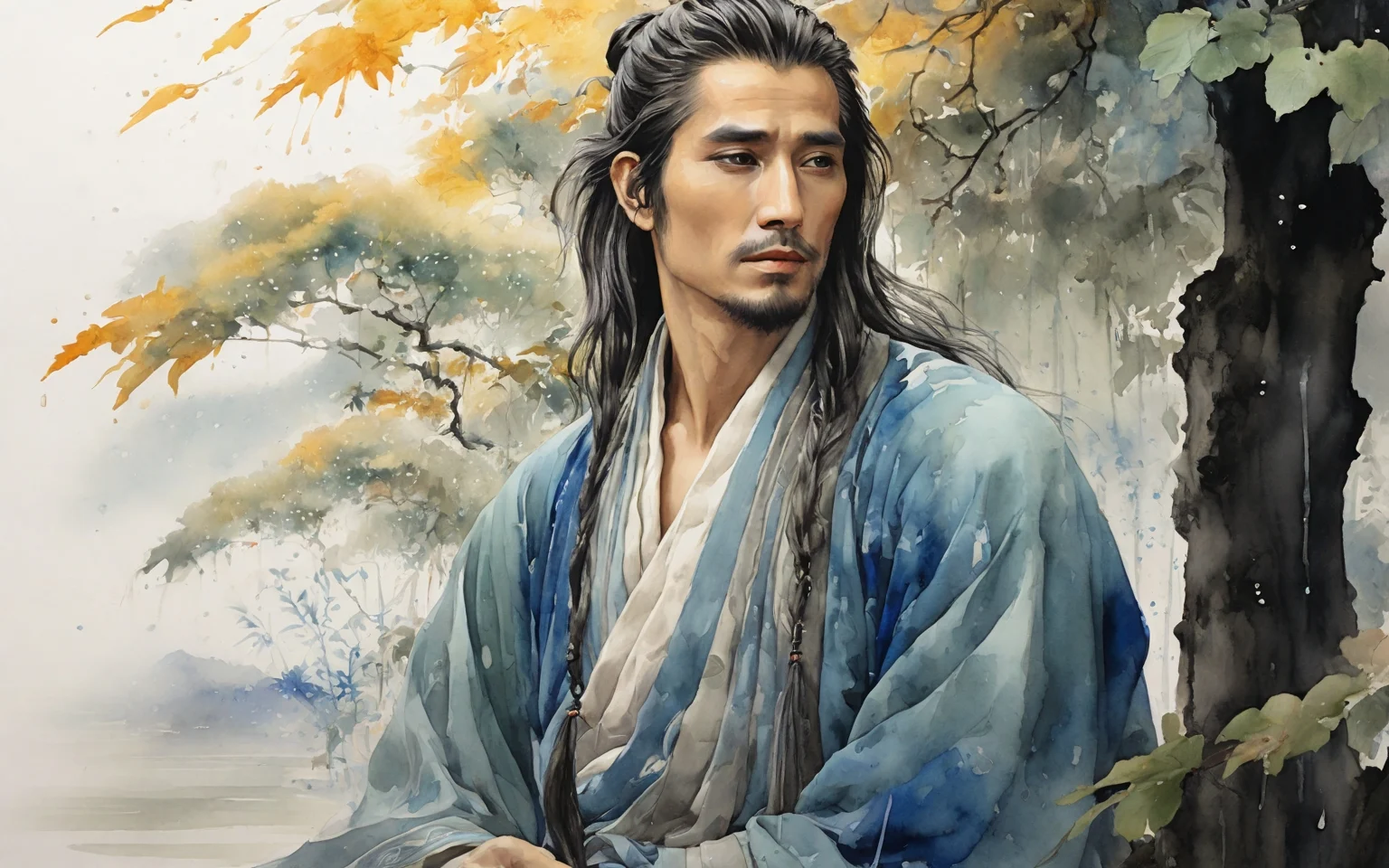
Du Fu (杜甫), 712 - 770 AD, was a great poet of the Tang Dynasty, known as the "Sage of Poetry". Born into a declining bureaucratic family, Du Fu had a rough life, and his turbulent and dislocated life made him keenly aware of the plight of the masses. Therefore, his poems were always closely related to the current affairs, reflecting the social life of that era in a more comprehensive way, with profound thoughts and a broad realm. In his poetic art, he was able to combine many styles, forming a unique style of "profound and thick", and becoming a great realist poet in the history of China.