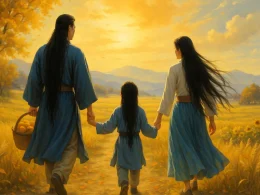

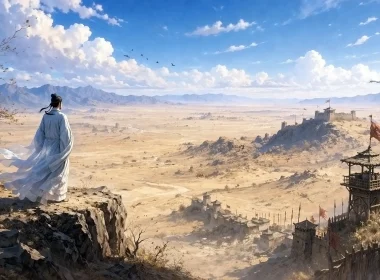
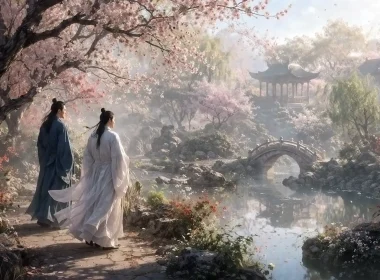

The sun has slanted, the land's fair and bright;
The vernal breeze brings fragrance of sweet flowers.
Swallows fly o'er the softened clay in flight;
On sand so warm are sleeping lovebirds in bowers.
Original Poem
「绝句二首 · 其一」
杜甫
迟日江山丽,春风花草香。
泥融飞燕子,沙暖睡鸳鸯。
Interpretation
This work was composed in the autumn of 768 CE, the third year of the Dali era under Emperor Daizong. Du Fu was fifty-seven years old, adrift in the Jianghan region (modern-day Hubei). Having left Kuizhou, his hope of returning north grew faint. Afflicted by poverty and illness, his future was uncertain. Yet, in these seemingly hopeless circumstances, Du Fu produced one of the most robust and profound declarations of his later years. This poem is not merely a wanderer's lament; it is a solemn meditation on aging, wisdom, and the indomitable nature of the human spirit.
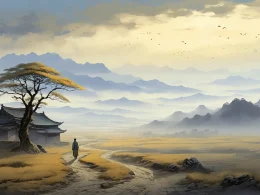
First Couplet: “江汉思归客,乾坤一腐儒。”
Jiāng Hàn sī guī kè, qián kūn yī fǔ rú.
A wanderer on Yangtze and Han, longing for the homeward way; / A scholar out of season, 'twixt heaven and earth I stray.
The opening starkly defines identity and place. "On Yangtze and Han" marks the physical plight of displacement; "'twixt heaven and earth" sets that plight within a boundless, lonely cosmos. The term "a scholar out of season" is pointed self-deprecation that also functions as a badge of honor. In an age when his Confucian ideals seemed increasingly irrelevant, calling himself "out of season" ironically affirms the purity and steadfastness of his moral character—a humble label that conveys deep, unshakable conviction.
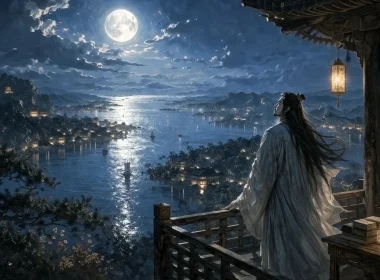
Second Couplet: “片云天共远,永夜月同孤。”
Piàn yún tiān gòng yuǎn, yǒng yè yuè tóng gū.
A wisp of cloud shares the sky's far, far-ranging flight; / The enduring moon, my sole companion through the long night.
This couplet contains some of Du Fu's most cosmically resonant lines. The poet merges his own state with enduring natural images. The "wisp of cloud" mirrors his rootless wandering, yet by "shar[ing] the sky's… flight," his personal perspective expands into vastness. The "enduring night" frames his solitude, but he finds a sublime fellowship in the moon, sharing its lonely vigil. Here, self and world are in complete communion; personal hardship is elevated to a philosophical unity with the cosmos—solitary, yet profoundly connected; alone, yet accompanied by the eternal.
Third Couplet: “落日心犹壮,秋风病欲苏。”
Luò rì xīn yóu zhuàng, qiū fēng bìng yù sū.
Before the setting sun, my heart still beats defiant, strong; / In the autumn wind, my wasting sickness feels a stirring, as of song.
Here, feeling and will surge upward, forming the poem's spiritual climax. "The setting sun" is both the day's end and a metaphor for a life and a dynasty in decline. Yet "my heart still beats defiant, strong" strikes a resolute, metallic note against this fading light. The "autumn wind" carries the chill of decay, but the poet senses his illness "feels a stirring"—an intimation of renewal. This is the spirit declaring its sovereignty over the body's frailty, the will asserting itself against circumstance. The words "defiant, strong" and "a stirring" erect a vigorous inner self against the backdrop of physical decline.
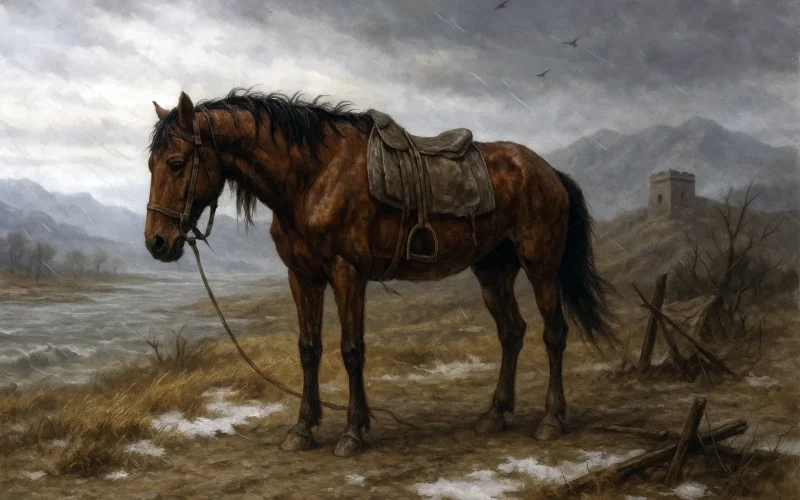
Fourth Couplet: “古来存老马,不必取长途。”
Gǔ lái cún lǎo mǎ, bú bì qǔ cháng tú.
Since ancient times, the old horse is kept—not for the long road's strain, / But for the wisdom of the way, to guide the path again.
By invoking the classical allusion of "the old horse knows the way," this couplet elevates the poem to its highest philosophical plane. The poet likens himself to the "old horse," accepting with clear-eyed dignity the physical constraints of age that prevent him from enduring "the long road's strain." Yet, in the same breath, he affirms his enduring value in being "kept"—a value rooted in lived experience, in hard-won wisdom, and in the profound understanding that can guide others, even when he himself can journey no farther. This represents a fundamental redefinition of worth: a poignant shift from the pursuit of "worldly accomplishment" to the authority of "embodied insight." It is a declaration imbued with the hard-earned clarity and quiet conviction of a life fully weathered by time and trial.
Holistic Appreciation
This five-character regulated verse crystallizes the spiritual zenith of Du Fu's final years. It traces a great soul's process of self-affirmation at the very edge of life: from acknowledging hardship (first couplet) → to merging with the cosmos and alchemizing solitude (second couplet) → to asserting an unbroken will against the pull of despair (third couplet) → to finally redefining life's purpose through accrued wisdom (fourth couplet). The emotional current runs deep and powerful, resolving into a state of resilient clarity.
The poem's most compelling power lies in its "dynamic of decay and resilience." The text is saturated with images of decline and limitation: "out of season," "sole companion," "setting sun," "autumn wind," "old horse." Yet these are consistently undergirded and transformed by a series of active verbs and steadfast affirmations: "longing for" (aspiration), "shares," "companion" (connection), "beats defiant, strong," "feels a stirring" (unbroken will), "is kept" (enduring value). It is precisely through an unflinching recognition of frailty and finitude that genuine spiritual fortitude is proven, making its declaration profoundly moving.
Artistic Merits
- Profound Fusion of the Cosmic and the Personal: The poet juxtaposes vast, timeless natural images—"wisp of cloud," "enduring night," "setting sun," "autumn wind"—with the minute, specific figure of the "wanderer" and "scholar out of season." From this stark contrast emerges a powerful sense of the individual spirit in communion with the universal, vastly expanding the poem's conceptual and emotional realm.
- Philosophical Depth Through Paradox: The poem's structure is built on resonant, fertile oppositions: "far-ranging" and "solitary," "setting sun" and "defiant heart," "autumn wind" and "stirring of song," "old horse" and "long road." Du Fu masterfully synthesizes these opposites from a higher spiritual vantage point, creating a poetic art rich in intellectual tension and layered meaning.
- Seamless and Profound Use of Allusion: The integration of the "old horse knows the way" literary allusion is flawless. It aligns perfectly with the poet's personal circumstances of age and wandering, naturally introducing the central theme of wisdom born from long experience. This transforms what might have been mere self-pity into a powerful, dignified affirmation of self-knowledge and enduring worth.
- Condensed, Vigorous, and Precise Diction: Not a word is superfluous. The careful deployment of connective particles and potent verbs—"shares," "companion," "still beats," "feels a stirring"—precisely charts the nuanced shifts of the poet's inner state and the tensile strength of his resolve. This showcases the "vigorous precision" that characterizes Du Fu's late style, often described as "deep emotion expressed through measured, forceful rhythm."
Insights
This work poses an enduring human question: When the body declines and conventional paths to achievement narrow or close, where does one's essential value reside? Du Fu's answer is resonant: value lies in the spirit's refusal to be extinguished, in the wisdom sedimented by experience, and in the meaningful, guiding role one can still fulfill—like the "old horse" that, though past the trials of long journeys, retains the precious, hard-earned knowledge of the path.
Its message holds particular significance for our time. In an era that often glorifies youth, speed, and immediately tangible success, Du Fu's "old horse" philosophy offers a crucial, balancing wisdom. It affirms that every stage of life possesses its own unique and irreplaceable worth. The "usefulness of the seemingly useless" in age or adversity may lie precisely in the deeper understanding, quiet resilience, and moral clarity that are forged only through a life fully and consciously lived. A truly "defiant heart" may express itself not in external conquest but in unwavering inner integrity, steadfastness in principle, and the capacity to illuminate the way for others.
Therefore, this poem is more than a personal song of resilience in old age; it is a timeless guide to discovering dignity and generative purpose within life's inevitable limitations. Through the testament of his own exile and endurance, Du Fu demonstrates that the realm of the human spirit can be vaster than the heavens, and that a heart resolved, clarified, and fortified by experience can outshine any setting sun.
Poem translator
Xu Yuanchong (许渊冲)
About the poet
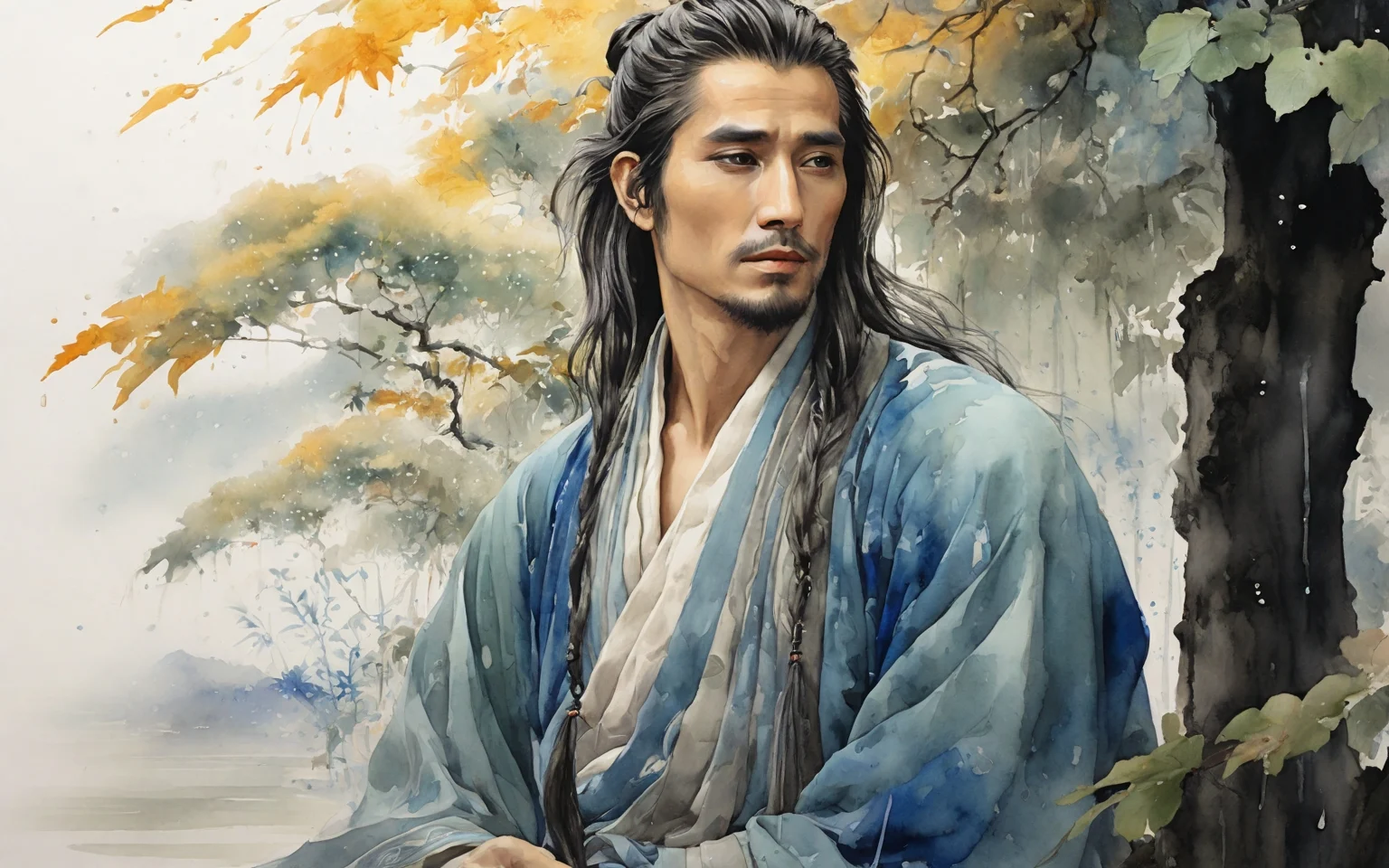
Du Fu (杜甫), 712 - 770 AD, was a great poet of the Tang Dynasty, known as the "Sage of Poetry". Born into a declining bureaucratic family, Du Fu had a rough life, and his turbulent and dislocated life made him keenly aware of the plight of the masses. Therefore, his poems were always closely related to the current affairs, reflecting the social life of that era in a more comprehensive way, with profound thoughts and a broad realm. In his poetic art, he was able to combine many styles, forming a unique style of "profound and thick", and becoming a great realist poet in the history of China.