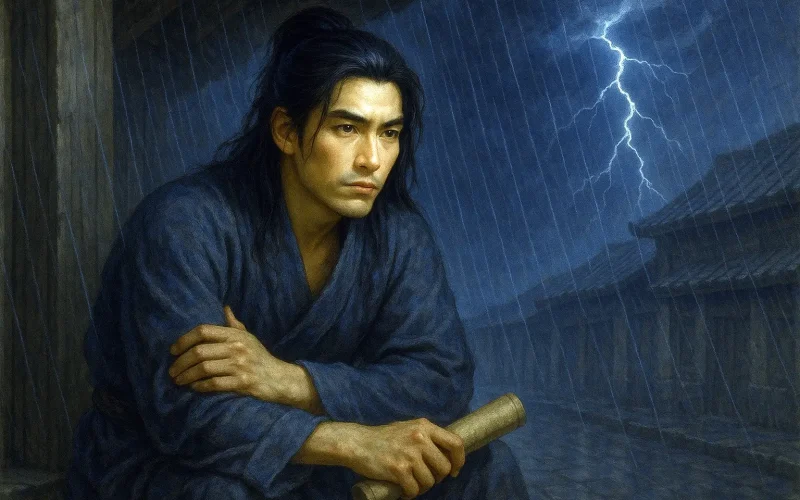


The style of Wang, Yang, Lu and Luo then in vogue
Has been mocked by modern critics without end.
Your bodies and your names will vanish in the fog,
But their works like the river will flow on and blend.
Original Poem
「戏为六绝句 · 其二」
杜甫
王杨卢骆当时体,轻薄为文哂未休。
尔曹身与名俱灭,不废江河万古流。
Interpretation
This poem is the second in Du Fu's series "戏为六绝句" and was composed around 761 CE during Emperor Suzong's reign. In his later years, while residing in Chengdu, Du Fu was responding to a growing trend in literary circles of exalting the ancient and disparaging the modern, particularly the disdain and mockery directed at the Four Masters of the Early Tang (Wang Bo, Yang Jiong, Lu Zhaolin, Luo Binwang). Feeling it necessary to clarify misconceptions and establish a correct view of literary history through poetic discourse, he wrote this piece. The poem not only defends the Four Masters but also serves as a crucial text where Du Fu systematically elaborates his views on poetic development and criticism, showcasing the profound historical insight of the "Poet-Historian."
First Couplet: “王杨卢骆当时体,轻薄为文哂未休。”
Wáng Yáng Lú Luò dāngshí tǐ, qīngbó wéi wén shěn wèi xiū.
Wang, Yang, Lu, Luo wrote in the style of their own day; "Frivolous scribblers!"—sneers at their work never fade away.
This couplet directly addresses the core of the controversy. The phrase "style of their own day" is key to Du Fu's view of literary history: he precisely locates the Four Masters' work as the inevitable product of their specific historical period (the Early Tang). This acknowledges both their achievement in transforming the lingering style of the Qi-Liang era and pioneering a new path for Tang poetry, and the unavoidable characteristics of a transitional period (the so-called "frivolity") in their style. Du Fu's brilliance lies in not judging predecessors harshly outside their historical context. "Sneers… never fade away" vividly depicts the narrow-mindedness and clamor of the critics; the word "sneers" fully reveals their flippancy and arrogance, building momentum for the refutation that follows.
Second Couplet: “尔曹身与名俱灭,不废江河万古流。”
Ěr cáo shēn yǔ míng jù miè, bù fèi jiāng hé wàngǔ liú.
But you will perish, body and name, leaving not a trace; While their fame flows on like the great rivers, through time and space.
The final couplet delivers a historical verdict with thunderous force. "You people" refers contemptuously to the "frivolous" critics of the previous line. "Perish, body and name" is a resolute prophecy, declaring the inevitable fate of those who, divorced from history, offer presumptuous criticism: oblivion. In stark contrast stands "flows on like the great rivers, through time and space." This simile is majestic: the literary achievement of the Four Masters is like the rivers of nature; its vitality and value are objective and eternal, not subject to existence or oblivion based on anyone's subjective praise or blame. The words "flows on" are filled with absolute confidence and historical conviction.
Holistic Appreciation
Though compact, this quatrain constitutes a complete act of literary criticism, showcasing Du Fu's acumen and courage as a critic. The poem employs a structure of stark contrast: on one side, representing the laws of literary development, are the "style of their own day" and the "great rivers… through time and space"; on the other, opposing these laws, are the "frivolous sneers" and "perish, body and name." Through this contrast, Du Fu clarifies two core principles: first, the necessity of a historical perspective—evaluating writers requires placing them within their specific historical context; second, that time is the most impartial judge—true artistic value withstands the washing of history's long river.
Though the title says "Playfully Written," the content is profoundly serious, with no hint of playfulness. This word "playfully" perhaps contains Du Fu's disdain for those shallow discussions and his calm confidence in the truth he upholds. He transforms abstract literary theory into resonant, vividly imagistic verse, perfectly merging philosophical insight with poetic sentiment.
Artistic Merits
- A Paradigm of Integrating Discourse into Poetry: It forges profound literary criticism and historical judgment into four lines, with clear viewpoints and rigorous logic, pioneering the use of the quatrain form for systematic poetic discourse.
- Intense Tension through Simile and Contrast: The use of the grand natural image, “flows on like the great rivers, through time and space,” to symbolize the eternal nature of the Four Masters’ achievement is both vivid and awe-inspiring. The ultimate contrast with “perish, body and name”—the immortal versus the ephemeral—makes praise and condemnation self-evident, with penetrating force.
- Extreme Conciseness and Incisiveness of Language: The three words "style of their own day" summarize a methodology of literary history; "sneers… never fade away" vividly captures a bad literary habit; the address "you people" overflows with contempt. The entire poem is like a spear or dagger—concise and sharp.
- Transcendent Historical Vision: Du Fu does not simply defend the Four Masters. He rises above the specific debates of his time, positioning their value within the long river of literary history, demonstrating insight that transcends his era.
Insights
The significance of this poem extends far beyond ordinary literary debate; it offers us a profound methodology for examining history and evaluating human achievement. It reminds us that when approaching any cultural phenomenon, artistic innovation, or historical figure, we should possess the historical empathy to understand the “style of their own day”—to seek comprehension within their original temporal and spatial context, rather than making rash judgments based on contemporary or personal standards.
Simultaneously, the declaration that their legacy “flows on like the great rivers, through time and space” inspires us to contemplate what truly possesses enduring value. It is those creations that align with the course of cultural development and propel it forward, not the empty clamor that is loud for a moment only to negate everything. In today’s world of information overload and discordant opinions, this poem can especially help us maintain clarity: to respect the process of history, trust the judgment of time, and focus our energy on construction and creation, rather than indulging in rash criticism and negation. What Du Fu defends here is not merely four poets, but an open, dialectical, and confident cultural spirit.
About the poet

Du Fu (杜甫), 712 - 770 AD, was a great poet of the Tang Dynasty, known as the "Sage of Poetry". Born into a declining bureaucratic family, Du Fu had a rough life, and his turbulent and dislocated life made him keenly aware of the plight of the masses. Therefore, his poems were always closely related to the current affairs, reflecting the social life of that era in a more comprehensive way, with profound thoughts and a broad realm. In his poetic art, he was able to combine many styles, forming a unique style of "profound and thick", and becoming a great realist poet in the history of China.