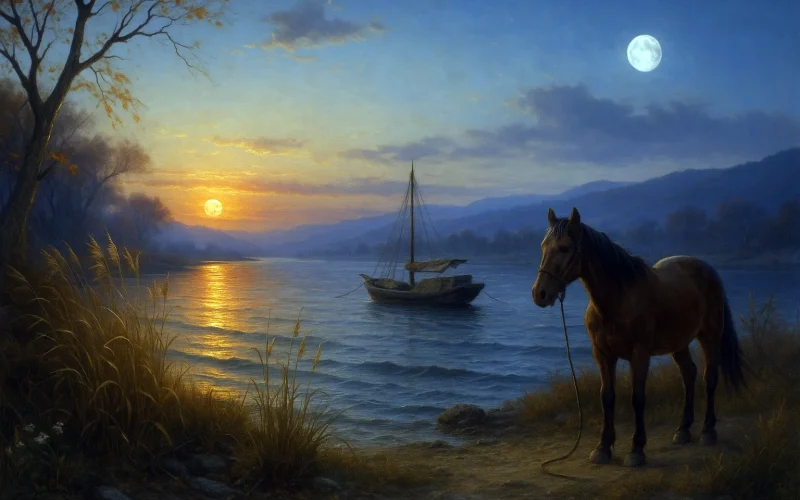

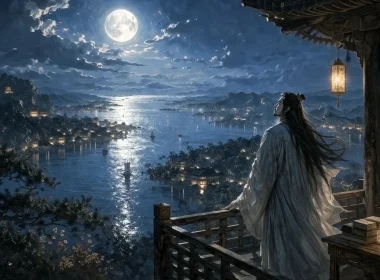
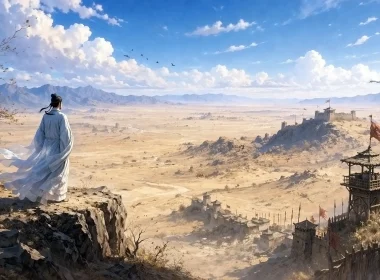
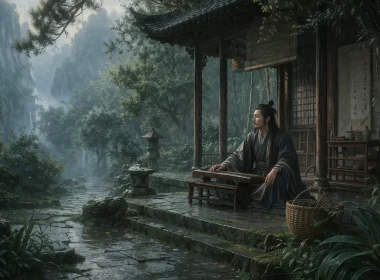
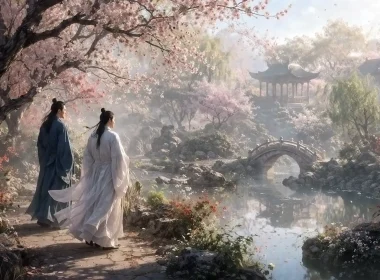

Since olden days there is no rope to bind the sun.
How could we stop the cloud and water on the run?
I'd like to buy the vast sea from the goddess nice,
But a cup of spring dew soon turns as cold as ice.
Original Poem
「谒山」
李商隐
从来系日乏长绳,水去云回恨不胜。
欲就麻姑买沧海,一杯春露冷如冰。
Interpretation
This poem stands as the most daring in conception and most stark in emotional tone among Li Shangyin's poetic meditations on time, likely composed during an ascent of a famed peak while gazing upon heaven and earth. The title "Paying Homage to the Mountain" signifies both a physical ascent and a solemn inquiry directed at time, that eternal mountain. In just four lines, the poet completes a spiritual odyssey—from the ancient fantasy of "lashing the sun," to the astonishingly audacious dream of "buying the vast sea," culminating in a plunge into the absolute, chilling clarity of "a cup of spring dew cold as ice." This journey expresses humanity's eternal anxiety and ultimate sense of nothingness in the face of time's passage with both magnificent abandon and bone-piercing chill.
First Couplet: 从来系日乏长绳,水去云回恨不胜。
Cóng lái xì rì fá cháng shéng, shuǐ qù yún huí hèn bù shèng.
Since time began, we've lacked the long rope to lash the sun;
I watch the waters flow, clouds circle back—my grief is past all bearing.
Explication: The opening lines strike directly at the core dilemma of time, establishing the poem's sorrowful and impassioned tone with a double negation. "Lacked the long rope to lash the sun" alludes to Fu Xuan's line, "How to get a long rope to lash the bright sun?" but the three words "since… lacked" utterly negate all physical possibility of humanity's attempt to arrest time, severing illusion to confront the cruelty. "Waters flow, clouds circle back" describes a scene eternal as the present: the flowing water symbolizes the linear, irreversible passage of time; the circling clouds suggest the cyclical appearance of space, a mere formality. Juxtaposed, they reveal the irreversible nature of linear dissolution beneath the semblance of cycles. "My grief is past all bearing" is the emotional eruption. This "grief" is not personal resentment but a vast protest and profound sense of powerlessness of the life force against time's ruthless law.
Final Couplet: 欲就麻姑买沧海,一杯春露冷如冰。
Yù jiù Má Gū mǎi cāng hǎi, yī bēi chūn lù lěng rú bīng.
I long to find Ma Gu and buy the vast sea from her hand;
Yet all I touch is a cup of spring dew, cold as ice.
Explication: This couplet rises like a precipice, propelling the poetic thought into unimaginable fancy, only to end in abrupt disillusionment. "I long to… buy the vast sea" is a fantasy of a higher dimension than "lashing the sun": since we cannot halt time (the sun), why not directly purchase the very vessel and symbol of time (the vast sea)? Ma Gu is the immortal who witnessed the "sea change into mulberry fields." To "buy the vast sea" from her implies an attempt, through supernatural transaction, to control the great transformations of time, to solidify flowing time into a possessable asset. This thought is absurd, arrogant, yet profoundly tragic—the ultimate inflation of humanity's desire to oppose time. However, "a cup of spring dew, cold as ice" pours like ice water, instantly shattering the inflated fantasy. "A cup of spring dew" is the small reality before one's eyes, a momentary condensation of the vast sea, and also a chilling metaphor for the brief existence of life. The three words "cold as ice" describe tactile sensation, and more so, a chilling realization: all efforts to possess time, to combat its flow, are in their essence like this cup of dew—seemingly crystalline, yet in truth cold, fleeting, dissolving at a touch. The violent contraction in scale from "vast sea" to "a cup of dew," from the grand ambition to "buy" to the physical sensation of "cold," produces a startling artistic effect.
Holistic Appreciation
This is a "poem of temporal paradox," structured like a boulder plummeting from a cliff, its emotion a searing mixture of ice and fire. The poem follows a dramatic psychological arc: "negation of reality—wild fantasy of transcendence—fall back to reality." The first couplet, with "lacked" and "grief," confirms humanity's absolute passivity before time. The second couplet, however, with "I long to buy," reveals a moment of madness aspiring to absolute agency. The final line, with the icy physicality of "a cup of spring dew," hurls us back into a void and chill deeper than the initial one. This rapid cycle and mutual negation of hope and despair is quintessentially Li Shangyin, brimming with intellectual tension and tragic beauty.
Li Shangyin's depth and uniqueness lie in not resting with the commonplace lament over time's swift passage. He pushes this sentiment into a metaphorical dimension rich with transactional imagination ("buy"), sharply exposing the human subconscious desire to reify and commodify time (buying the sea to control it). Yet this distinctly modern desire is ultimately mocked and dissolved by the natural truth of "spring dew cold as ice." Therefore, this poem is not merely sentimental; it is a cold, sober deconstruction of humanity's very desire concerning time itself.
Artistic Merits
- Radical Scaling and Paradox of Imagery: From the "long rope" (a thin line) to lash the sun, to the boundless "vast sea," down to the tiny "cup of spring dew"; from the blazing "sun," to the temperate "waters and clouds," to the piercing "ice." The imagery undergoes extreme shifts in scale and temperature, vividly externalizing the poet's violent psychological upheaval and final, frozen stillness.
- Mythological Allusion as a Piercing Point of Reality: "Buy the vast sea from Ma Gu" introduces the mythological allusion not for simple nostalgia, but as the basis for a virtual, absurd "transaction," thereby probing the impossibility between time and possession, eternity and trade. The conception is exceptionally ingenious.
- Verbs of Strong Will versus an Ending of Absolute Stasis: "Lash" and "buy" are verbs brimming with agency and the desire to conquer. "Lacked" and "cold" are states announcing failure and stillness. The soaring aspiration of the will and the chilling finality of the outcome form a cruel contrast, intensifying the tragedy.
- Profound Fusion of Synesthesia and Metaphor: "Spring dew cold as ice" is synesthesia (the visual and tactile interconnected), and more profoundly, a deep metaphor: spring dew symbolizes the brief beauty of life; ice symbolizes the ruthless essence of time. Beauty and ruthlessness fuse in an instant, congealing into an insoluble paradox of existence.
Insights
This poem is like a bolt of incisive, piercing wisdom, piercing humanity's eternal delusion of seeking to possess time and conquer its flow. It reveals that time is not an object to be "lashed" or "bought"; it is the fundamental dimension of being and the flow itself. All efforts to objectify it, to turn it into capital, may ultimately, like the fantasy of "buying the vast sea," plunge into the nihilistic reality of "spring dew cold as ice."
In the contemporary era where "time management" is a prominent discipline and life is filled with efficiency and planning, this poem carries a potent warning. It reminds us that in our busyness "lashing" every moment (utilizing it efficiently) or even fantasizing about "buying" more time (pursuing immortality), we may overlook the essential nature of time as "spring dew cold as ice"—its transience, its un-ownability, and within that, the fleetingness and preciousness of life. Perhaps true wisdom lies not in conquering time, but in recognizing its absolute law of being "cold as ice," yet still being able to feel the momentary clarity of the "spring dew," and within this profound finitude, to seek the dignity and meaning of life.
With this poem, Li Shangyin transforms a moment of gazing from a high peak into a startling glimpse into the abyss of time. That "cup of spring dew cold as ice" is the sobering draft he offers to all contemplative souls across the ages—a cup mingling ultimate poetry with ultimate chill.
Poem translator
Xu Yuanchong (许渊冲)
About the poet
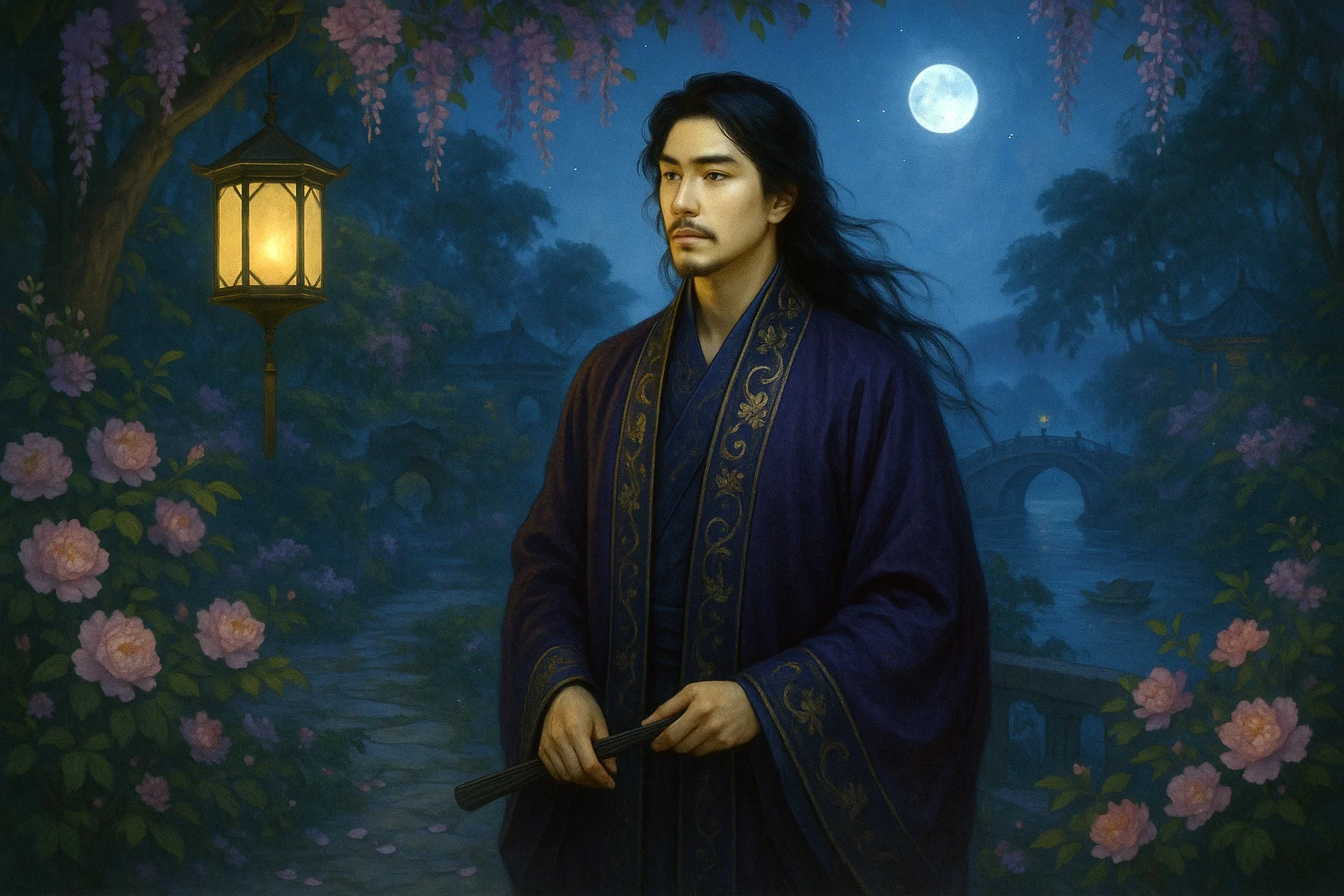
Li Shangyin (李商隐), 813 - 858 AD, was a great poet of the late Tang Dynasty. His poems were on a par with those of Du Mu, and he was known as "Little Li Du". Li Shangyin was a native of Qinyang, Jiaozuo City, Henan Province. When he was a teenager, he lost his father at the age of nine, and was called "Zheshui East and West, half a century of wandering".