


What does the old man fare?
He cuts the wood in southern hill and fires his ware.
His face is grimed with smoke and streaked with ash and dust,
His temples grizzled and his fingers all turned black.
The money earned by selling charcoal is not just
Enough for food for his mouth and clothing for his back.
Though his coat is thin, he hopes winter will set in,
For cold weather will keep up the charcoals good price.

At night a foot of snow falls outside city walls;
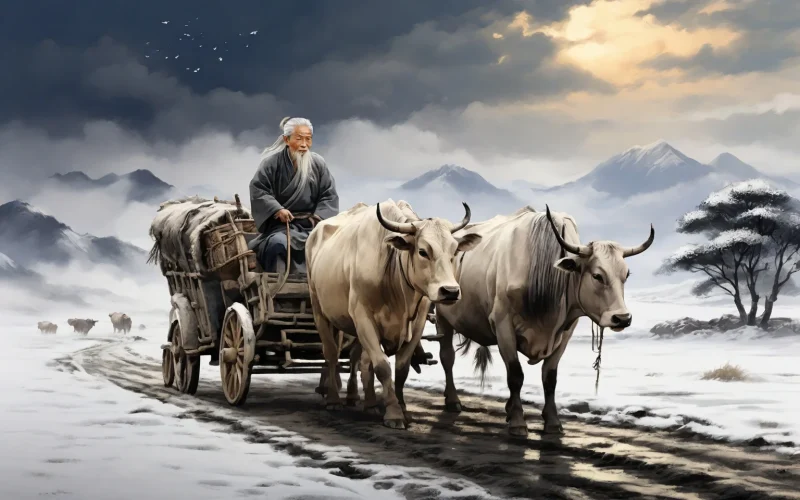
At dawn his charcoal cart crushes ruts in the ice.
The sun is high, the ox tired out and hungry he;
Outside the southern gate in snow and slush they rest.

Two riders canter up. Alas! Who can they be?
Two palace heralds in the yellow jackets dressed.
Decree in hand, which is imperial order, one says;
They turn the cart about and at the ox they shout.
A cartload of charcoal a thousand catties weighs;
They drive the cart away. What dare the old man say?

Ten feet of silk and twenty feet of gauze deep red,
That is the payment they fasten to the ox's head.
Original Poem
「卖炭翁」
白居易
卖炭翁,伐薪烧炭南山中。
满面尘灰烟火色,两鬓苍苍十指黑。
卖炭得钱何所营?身上衣裳口中食。
可怜身上衣正单,心忧炭贱愿天寒。
夜来城外一尺雪,晓驾炭车辗冰辙。
牛困人饥日已高,市南门外泥中歇。
翩翩两骑来是谁?黄衣使者白衫儿。
手把文书口称敕,回车叱牛牵向北。
一车炭,千余斤,宫使驱将惜不得。
半匹红绡一丈绫,系向牛头充炭直。
Interpretation
This poem is from Bai Juyi’s Fifty New Music Bureau Poems, composed around 809 CE. While serving as a Reminder at court, Bai Juyi was acutely aware of the deepening social strife of the mid-Tang period, particularly the cruel exploitation of commoners under the "Palace Market" system. In practice, this system was legalized plunder. Eunuchs and their agents would roam the markets of Chang'an, claim goods for the palace at a fraction of their worth or simply seize them, leaving victims powerless. Writing in the tradition of Du Fu's socially engaged "New Music Bureau" style, and guided by his own principle that literature should address contemporary issues, Bai Juyi focused on this injustice. Through the ordeal of an old charcoal vendor, he compressed the greed of the powerful and the suffering of the powerless into a single, devastating narrative, creating one of the most powerful critical works in the genre.
Section One: 卖炭翁,伐薪烧炭南山中。满面尘灰烟火色,两鬓苍苍十指黑。卖炭得钱何所营?身上衣裳口中食。
Mài tàn wēng, fá xīn shāo tàn nán shān zhōng. Mǎn miàn chén huī yān huǒ sè, liǎng bìn cāng cāng shí zhǐ hēi. Mài tàn dé qián hé suǒ yíng? Shēn shàng yī shang kǒu zhōng shí.
The old man who sells charcoal—he cuts the wood, he burns the coal / In the southern hills. His face is stained with soot and grimy smoke; / His temples streaked with grey, his ten fingers universally black. / What does he seek, the coin his charcoal brings? / For clothes upon his back, for food—life’s bare and urgent things.
The poet begins with stark, factual narration, outlining the most basic facts of the old man’s existence. The phrase “cuts the wood, he burns the coal” summarizes the long, arduous cycle of his labor. “In the southern hills” places that labor in a remote, demanding setting. The description that follows is sculptural in its precision: “stained with soot and grimy smoke” is the indelible mark of his trade; “his temples streaked with grey” shows the passage of time; “his ten fingers universally black” is the direct proof of his work. These plain lines make the figure of a laborer utterly fused with the elements of his craft vividly real. The concluding rhetorical question and its answer—“What does he seek… / For clothes upon his back, for food”—reveal in the simplest terms that the sole purpose of his exhausting toil is mere subsistence. This establishes a foundation of profound pathos for the tragedy that follows.
Section Two: 可怜身上衣正单,心忧炭贱愿天寒。夜来城外一尺雪,晓驾炭车辗冰辙。牛困人饥日已高,市南门外泥中歇。
Kělián shēn shàng yī zhèng dān, xīn yōu tàn jiàn yuàn tiān hán. Yè lái chéng wài yī chǐ xuě, xiǎo jià tàn chē niǎn bīng zhé. Niú kùn rén jī rì yǐ gāo, shì nán mén wài ní zhōng xiē.
Pitiful—the clothes upon his back are thin, a scant defense; / Yet in his heart he fears a low price, so he longs for cold’s intensity. / Last night, beyond the walls, a full foot of snow fell; / At dawn, he drives his cart, its wheels crunched over frozen ruts. / Ox worn out, man famished, the sun already riding high; / South of the market gate, in mire, he comes to a halt.
This section delves into the cruel contradiction of the old man’s plight. “The clothes upon his back are thin” versus “he longs for cold’s intensity” forms a heartbreaking paradox: his body’s need is for warmth, but his economic survival depends on the very frost that harms him. This lays bare the twisted logic forced upon those at society’s bottom. The description of the bitter cold—“a full foot of snow” and “frozen ruts”—confirms the grim fulfillment of his wish and magnifies the hardship of his journey. The exhaustion of “Ox worn out, man famished” and the bleak image of halting “in mire” depict the final toll exacted before he can even attempt to sell his goods, building a sense of foreboding in the reader.
Section Three: 翩翩两骑来是谁?黄衣使者白衫儿。手把文书口称敕,回车叱牛牵向北。一车炭,千余斤,宫使驱将惜不得。半匹红绡一丈绫,系向牛头充炭直。
Piānpiān liǎng qí lái shì shéi? Huáng yī shǐzhě bái shān er. Shǒu bǎ wénshū kǒu chēng chì, huí chē chì niú qiān xiàng běi. Yī chē tàn, qiān yú jīn, gōng shǐ qū jiāng xī bù dé. Bàn pǐ hóng xiāo yī zhàng líng, jì xiàng niú tóu chōng tàn zhí.
Who are those two, on horseback, arriving with a careless air? / In yellow, palace officials; in white, an attendant there. / A document in hand, they cry, “By the Emperor’s decree!” / Turn the cart, shout at the ox, and lead it north, peremptorily. / A whole cart of charcoal, a thousand catties, more or less, / Driven off by palace agents—his loss, his powerless distress. / Half a bolt of red gauze, ten feet of silk, so fine— / Knotted on the ox’s head: the payment for what was mine.
Here, the poem pivots with dramatic force. The “careless air” of the horsemen starkly contrasts with the old man’s exhaustion. The vivid “In yellow… in white” of their uniforms clashes with his soot-stained monochrome. Their actions—“A document in hand, they cry…”—invoke unimpeachable authority; the series of commands—“Turn the cart, shout… lead it north”—enacts a swift, total confiscation. “His powerless distress” encapsulates the impotence of the weak before institutionalized power. The climax is a devastating equation: “A whole cart of charcoal…”, the physical sum of a year’s labor, is weighed against “Half a bolt of red gauze…”, a pittance of useless finery. The contemptuous, offhand gesture of knotting this trifle “on the ox’s head” captures the system’s predatory nature and its utter disdain for labor. The poem ends abruptly, the old man’s stunned silence and aftermath more powerful than any lament.
Holistic Appreciation
This poem is a landmark of the New Music Bureau movement. Its power derives from using an intensely focused narrative and stark contrasts to craft a miniature epic of social tragedy. The poet masterfully employs techniques like dramatic irony (his wish for cold is granted, to his ruin), exterior revelation (appearance conveying circumstance), and jarring juxtaposition (the officials’ brisk efficiency shattering the laborer’s struggle) to build, in under 130 characters, a complete arc from toil, to hope, to catastrophic loss. Bai Juyi’s critique is not stated but woven into the fabric of the story, allowing the stark presentation of facts to carry the full weight of indictment. The old charcoal seller thus transcends his individual story, becoming an eternal symbol for all who are exploited by unaccountable power.
Artistic Merits
- Extreme Narrative Concentration: The poem selects only three essential scenes—labor, journey, seizure—omitting all extraneous detail. This creates a tight, relentless pace that amplifies the emotional impact.
- Masterful Use of Plain Description: The depiction of the old man’s appearance, his internal contradiction, and the harsh journey uses simple, precise language. Every detail serves the whole, achieving a profound realism.
- Layered Structural Contrasts: The poem is built on a series of deepening contrasts: the man’s physical need versus his economic need; his arduous journey versus the officials’ easy ride; the massive, useful weight of the charcoal versus the meager, frivolous "payment." Each layer further exposes the injustice at the poem’s core.
- Restrained Narrative Voice, Potent Emotional Force: The poet maintains the calm tone of a witness throughout, avoiding direct commentary. Yet, his deep compassion for the victim and fierce condemnation of the system are fully communicated through this disciplined, objective style, achieving the effect he described as “words straightforward and sharp, feeling sorrowful and deep.”
Insights
The enduring relevance of this work lies in its exposure of how power, when draped in legal pretext, can sanctify predation. It is a timeless warning: when authority faces no real check, even simple exchange becomes seizure; when a society fails in justice, the basic logic of survival becomes distorted. Through the fate of one old man, Bai Juyi measured the moral foundation of his society. The poem is more than a historical critique; it is a permanent challenge to all systems that ignore the suffering of the vulnerable or enable the abuse of power. It compels us to ask: how can a society be structured so that the labor of its simplest members is met with fair reward, so that the hope to merely “clothe the back and feed the mouth” does not require the tragic, self-defeating prayer for one’s own misfortune?
Poem translator
Xu Yuanchong (许渊冲)
About the Poet

Bai Juyi (白居易), 772 - 846 AD, was originally from Taiyuan, then moved to Weinan in Shaanxi. Bai Juyi was the most prolific poet of the Tang Dynasty, with poems in the categories of satirical oracles, idleness, sentimentality, and miscellaneous rhythms, and the most influential poet after Li Bai Du Fu.