The road is overwhelmed with their pride,
Saddled steeds brighten the roadside.
How proud these officers appear
For they are eunuchs without fear!
They wear official tassels red
And violet ribbon round the head.
To feast in the army they're proud,
Their horses run as light as cloud.
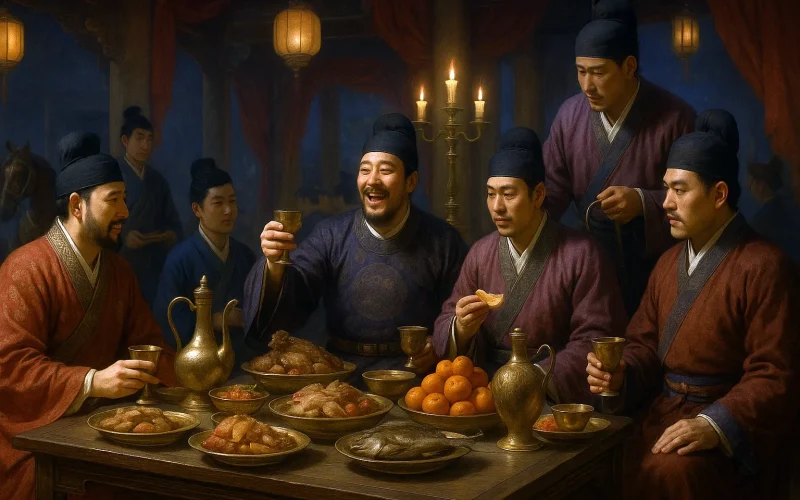
They drink and eat, wine cup in hand,
Delicious food from sea and land.
The oranges come from the lakeside;
The fish from Heaven's Pool well fried.
Full fed, they set their heart at ease;
Drunken, they would do as they please.

This year in the south the drought rages;
Men eat human flesh like savages.
Original Poem
「轻肥」
白居易
意气骄满路,鞍马光照尘。
借问何为者,人称是内臣。
朱绂皆大夫,紫绶或将军。
夸赴军中宴,走马去如云。
樽罍溢九酝,水陆罗八珍。
果擘洞庭橘,脍切天池鳞。
食饱心自若,酒酣气益振。
是岁江南旱,衢州人食人。
Interpretation
This poem is from Bai Juyi’s suite Ten Songs of Qin, composed around 809 CE while he served as a Reminder and Hanlin Academician. During the mid-Tang period, the power of the palace eunuchs expanded dramatically. They not only controlled the imperial guard and dominated court politics but even manipulated the deposition of emperors, creating a despotic system. Concurrently, regional military governors grew powerful, taxes were heavy, and the people suffered. Historical records note severe droughts south of the Yangtze around 803-804 CE, with conditions so dire that incidents of cannibalism were reported. From his position as a remonstrance official committed to “relieving human suffering and remedying the failings of the time,” Bai Juyi placed the extravagant “military feast” of the eunuchs and the horrific famine in the south within the same temporal frame, creating a startling historical record. The title “Arrogance and Excess” alludes ironically to the Analects (“They drive fat horses and wear light furs”), directly indicting the profligacy of the privileged. It stands as one of the most sharply critical and harrowingly contrasted poems in the Ten Songs of Qin.
Section One: 意气骄满路,鞍马光照尘。借问何为者,人称是内臣。
Yìqì jiāo mǎn lù, ān mǎ guāng zhào chén. Jièwèn hé wéi zhě, rén chēng shì nèi chén.
Their arrogant airs fill the road they occupy; / Their tack and trappings gleam and light the dust they travel by. / “What men are these, who pass in such a show?” / “Those are the palace eunuchs,” people answer, low.
The poem opens with a potent image and stark contrast. “Their arrogant airs fill the road” captures their overbearing demeanor; the word “fill” conveys the oppressive pervasiveness of their presence. “Their tack and trappings gleam and light the dust” contrasts the luxury of their gear with the common dust of the road, highlighting their ostentation. The dialogue—“What men are these…” / “Those are the palace eunuchs”—vividly recreates a street scene and implies the notoriety of their processions, setting the poem’s critical tone.
Section Two: 朱绂皆大夫,紫绶或将军。夸赴军中宴,走马去如云。
Zhū fú jiē dàifu, zǐ shòu huò jiāngjūn. Kuā fù jūn zhōng yàn, zǒu mǎ qù rú yún.
Scarlet ribbons—all are senior court officials, grand; / Purple sashes—some are generals, in command. / In high boast, to the army headquarters’ feast they race; / Their galloping horses flow like clouds, a swift, unbroken pace.
This section targets the core of eunuch usurpation: their seizure of high civil and military rank. “Scarlet ribbons” and “Purple sashes” are visual symbols of high office; “all” and “some” reveal the systemic nature of their ascendancy. “In high boast, to the army headquarters’ feast” indicates their dangerous encroachment upon military authority. “Their galloping horses flow like clouds” depicts the pomp of their procession while讽刺 their clamorous rush toward power and privilege.
Section Three: 樽罍溢九酝,水陆罗八珍。果擘洞庭橘,脍切天池鳞。
Zūn léi yì jiǔ yùn, shuǐ lù luó bā zhēn. Guǒ bāi Dòngtíng jú, kuài qiè Tiānchí lín.
Flagons overflow with vintage wine, the rarest brew; / Land and sea’s eight delicacies are arrayed in view. / Fruit: the Dongting Lake tangerine, peeled by hand; / Sashimi: Tianchi Pond’s finest fish, in slices spanned.
The poet uses exhaustive cataloging to portray the feast’s extreme luxury. Verbs like “overflow” and “are arrayed” show grotesque abundance; items like “vintage wine,” “eight delicacies,” “Dongting Lake tangerine,” and “Tianchi Pond’s… fish” stress the rarity and distant provenance of the fare. This meticulous listing builds not a celebration of cuisine but a shocking sense of waste and plunder. Every luxury consumed is intimately connected to the systemic extraction of resources.
Section Four: 食饱心自若,酒酣气益振。是岁江南旱,衢州人食人。
Shí bǎo xīn zìruò, jiǔ hān qì yì zhèn. Shì suì Jiāngnán hàn, Qúzhōu rén shí rén.
Glutted with food, their hearts are quite at ease, content; / Drunk with wine, their spirits gain new force, confident. / That year, south of the River, drought held cruel command; / In Quzhou, people ate the flesh of human, hand to hand.
The conclusion delivers the poem’s devastating leap. The first lines, “their hearts are quite at ease” and “their spirits gain new force,” capture the eunuchs’ satiated numbness and arrogance. Then, the poet’s brush falls like a blade: “That year… / In Quzhou, people ate the flesh of human.” The shared temporal marker “That year” forcibly yokes together two worlds. The spatial names—“south of the River,” “Quzhou”—tear apart the heaven and hell existing within the same nation. No commentary is needed. The stark juxtaposition makes the eunuchs’ every indulgence seem soaked in the people’s fat and blood, their every boast echo with screams. This technique of the “pivotal final touch” generates immense moral force.
Holistic Appreciation
This work is among the most trenchant in Bai Juyi’s Ten Songs of Qin. It employs a structure of “elaborate depiction—sudden juxtaposition.” The first three sections, with a dispassionate, descriptive eye, detail the eunuchs’ procession, status, and feast, meticulously documenting their “arrogance” and “excess.” The final two lines arrive like a thunderclap, presenting the horrific reality of famine with brutal abruptness, creating a profound fracture in the reader’s perception. This rupture is the accusation: the eunuchs’ profligacy and the people’s cannibalism are not coincidental but are cause and effect within a single, broken system. The poet, writing as a historian, lets the contrasted facts speak, achieving a powerful unity of critique and artistic restraint.
Artistic Merits
- The Masterful Use of Contrast: The poem’s power resides in the shocking juxtaposition of its final fourteen words against the preceding lines. This model of “vermilion gates versus starving skeletons” became a classic template for social critique.
- Profound Meaning in Plain Description: Descriptions of demeanor, regalia, and fare use economical, precise language. Every detail serves to expose the essence of privilege, with no wasted word.
- Calm Narrative Control: The poet maintains a restrained, nearly documentary tone throughout, avoiding direct commentary. The critique emerges with greater force from the objective presentation of starkly contrasted realities.
- Ironic Titling: The title “Arrogance and Excess” quotes the Analects on noble life. Its use here is deeply ironic, immediately framing the subject as one of misplaced and immoral privilege.
Insights
This poem is a deliberately collaged historical snapshot, ruthlessly superimposing the rulers’ “feast” upon the people’s “famine,” forcing the viewer to confront the connection. It warns: Any power exercised in detachment from the people’s welfare, any monopoly of resources that ignores suffering, constitutes a brutal predation upon society. The phrase “That year” is crucial—it specifies that these extremes coexisted in the same moment, stripping away any excuse of distance. Bai Juyi demonstrates that true realism involves not only recording suffering but having the courage to trace its lineage to the corruption of power. This literary moral courage, across a millennium, still strikes at the heart.
Poem translator
Xu Yuan-chong (许渊冲)
About the Poet
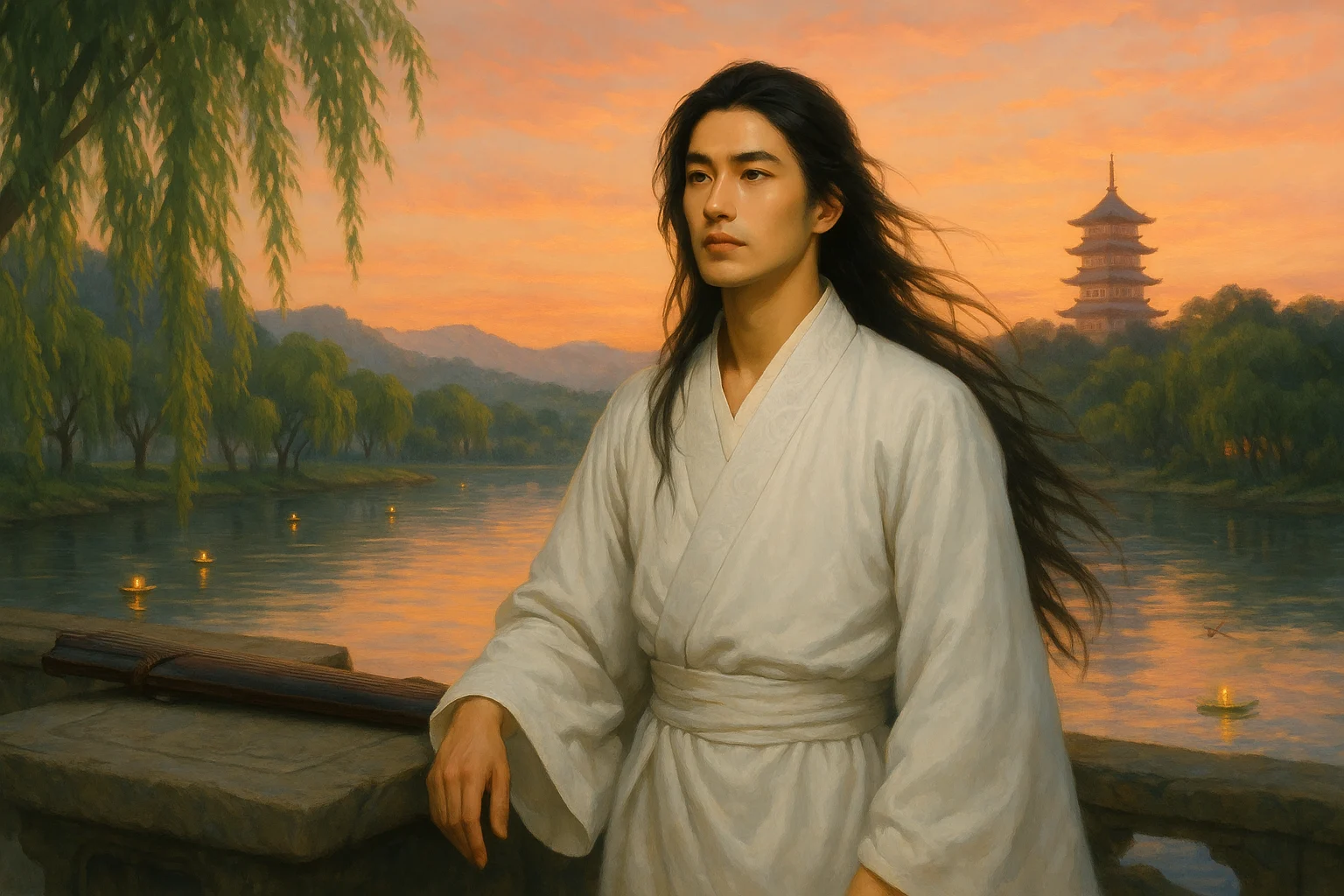
Bai Juyi (白居易), 772 - 846 AD, was originally from Taiyuan, then moved to Weinan in Shaanxi. Bai Juyi was the most prolific poet of the Tang Dynasty, with poems in the categories of satirical oracles, idleness, sentimentality, and miscellaneous rhythms, and the most influential poet after Li Bai Du Fu.