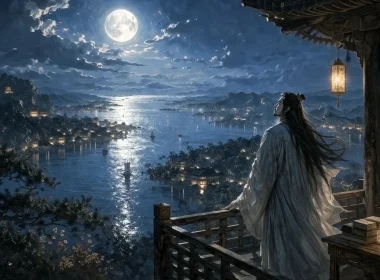
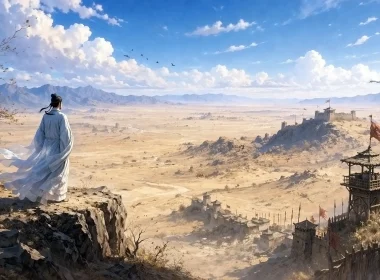

Northern Lake and Southern Mound, the waters stretch wide and long;
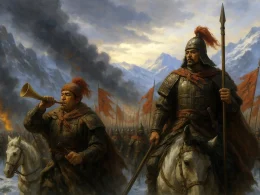
Flags of surrender, once raised here, marked where all kings succumbed.
Three hundred reigns have passed like a single, vanished dream;
Even the Coiling Dragon could not avert the hall’s doom.
Original Poem
「咏史二首 · 其一」
李商隐
北湖南埭水漫漫,一片降旗百尺竿。
三百年间同晓梦,钟山何处有龙盘。
Interpretation
This poem serves as the opening piece in a series of historical poems Li Shangyin composed in his later years, likely inspired by his travels in the Jiangdong region and his witnessing of the former sites of the Six Dynasties. Through highly condensed imagery and austere, profound rhetorical questions, the poet compresses the three-centuries-long history of the rise and fall of the Six Dynasties into a single, congealed tableau of boundless waters and a lone flag of surrender. Building on this, he launches a fundamental challenge to traditional historical views such as the "Imperial Vitality" (wangqi) and the "Genius of the Place" (diling). The entire poem omits any detailed narration of specific historical events; instead, it uses abstract imagery of time and space to directly engage with the philosophical core of historical nihilism and the illusory nature of the Mandate of Heaven, showcasing the unique character of Li Shangyin's historical verse: governing the concrete with the abstract, replacing exposition with inquiry.
First Couplet: 北湖南埭水漫漫,一片降旗百尺竿。
Běi hú nán dài shuǐ màn màn, yī piàn jiàng qí bǎi chǐ gān.
The Northern Lake, the Southern Weir, vast waters stretching on and on;
A single flag of surrender hung from a pole a hundred feet tall.
Explication: The opening establishes the tone with a vast, hazy visual field. The "Northern Lake" (Xuanwu Lake) and "Southern Weir" (Jiming Weir) are symbolic landmarks of the Six Dynasties' imperial leisure, once witnesses to countless scenes of splendor. The three words "vast waters stretching on" describe the actual scene but, more importantly, imbue it with the metaphor of time's passage and the erasure of all historical traces—the once halls of song and dance, the imperial majesty, all now submerged beneath these eternal, "stretching" waters. Immediately following, "a single flag of surrender hung from a pole a hundred feet tall" cuts in like a close-up shot, laying bare the outcome of history. "A single" conveys its isolation; "a hundred feet" its glaring height. The vertical tension of the flag "hung high" and the horizontal expanse of the lake's "stretching" waters together construct a symbolic scene saturated with failure and oblivion. Splendor and conclusion are juxtaposed here.
Final Couplet: 三百年间同晓梦,钟山何处有龙盘?
Sān bǎi nián jiān tóng xiǎo mèng, Zhōng Shān hé chù yǒu lóng pán?
Three hundred years were all the same, a dream at break of day;
Where, on Mount Bell, was coiled the dragon, where crouched the tiger, pray?
Explication: This couplet leaps from concrete image into historical contemplation, using a double negation to subvert traditional notions. "Three hundred years were all the same, a dream at break of day" characterizes the entire history of the Six Dynasties: "a dream at break of day" evokes its qualities of being brief, illusory, elusive, and bound to vanish upon waking, echoing the hazy spatial sense of "vast waters" to jointly dissolve the substance of history. "Where, on Mount Bell, was coiled the dragon…" thrusts a sharp, rhetorical question at the historical superstition of the "Imperial Vitality of Jinling." Mount Bell (Purple Mountain) was traditionally deemed a "crouching tiger, coiled dragon" site, seen as a geomantic guarantee for an imperial house. The poet's question, "Where was…?" is, in essence, a complete negation of the traditional historical view that geographic advantage determines dynastic fate. This question not only negates the Six Dynasties but also implicitly questions the legitimacy of all regimes relying on "Imperial Vitality," its edge piercingly sharp.
Holistic Appreciation
This is a "poem of subverted historical perspective" that discards narrative to strike directly at essence. The poem's structure is masterfully crafted: the first couplet uses space (vast waters) to engulf time (history), presenting the desolate outcome; the final couplet uses time (a dawn dream) to dissolve space (the coiled dragon), questioning the fallacy of the cause. The two couplets together complete a circular argument: because history is as illusory as a dawn dream, only vast waters remain before the eyes; because the "coiled dragon" theory is utterly false, the flag of surrender must hang high. Cause and effect prove each other, placing the rise and fall of the Six Dynasties in an inescapable, almost fatalistic realm of nothingness.
Li Shangyin's depth and transcendence lie in not getting bogged down in praising or blaming the gains and losses of specific dynasties, or simplistically attributing causes to imperial folly or political corruption (though these are implied). Instead, he elevates the critique to a philosophical reflection on historical determinism and the concept of the Mandate of Heaven. When people habitually seek the reasons for rise and fall in geography, fortune, or the personal qualities of emperors, the poet suggests that perhaps history itself is like a "dream at break of day," lacking solid logic or necessary support; its outcome (the surrender flag) and its former boasts (the coiled dragon) form an eternal irony. This sentiment is less a historical summation and more a reflection, in the late Tang's decaying world, of the sensitive poet's fundamental questioning of all grand narratives and stable values.
Artistic Merits
- Extreme Sparseness of Imagery, Extreme Richness of Symbolism: "Vast waters" are the time and void that obliterate everything; "a flag of surrender on a pole a hundred feet tall" is the glaring marker of power's end; "a dream at break of day" is the very texture of collective history; "coiled dragon" is the symbol of traditional belief. Using only these four core images, he constructs a complete, tension-filled world of meaning.
- Potent Contrast and Irony Through Numbers and Questions: The long historical time of "Three hundred years" stands in cruel contrast to the brief psychological time of "a dream at break of day"; the solitary "single" flag contrasts with the conspicuous height of the "hundred-foot" pole; the utter negation of "Where was…?" clashes with the solid legend of the "coiled dragon." Numbers and interrogatives become powerful tools for expressing a sense of historical absurdity.
- Poetic Fusion of Space and Time: The former line treats space (lake, weir, vast waters), the latter time (three hundred years, a dawn dream), yet space bears the traces of time, and time gives meaning to space. Space and time are no longer background but the very subject and object of the poem's contemplation.
- The Conclusive Power of the Rhetorical Question: Ending with the question, "Where, on Mount Bell, was coiled the dragon…" provides no answer, permits no rebuttal. This open yet decisive phrasing leaves the thought and shock with the reader, possessing immense critical force and artistic resonance.
Insights
This work acts like a cold, keen philosophical razor, shaving away the "coiled dragon" myths and illusions of inevitability attached to historical narratives. It reveals that interpreting history requires vigilance against overly simplistic geographical determinism, theories of fate, or cyclical dogma. The truth of history may lie closer to the chaos of "vast waters" and the illusion of "a dream at break of day"—full of accident, rupture, and inscrutable impermanence.
Today, whether examining the grand history of nations or reflecting on the rise and fall of institutions and individuals, this poem reminds us: we must not rely excessively on any inherent advantage or narrative of success akin to the "coiled dragon" (such as geographic location, resource advantages, past achievements). True stability and continuity require moving beyond superstitions about terrain and fortune to seek answers within the more complex, fundamental layers of institutions, culture, and the human heart. Li Shangyin's question, "Where was…?" posed a thousand years ago, remains a sobering alarm for all blind confidence and inertia in thought, both historical and present.
Poem Translator
Xu Yuanchong (许渊冲)
About the poet
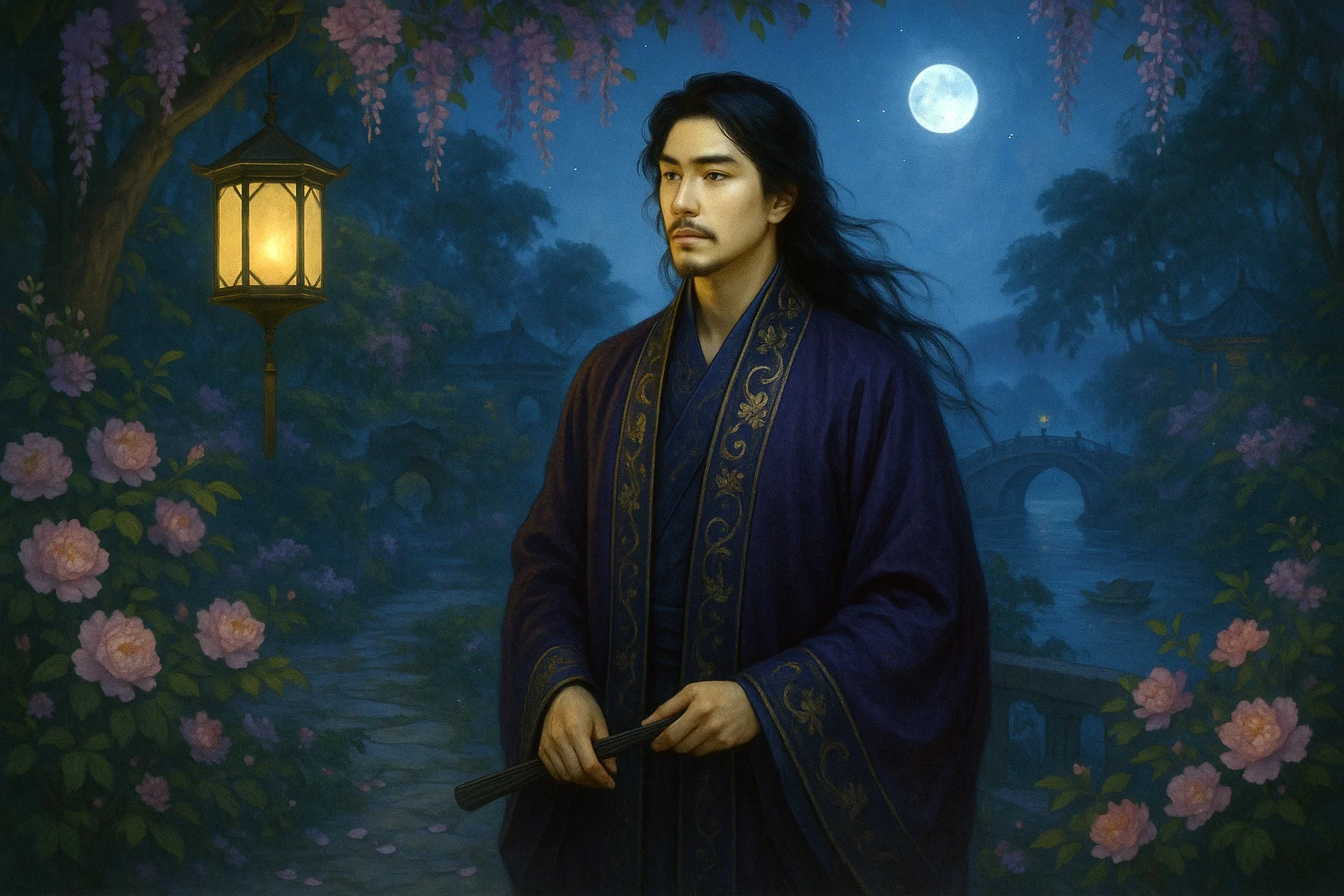
Li Shangyin (李商隐), 813 - 858 AD, was a great poet of the late Tang Dynasty. His poems were on a par with those of Du Mu, and he was known as "Little Li Du". Li Shangyin was a native of Qinyang, Jiaozuo City, Henan Province. When he was a teenager, he lost his father at the age of nine, and was called "Zheshui East and West, half a century of wandering".