
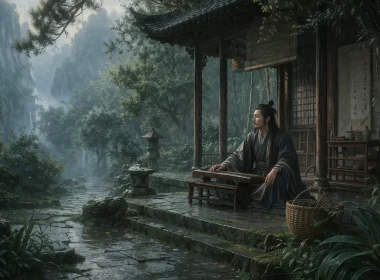
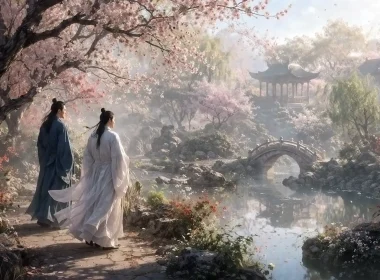
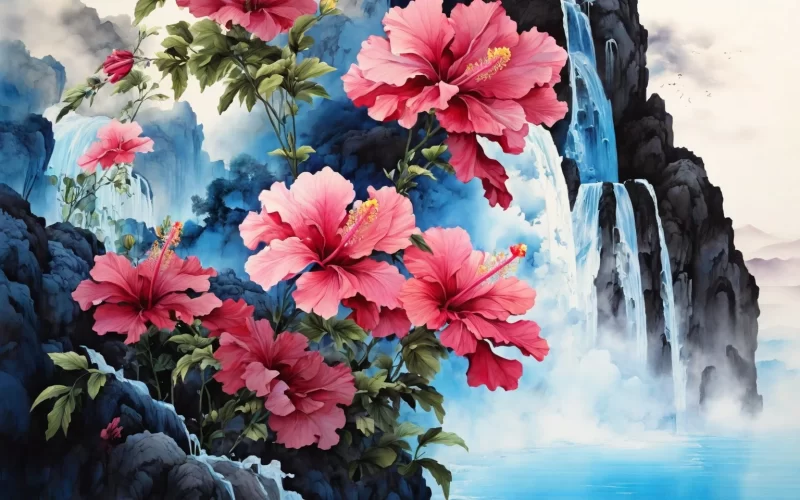
The magnolia-tipped trees,
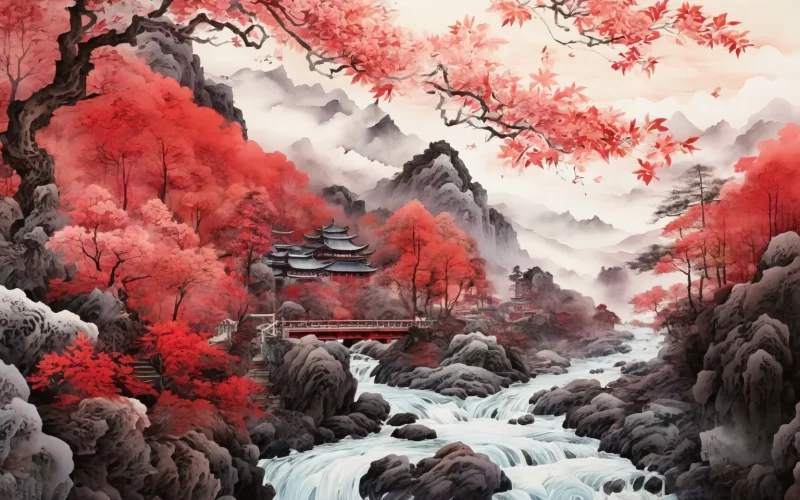
In mountains burst in flowers.
The mute brook-side house sees,
Them blow and fall in showers.
Original Poem
「辛夷坞」
王维
木末芙蓉花,山中发红萼。
涧户寂无人,纷纷开且落。
Interpretation
This poem is from Wang Wei's later compilation Wang River Collection and stands as a representative work of his landscape poetry from his period of seclusion at Wangchuan. During the Tianbao era, living a life divided between official duty and retreat at his Wang River estate in Lantian, Wang Wei, along with his friend Pei Di, composed poems celebrating twenty scenic spots around Wangchuan. This poem is one of them. It depicts the scene of magnolia blossoms blooming and falling unnoticed in a deep mountain gorge. Its language is deceptively simple, yet its conception is profoundly subtle. The poem presents not only a vivid yet utterly solitary image of mountain flowers but also condenses the aesthetic pursuit of Wang Wei's later years, which fused Chan (Zen) philosophy with poetry and painting. It stands as a paradigm of the "ethereal, serene, and secluded" mode within Tang dynasty landscape poetry.
First Couplet: 木末芙蓉花,山中发红萼。
Mù mò fúróng huā, shān zhōng fā hóng è.
Atop the branches, like lotus flowers they glow; / Deep in the mountains, red calyxes start to show.
The opening captivates with a striking image. "Atop the branches" specifies the flowers' high position, endowing the magnolias with a visual posture of standing aloof and transcendent above the forest. "Like lotus flowers" is a simile; the magnolia's form and hue resemble the lotus, cleverly evoking its lush redness and untainted, ethereal quality. "Red calyxes start to show" further focuses on the moment the buds first burst open; that dash of "red" is especially eye-catching amidst the mountain greenery. It is both a vivid splash of color and a quiet eruption of vitality. With a painter's acuity, Wang Wei seizes this visual focus of "a single spot of red amidst endless green" but places it against the vast backdrop of "deep in the mountains." The juxtaposition of brilliance and secluded depth foreshadows the turn in the following couplet.
Second Couplet: 涧户寂无人,纷纷开且落。
Jiàn hù jì wú rén, fēnfēn kāi qiě luò.
By the ravine door, stillness, nobody is there; / They bloom and fall, on their own, free of all care.
This couplet pushes the poetic realm into a state of absolute seclusion. "By the ravine door, stillness, nobody is there" conveys emptiness in both space and human affairs: the mountain ravine is remote and untrodden; the "door" that might once have housed a recluse is now utterly vacant. Within this absolute silence, only the magnolias continue to follow nature's rhythm—"They bloom and fall, on their own." The reduplicated word "fēnfēn" (here, 'on their own' implies the continuous, profuse motion) carries a dynamic, rhythmic quality, as if one can see the light, incessant process of blossoms opening and scattering. "Bloom and fall" merges the opposing states of birth and death, flourish and decay, into the same instant, revealing the intrinsic, complete cycle of life. The flowers bloom and fall, not refraining from fragrance because no one is there to admire them, nor holding themselves aloof in self-appreciation. They simply exist and change according to their own nature, embodying a cosmic rhythm that transcends human presence, autonomous and self-sufficient.
Holistic Appreciation
This is a poem imbued with Chan (Zen) spirit, one that uses splendor to convey emptiness, and dynamism to attest to eternity. Its structure is exquisite. The first couplet intensely describes the flower's "radiance" and "presence," the second intensely describes the setting's "solitude" and "emptiness." Through this strong contrast, it evokes a deeper mood where "being" returns to "non-being" and "movement" reverts to "stillness." The dazzling red magnolias are like a pebble dropped into a still, deep pool; their bright color and vital dynamism make the surrounding silence seem all the more profound and boundless. And the flowers' blooming and falling achieve their own perfection within this boundless silence, needing no audience, requiring no meaning; they are simply the direct manifestation of the Way of Nature.
In this poem, Wang Wei quietly erases the observing, lyrical "self." He is no longer an admirer or a sentimentalist but becomes a pure contemplator and presenter, letting the scene speak for itself. This "effacement of the self" in writing is a clear reflection of the influence of Chan Buddhist concepts like "non-abiding" and "no-thought." The magnolia in the poem thus transcends the typical "using an object to express an idea" of most nature poetry, becoming a symbol of the fundamental state of cosmic life—flourishing and fading of its own accord, untouched by human judgment or sentiment, completing its own brilliant yet serene rite of life within absolute stillness.
Artistic Merits
- Art of Juxtaposing Color and Space: The vivid intensity of the "red calyxes" and the secluded depth of the "deep mountains" and "ravine door" create a dual tension, visual and psychological. The bright color does not appear vulgar; instead, set against the secluded backdrop, it appears all the more pure and solitary. The secluded setting does not lapse into lifelessness; instead, touched by the bright color, it is filled with an inner vitality.
- Subtlety of Verbs and Their Philosophical Load: The verb "show" (fā) implies the burgeoning of life and the beginning of time. The reduplicated word "fēnfēn" (profusely/on their own) mimics the abundance of the floral display while subtly suggesting a natural order that is purposeless and centerless. "Bloom and fall" uses the conjunctive "and" (qiě) to place opposing processes side-by-side, revealing the Chan principle of "birth and extinction as one, the eternal within the present moment." The language is extremely simple, yet each character carries the dual function of depicting surface appearance and conveying deeper meaning.
- Layered Construction and Reversal of Mood: The space contracts layer by layer from "atop the branches" (high), to "deep in the mountains" (broad), to "by the ravine door" (secluded), finally focusing on the "flower" as the tiny yet brilliant center. The feeling shifts from the direct perception of "beauty" in the first couplet to the recognition of "solitude" in the second, accomplishing a poetic sublimation from aesthetic appreciation to spiritual insight.
- Philosophy of Dynamism within Absolute Stillness: The poem takes "stillness, nobody is there" as its backdrop, yet makes "they bloom and fall, on their own" the main visual event. This is not using motion to set off stillness, but rather revealing a philosophical view that stillness itself is the ultimate dynamic force—within the seeming emptiness of utter silence, the most essential, most vigorous cycle of flourishing and decay is actively occurring.
Insights
This work is like a clear mirror, reflecting the spiritual realm of "form itself is emptiness" in Wang Wei's late poetry. It reveals to us that the most fundamental state of life might be precisely this kind of autonomous ease: "to be yet not to possess, to act yet not to claim." The magnolia does not refrain from blooming because no one admires it, nor does it hold back from flourishing because it will eventually fall. It simply immerses itself completely in each blooming and each falling, living a life of absolute fullness within absolute stillness.
For the modern reader, this poem is a cooling balm for the soul. In an era where everyone seeks to "be seen" and "be validated," it invites us to ponder: Can we, like the mountain magnolia, rediscover a state of being unfettered by external judgment, purely following an inner rhythm, in those moments of "stillness, nobody is there"? Can we, amidst the clamor, preserve a spiritual "Magnolia Basin" for ourselves, where all "blooming" and "falling" is simply natural, simply the original face?
In just twenty characters, Wang Wei guards for us a spiritual origin point that is both silent and splendid, empty yet full. Whenever we read "they bloom and fall, on their own," we seem to momentarily detach from worldly turmoil, entering that cosmic rhythm where flowers bloom in autonomy and fall without sorrow, attaining a moment of clarity and peace. This is not only the art of poetry, but a wisdom for life.
Poem translator
Xu Yuanchong (许渊冲)
About the poet
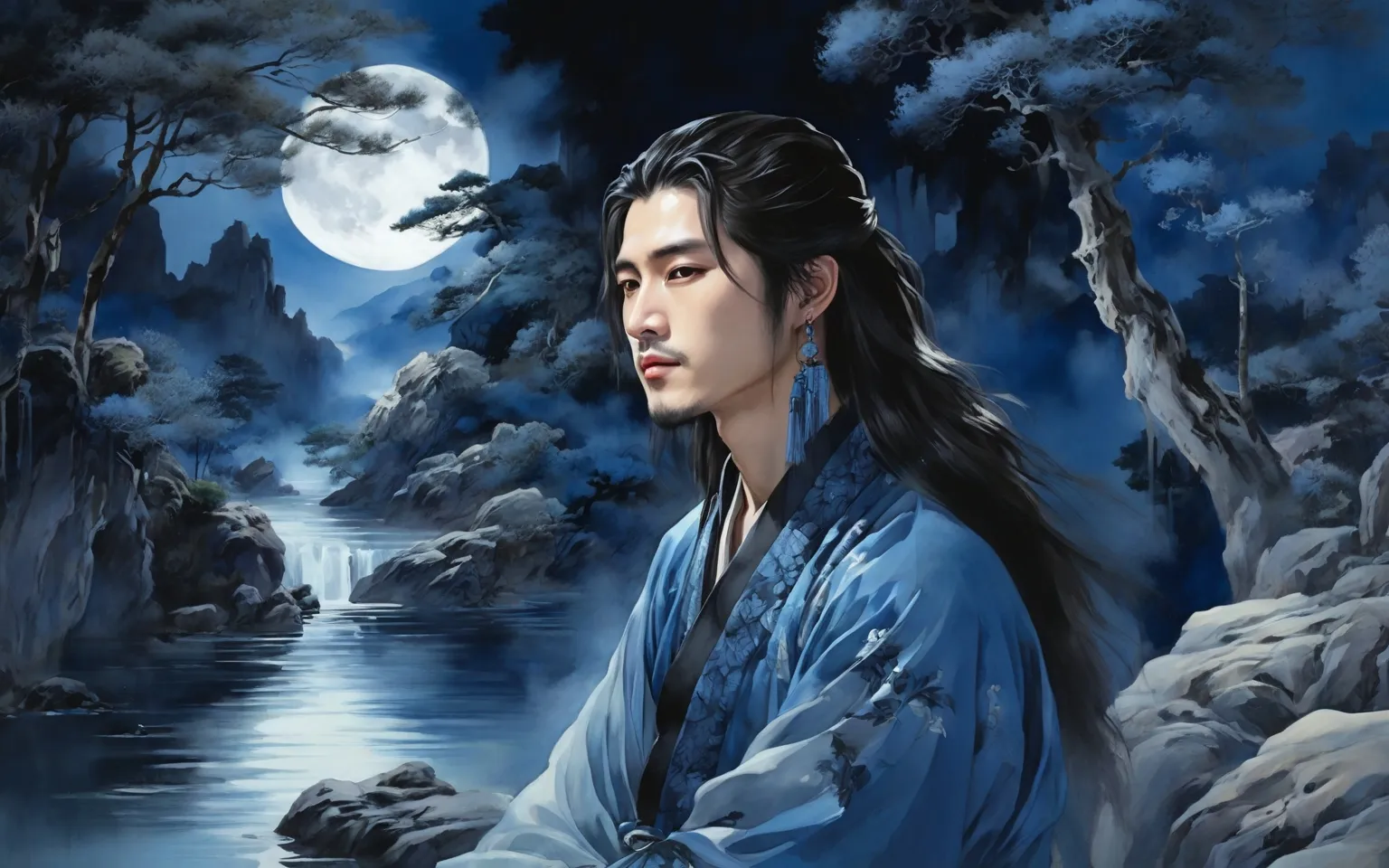
Wang Wei (王维), 701 - 761 A.D., was a native of Yuncheng, Shanxi Province. Wang Wei was a poet of landscape and idylls. His poems of landscape and idylls, with far-reaching images and mysterious meanings, were widely loved by readers in later generations, but Wang Wei never really became a man of landscape and idylls.