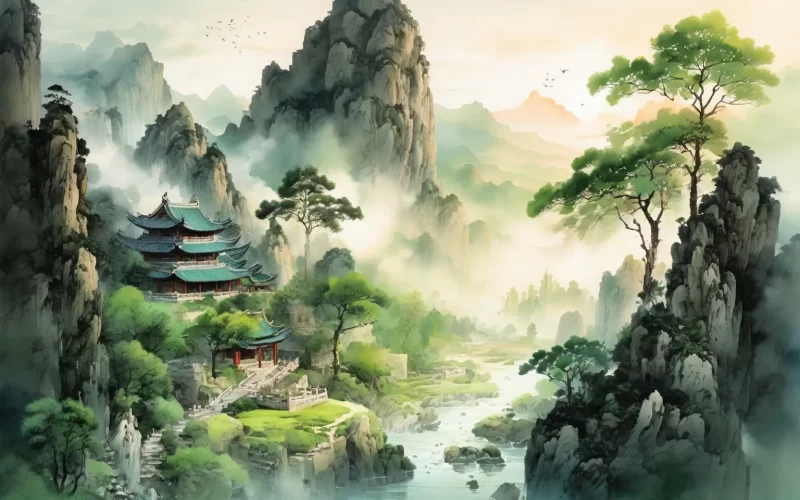

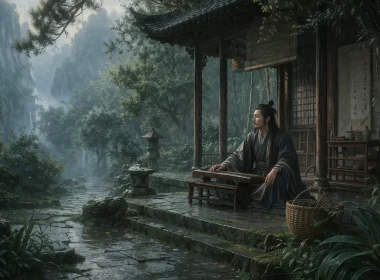
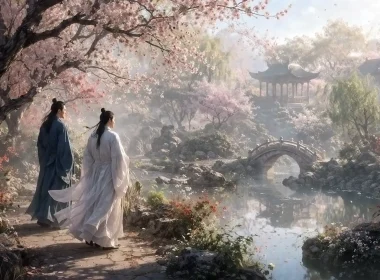
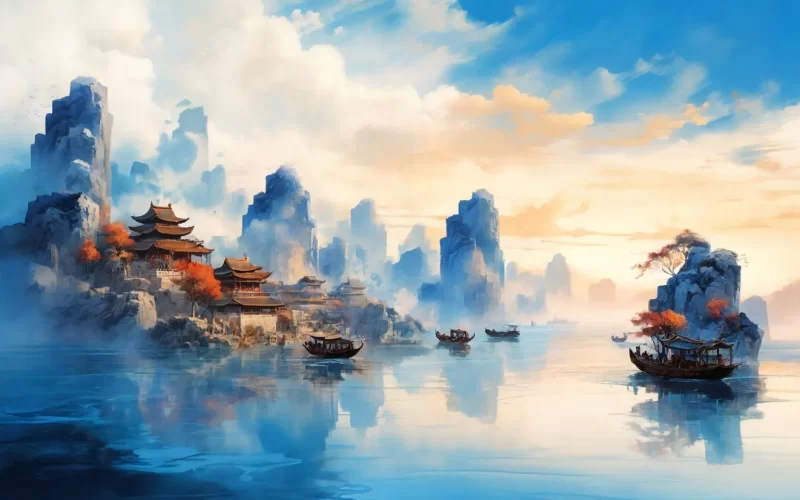
With its three southern branches reaching the borders of Chu,
And its nine tributaries linking by the gates of Jing,
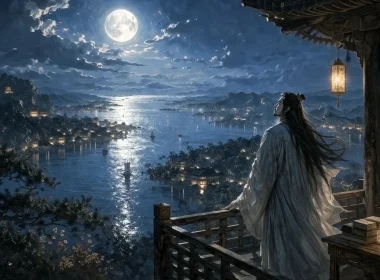
Its waters flow beyond the bounds of heaven and earth,
Where the colours of the mountains hover between being and non-being.

The towns and dwellings of men seem to float afar,
As if on the ripples of a distant, hazy sky.
Such fine days here in Xiangyang, so rich and rare,
Make even my old mountain heart drunk with delight!
Original Poem
「汉江临眺」
王维
楚塞三湘接,荆门九派通。
江流天地外,山色有无中。
郡邑浮前浦,波澜动远空。
襄阳好风日,留醉与山翁。
Interpretation
This poem is a monumental work marking a milestone in Wang Wei's landscape poetry, transitioning from serene seclusion to majestic grandeur, and from concrete depiction towards cosmic consciousness. It is also a magnificent display of his geographical vision and philosophical perspective during his prime. Composed around the time he served as a Palace Censor and was passing through Xiangyang on an inspection tour, the poet ascends the banks of the Han River. With a brush as mighty as a rafter, he fuses the actual scene before his eyes with the landscape within his mind. It not only portrays the vast geography of the Han River basin but also constructs a dynamic cosmic model that transcends visual limits, surges with unceasing motion, and interweaves the substantial and the void. It can be considered the pinnacle embodiment of the High Tang landscape aesthetic of "viewing the small from the grand, depicting stillness through motion, and revealing the void through presence."
First Couplet: 楚塞三湘接,荆门九派通。
Chǔ sāi sān xiāng jiē, Jīngmén jiǔ pài tōng.
The triple streams touch the frontier of the southern state;
Their nine tributaries wind to the city’s gate.
The opening immediately sketches, with grand geographical narrative, the Han River’s strategic position as the central hub of China's river systems and a corridor of civilization. "The frontier of Chu" and "Jingmen" are key historical and geographical coordinates. "Touch the triple streams" and "their nine tributaries wind" use the numerical vagueness ("triple," "nine" denoting multiplicity) and the powerful verbs ("touch," "wind") to imbue the river with a life force that sweeps across and connects heaven and earth. This couplet is not a static map annotation but a dynamic map of energy, establishing the poem’s majestic and boundless tone.
Second Couplet: 江流天地外,山色有无中。
Jiāng liú tiān dì wài, shān sè yǒu wú zhōng.
Its waves seem to stretch beyond the sky and earth;
Now faint, now clear, the mountain’s colors float.
This couplet is an immortal masterpiece, achieving a breathtaking leap from geographical description to philosophical contemplation. "Its waves seem to stretch beyond" is an infinite horizontal extension, challenging the boundaries of sight and imagination, placing the finite river within an infinite cosmic framework, granting it an epic sense of eternal flow. "Now faint, now clear, the mountain’s colors float" is a subtle vertical permeation, capturing the shifting presence and absence of the mountains under the effects of light and atmosphere. The words "faint" and "clear" ("you" and "wu" – presence and absence) are both a visual phenomenon and a direct reflection of the Daoist cosmic rhythm of "the mutual generation of Being and Non-Being" and the Chan Buddhist insight of "form and emptiness are not two." One "beyond" and one "within," one substantial and one void, together construct a poetic space that is both vast and subtle, both existent and transcendent.
Third Couplet: 郡邑浮前浦,波澜动远空。
Jùn yì fú qián pǔ, bō lán dòng yuǎn kōng.
The city seems to float on the water-side;
The sky is moved with waves that rise and fade.
The gaze withdraws from the extreme distance to the middle and near ground, yet subverts common sense with transcendent perception. "The city seems to float" is a visual illusion, and more so a projection of the mind’s state—when the viewer’s spirit resonates with the river, even the solid city seems to lose its weight, rising and falling with the waves. "The sky is moved with waves" goes a step further, exaggerating the river’s dynamic power to the point of shaking the firmament, achieving an energetic connection and dynamic isomorphism between "water" and "sky," "below" and "above." These two lines, with the highly dynamic verbs "float" and "moved," draw all things in heaven and earth into a vast, resonating field of life.
Fourth Couplet: 襄阳好风日,留醉与山翁。
Xiāngyáng hǎo fēng rì, liú zuì yǔ shān wēng.
O what a lovely day in this riverside town!
I’d rather stay with an old drunkard than to seek official gown.
The poem concludes with a moment filled with historical warmth and personal resolution. "O what a lovely day" is a summation and emotional transformation of the magnificent scenery described in the previous three couplets; the word "lovely" is simple yet full of admiration. "I’d rather stay with an old drunkard" skillfully employs an allusion. Shan Jian was a famous Jin dynasty official who governed Xiangyang, renowned for his hearty drinking and unrestrained nature. Through this, the poet expresses that facing such magnificent scenery, the best tribute and final recourse is to respond like Shan Jian, with "drunkenness" – a state of total immersion and aesthetic intoxication. This "drunkenness" is not passive decadence but the supreme life experience of unity between heaven and man, forgetting both self and objects. It is the spirit’s complete surrender to and fusion with sublime nature.
Holistic Appreciation
This is a "river-and-mountain rhapsody" structured like a symphony and envisioned like a cosmic scroll. The four couplets correspond respectively to "geographical breadth" (first), "cosmic distance" (second), "transformation of movement and stillness" (third), and "intoxication of heart and spirit" (fourth). Using the Han River as his axis, the poet completes a full spiritual pilgrimage from historical geography to natural philosophy, and finally to the aesthetics of life.
In this poem, Wang Wei demonstrates the dual cultivation of a High Tang literatus. On one hand, he possesses the grand geographical knowledge and historical vision seen in "The triple streams touch the frontier of Chu," reflecting the Confucian ideal of "ordering the state and bringing peace to the world." On the other, he possesses the metaphysical understanding and transcendent imagination of "Its waves seem to stretch beyond the sky and earth; / Now faint, now clear, the mountain’s colors float," deeply absorbing the essence of Daoism and Chan Buddhism. He perfectly fuses these seemingly contradictory dispositions: within the most majestic spectacle, he perceives the most subtle interplay of "presence and absence"; within the most turbulent waves, he finds the most serene resolve to "stay" and be "drunk." This realm of simultaneous grandeur and subtlety, turbulence and tranquility is precisely the unique spiritual height of Wang Wei’s landscape poetry.
Artistic Merits
- Fluid Leaps and Mastery of Scale: The poem moves freely between the watershed scale of "triple streams" and "nine tributaries," the cosmic scale of "beyond the sky and earth," the urban scale of "the city" and "the water-side," and the personal scale of "an old drunkard." This astonishing fluidity and effortless command of scale demonstrates the poet’s extraordinary ability to handle vast subjects with seemingly effortless grace.
- Tension of Verbs and the Animation of the World: "Touch" and "wind" describe the river’s connective force; "stretch" describes its eternal motion; "float" and "moved" describe its illusory power to shake the stable world (city, distant sky). Each verb is charged with tension, thoroughly transforming a static geographical picture into a dynamic world of surging, interacting energies.
- Formal Parallelism and Flowing Imagery: The first three couplets are all perfectly parallel, especially the second: "Its waves" parallels "the mountain’s colors"; "beyond the sky and earth" parallels "now faint, now clear… float." The parallelism is precise to the extreme, yet the imagery flows unceasingly, without a hint of rigidity. The juxtaposition of formal rigor and open-ended meaning creates a wonderful contrast.
- Lightness of Allusion and Deepening of Emotion: The allusion to "an old drunkard" (Shan Jian) in the final couplet is used with deft lightness, without any sense of heaviness. It echoes the regional culture of Xiangyang while also historicizing and canonizing the poet’s personal sense of intoxication, granting the present aesthetic experience a deep cultural resonance.
Insights
This work stands like a spiritual monument amidst the rivers and mountains of Tang poetry. It reveals that true "gazing into the distance" is not just the far casting of one’s eyes, but the expansion of the mind and the flight of the spirit. When our vision can reach "beyond the sky and earth" and our perception can be as subtle as discerning "now faint, now clear," we can then, within our finite lives and geography, apprehend the infinite意境 of the cosmos.
In a contemporary age of information explosion yet narrowed perspectives, material abundance yet dulled senses, this poem invites us to relearn the art of "gazing from a height": to feel, not just with our eyes but with our whole being, how the world’s "waves" can "move the distant sky"; to experience how the "city" seems to "float" upon the "water-side" amidst the tides of our times. More importantly, it reminds us that amidst hurried journeys and weighty tasks, we must not forget to find our own "lovely day" and dare to "stay" and be "drunk" for it—that total immersion in beauty, in the present moment, in resonance with higher value—which may be the very antidote to the fragmentation of life and the nihilism of meaning.
Wang Wei’s Han River flows not only through Hubei but should also flow through the inner landscapes of all souls who yearn to face the world with an open heart and life with a profound, intoxicating embrace.
Poem translator
Kiang Kanghu
About the poet
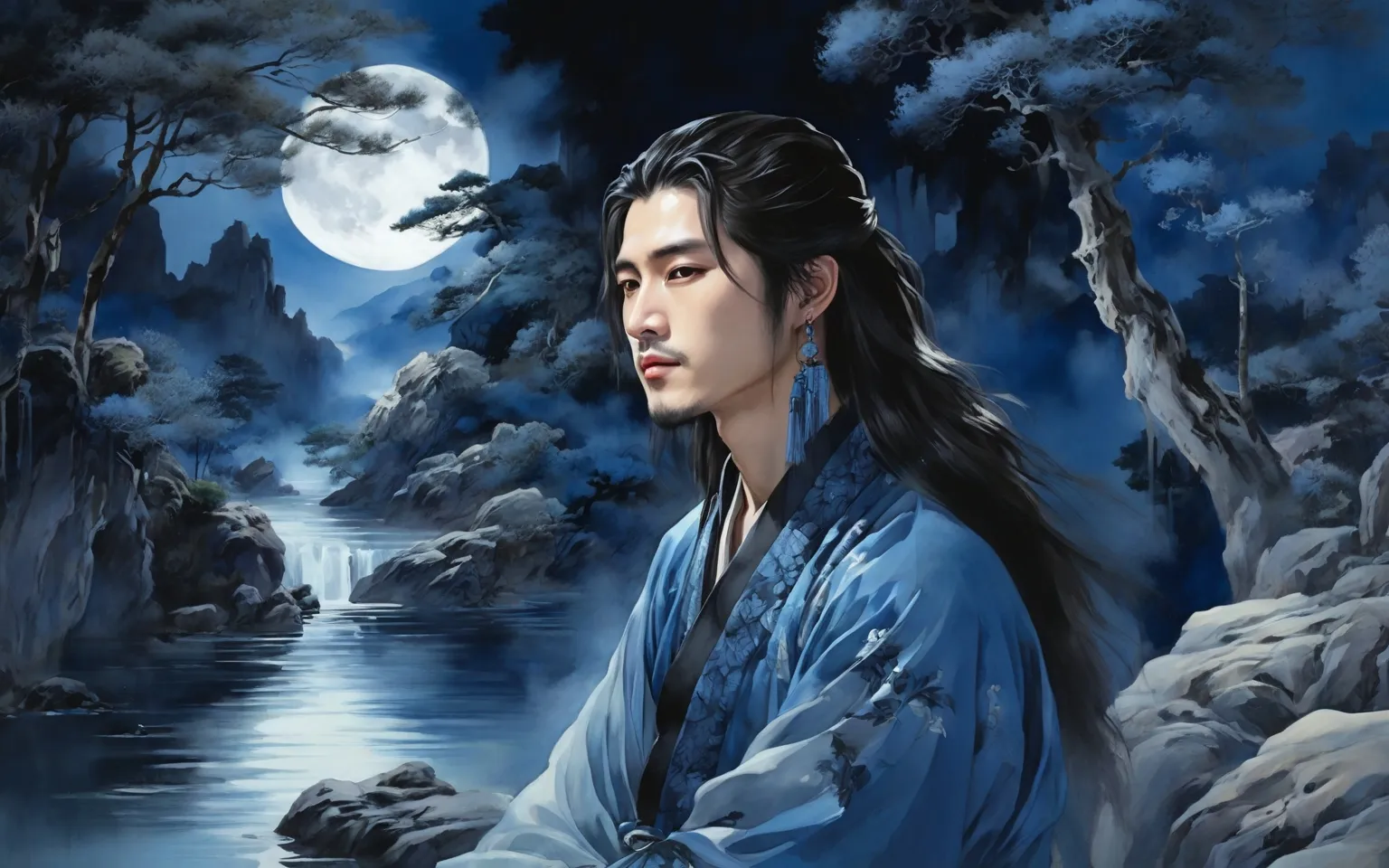
Wang Wei (王维), 701 - 761 A.D., was a native of Yuncheng, Shanxi Province. Wang Wei was a poet of landscape and idylls. His poems of landscape and idylls, with far-reaching images and mysterious meanings, were widely loved by readers in later generations, but Wang Wei never really became a man of landscape and idylls.