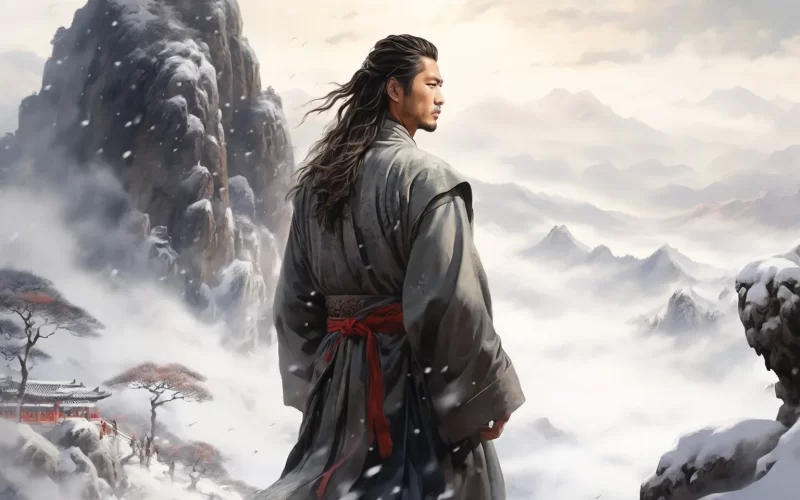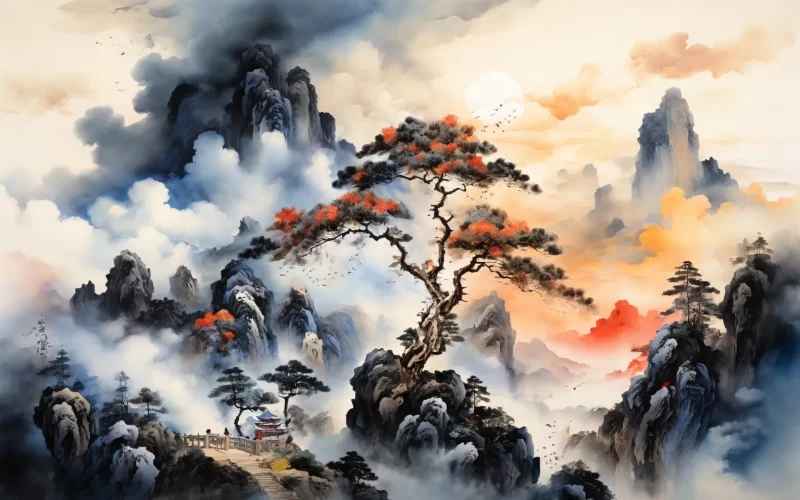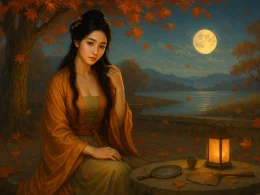

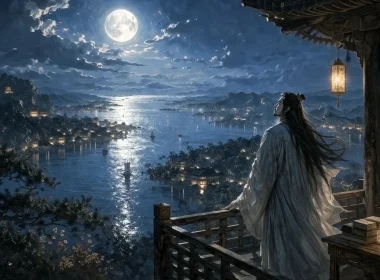
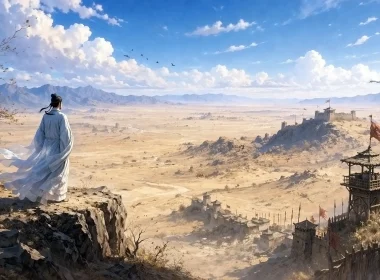
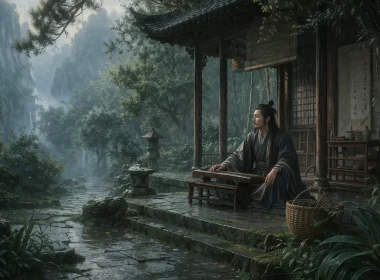
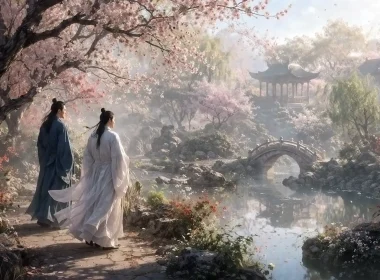
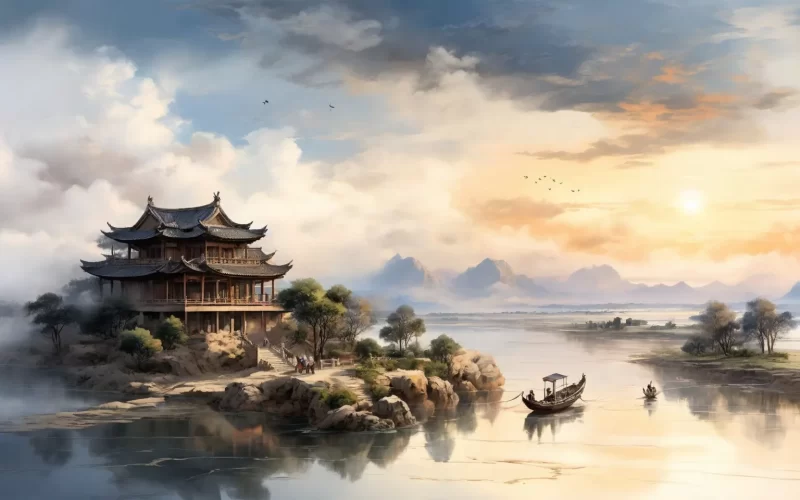
Where long ago a yellow crane bore a sage to heaven,
Nothing is left now but the Yellow Crane Terrace.
The yellow crane never revisited earth,
And white clouds are flying without him for ever.

...Every tree in Hanyang becomes clear in the water,
And Parrot Island is a nest of sweet grasses;
But I look toward home, and twilight grows dark
With a mist of grief on the river waves.
Original Poem
「黄鹤楼」
崔颢
昔人已乘黄鹤去,此地空余黄鹤楼。
黄鹤一去不复返,白云千载空悠悠。
晴川历历汉阳树,芳草萋萋鹦鹉洲。
日暮乡关何处是?烟波江上使人愁。
Interpretation
"The Tellow Crane Terrace" is a representative work by the Tang poet Cui Hao, composed during his visit to the tower. Located in present-day Wuhan, Hubei Province, the tower was first built during the Three Kingdoms period and has long been a site where literati would ascend to compose poetry. It is surrounded by numerous legends, the most famous being that of the immortal Zi An, who is said to have ridden a yellow crane from this tower into the heavens, imbuing the place with a divine aura. Ascending the tower and gazing into the distance, Cui Hao was stirred by the view. He reflected on figures of the past, lamented the passage of time, and expressed a deep longing for home. The poem masterfully blends scene and emotion, making it a renowned masterpiece among Tang poems of historical reflection and nostalgia.
This poem emerged from a profound spiritual experience of the young Cui Hao during the High Tang era's culture of travel, arriving at a significant geographical and cultural node on the Yangtze River. The Yellow Crane Tower he ascended was no longer merely an architectural structure; it was a "summit of meaning" fused with memories of the Three Kingdoms period, legends of crane-riding immortals, and literary inscriptions from past dynasties. When the poet's personal mood of wandering in pursuit of official career met the vast river scene at dusk—a view layered upon the deep sense of time and history embodied by the tower—it naturally evoked a universal contemplation surpassing mere personal sorrow: an inquiry into the eternal versus the transient, and the celestial realm versus the human world. The poem's form, with its majestic spirit that loosely follows but is not rigidly bound by the conventions of the seven-character regulated verse, is itself a poetic expression of the cultural confidence and creative vitality of the High Tang.
First Couplet: "昔人已乘黄鹤去,此地空余黄鹤楼。"
Xīrén yǐ chéng huánghè qù, cǐ dì kōng yú huánghè lóu.
The sage on yellow crane was gone amid clouds white. / What is left here is but the empty Yellow Crane Tower.
The opening couplet immediately merges myth with the physical scene, where the tower's immortal aura coexists with the forlorn emptiness left behind. The ancient sage's departure on the crane gave the tower its name but also left it with an untouchable, divine melancholy. By invoking this story, the poet establishes the emotional tone for the reflection on the past that follows.
Second Couplet: "黄鹤一去不复返,白云千载空悠悠。"
Huánghè yī qù bù fù fǎn, báiyún qiānzǎi kōng yōuyōu.
The yellow crane, once it is gone, will ne'er on earth alight; / Only white clouds still float in vain from year to year in flight.
This couplet deepens the sentiment of time's relentless passage and the permanence of change. The yellow crane is gone forever, leaving only the endless, drifting white clouds—a vast solitude stretching across the ages. This is a lament not only for the tower's history but also for the transience of human life and the impermanence of all worldly things.
Third Couplet: "晴川历历汉阳树,芳草萋萋鹦鹉洲。"
Qíng chuān lìlì Hànyáng shù, fāngcǎo qīqī Yīngwǔ zhōu.
By sunlit river trees can be count'd one by one; / On Parrot Islet sweet green grass grows fast and thick.
The vista opens up here, presenting a clear and tangible view. Under the bright sky, the trees of Hanyang on the far bank and the lush grasses of the nearby Parrot Islet are distinctly visible, creating a vivid and vibrant picture that sets the stage for the climactic expression of homesickness.
Fourth Couplet: "日暮乡关何处是?烟波江上使人愁。"
Rìmù xiāng guān héchù shì? Yānbō jiāng shàng shǐ rén chóu.
When will my homeland vanish from my sight, I care? / The mist-veiled waves of River make me homesick and sad.
As evening descends, the poet, gazing from the tower, is spontaneously overcome by homesickness. The vast, mist-covered Yangtze is both a natural spectacle and a vessel for his longing. The interplay of the setting sun and the distant homeland, the misty waves and parting sorrow, brings the poem's emotion to its peak, leaving a resonant, lingering effect.
Holistic Appreciation
Cui Hao's poem is a classic of the "ascending-a-height-and-pondering-the-past" genre. From the tower, the poet surveys historic sites and the boundless river, while the immortal legends add a layer of mystique. The first couplet contrasts myth with the tangible, empty tower, creating an atmosphere of "divine aura and human absence." The second uses the eternal white clouds against the departed crane to symbolize the flow of time and evoke historical profundity. The third paints a bright, expansive scene of trees and grass. The final couplet expresses the surge of homesickness at dusk, with sorrow rising amidst the misty waves, culminating the personal emotions stirred by the ascent.
The poem's language is clear and flowing, its conception lofty and expansive. It possesses both the ethereal beauty of an immortal realm and the grandeur of the real landscape, seamlessly blending scene and emotion, the imagined and the real. It captures the complex state of mind of gazing into the distance from a height. Leaning on the railing, the poet's thoughts travel across millennia; reflecting on past and present, contemplating homeland and nation, and projecting his nostalgia, the poetic sentiment flows naturally with a vitality that seems innate.
Artistic Merits
- Integration of the Imagined and the Real, Fusion of Scene and Emotion: The poem skillfully interweaves the tower's legends with the actual view. The departed immortal and crane, the eternally drifting clouds, the sunlit river and lush islet, and the misty waves all echo and enhance one another, masterfully blending illusion and reality.
- Layered Progression, Rich Emotional Depth: From the melancholy of the empty tower, to the contemplation of time evoked by the clouds, to the realistic scenery, and finally to the homesickness in the evening mist, the emotional thread is clear and powerfully layered, advancing step by step.
- Vernacular yet Profound Language, Far-reaching Conception: The diction is simple and natural, seemingly artless, yet it integrates historical vicissitudes, the feelings evoked by the ascent, and the pains of nostalgia into a seamless whole where scene and emotion are fused, leaving an endless aftertaste. It is this seemingly plain expression that achieves the work's profound and lasting artistic conception.
- Balanced Parallelism with Flexible Syntax: Though a seven-character regulated verse, it does not rigidly adhere to formal parallelism. Instead, it unfolds naturally, using scenery to convey emotion with a smooth and coherent flow, showcasing the poet's distinctive creative style.
Insights
The enduring power of this poem lies in its precise capture of a universal human "intermediate state"—neither pure nostalgia for the past nor simple homesickness, but an awakening to one's own place within the continuum of time and space, triggered in the moment of ascending to a height and gazing afar. This offers a profound revelation for us today. In modern society, we are often consumed by immediate anxieties, losing connection with vaster spans of time and space. This poem reminds us of the need to occasionally create our own "tower-ascending moment"—to actively seek a physical or spiritual vantage point for contemplation. This gaze looks back into the depths of history (the crane, the clouds) and opens out to the surrounding world (the clear river, the lush grass), ultimately leading to a clearer awareness of one's own origins and destination (the homeland gate, the misty waves). It is a ritual that lifts the individual from daily trivialities and places them under the contemplation of heaven, earth, and flowing rivers.
The contrast between "the yellow crane, once gone" and the clouds that "float in vain from year to year" reveals a root of modern anxiety: in a pursuit of instant efficiency and results, we have lost our sensitivity to and reverence for the slow, "vain floating" passage of time. The poem teaches us to appreciate a value in "emptiness" or "in vain"—not nihilism, but the space that accommodates change and allows meaning to settle. The tower "left empty," the clouds floating "in vain"—precisely because of their "emptiness" or "vainness"—carry millennia of legend and sorrow, allowing for infinite spiritual travel.
Ultimately, the "sad" or "homesick" sorrow of "The mist-veiled waves of River make me homesick and sad" is far from simple melancholy. It is a profound attitude born from recognizing life's finitude and the obscure vastness of one's return, yet still choosing to gaze and question. It is a refined emotion, distinct from dejection because it contains a tremor for beauty (the beauty of the misty waves), and distinct from resolution because it maintains an open-ended pensiveness. In today's pursuit of certainty and "positive energy," this complex yet sincere "sorrow" is perhaps a precious poetic quality and honesty we should preserve when confronting life's essence.
This poem stands like a spiritual tower on the horizon of every age. It tells us that no matter how technology changes, certain needs of the human heart remain constant: we need legends to transcend the ordinary, need landscapes to settle our present, and also need that wisp of light sorrow like misty waves to connect our finite lives with the infinite starry sky.
Poem translator
Kiang Kanghu
About the poet
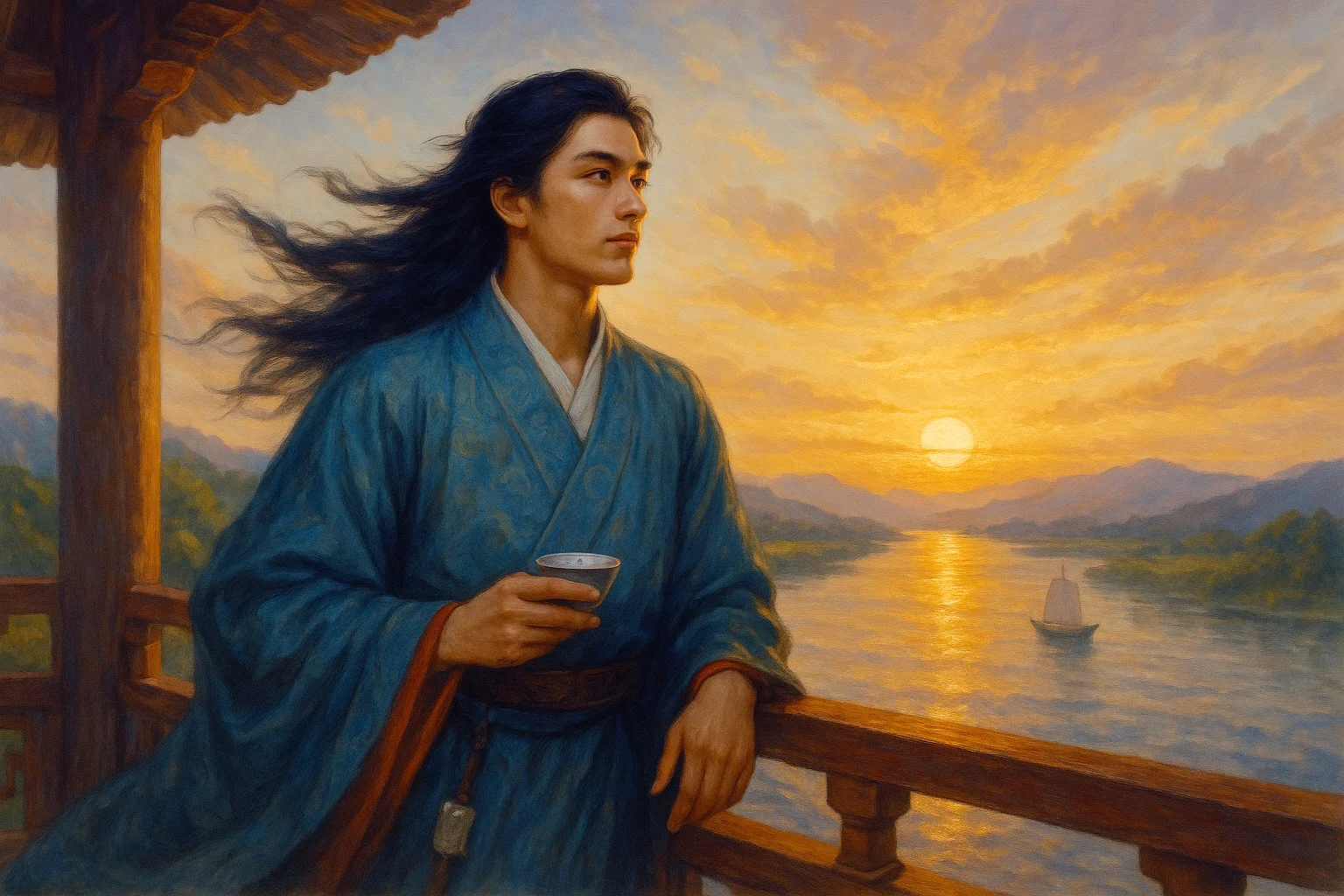
Cui Hao (崔颢), A.D. ? – 754, a native of Kaifeng, Henan Province. He was admitted as a scholar in 723 AD. At that time, Cui Hao was well known, along with Wang Changling, Gao Shi, Meng Haoran, and Wang Wei.