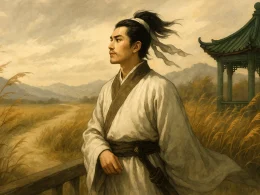

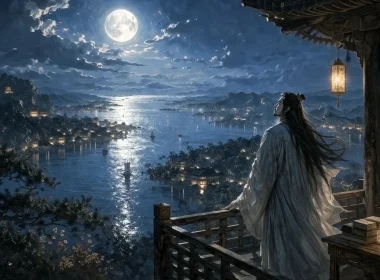
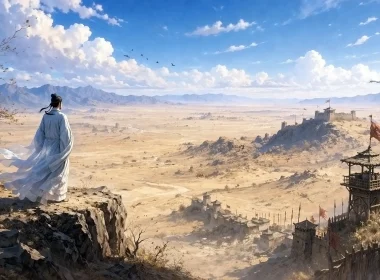
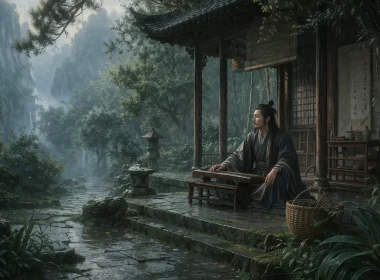
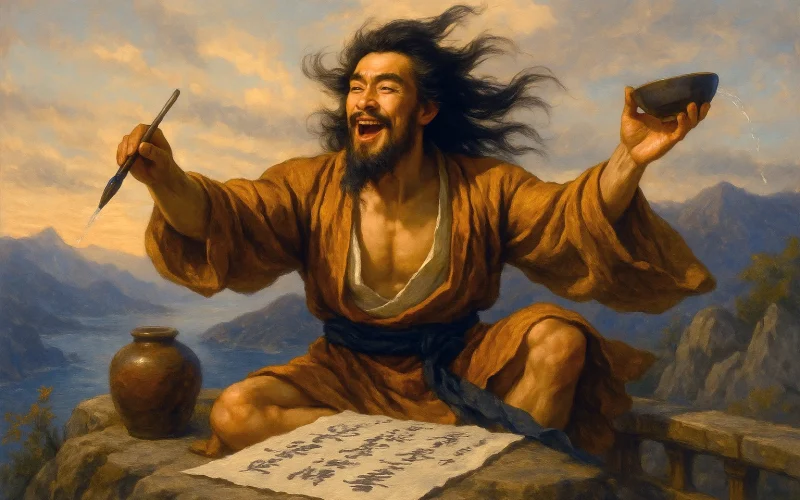
Zhang Xu (张旭 c. 675 – c. 750), a native of Suzhou, Jiangsu Province, was a renowned calligrapher and poet of the High Tang period. Born in the Early Tang but active during the High Tang, he was unrivaled in cursive calligraphy. His personality was wild and unrestrained, and he was famously addicted to wine. He often wielded his brush with great speed after drinking, sometimes even dipping his hair in ink. His contemporaries called him “Madman Zhang,” and Du Fu listed him as one of the “Eight Immortal Drinkers.” Although his poetic achievements were overshadowed by his fame in calligraphy, his poetry still embodies the spirit of the High Tang. His artistic hallmark lies in the “unity of calligraphy and poetry,” both distinguished by a seamless flow of energy and an untrammeled natural elegance.
Major Works


Life
Zhang Xu was born into a family of officials. His mother, née Lu, was the niece of the renowned calligrapher Lu Jianzhi, and thus the granddaughter of Yu Shinan. The Lu family had been famous for calligraphy for generations, and Zhang Xu received an excellent education in the art from an early age. In his youth, he studied under such masters as Zhang Fang and Lu Yanyuan, laying a solid foundation for his later work.
Historical records of Zhang Xu's life are relatively brief. He entered official service around the time of Empress Wu Zetian, serving as Magistrate of Changshu County. While in Changshu, an elderly man repeatedly brought trivial lawsuits before him. Zhang Xu, growing impatient, reprimanded him. The old man replied, "I am not here for the lawsuit, but because I admire your calligraphy and hope to obtain more of your works." Deeply moved by this, Zhang Xu brought out all his calligraphic works to share with the old man. This story became widely known, illustrating that Zhang Xu's calligraphy was already renowned at the time.
Thereafter, Zhang Xu held positions such as Senior Scribe of the Left Guard and Senior Scribe of the Golden Guard, hence he is known to posterity as "Senior Scribe Zhang." However, his official career was not successful; he never held high office. His main energy was devoted to the art of calligraphy and the composition of poetry.
Zhang Xu had an uninhibited and unrestrained personality and was an ardent lover of wine. He was counted among the "Eight Immortals of the Wine Cup" together with Li Bai, He Zhizhang, Li Shizhi, Li Jin, Cui Zongzhi, Su Jin, and Jiao Sui. Du Fu, in his "Song of the Eight Immortals of the Wine Cup," described his drunken state: "张旭三杯草圣传,脱帽露顶王公前,挥毫落纸如云烟." He often practiced calligraphy while drunk, wild and uninhibited, his brush moving across the paper like shifting clouds and mist, earning him the nickname "Madman Zhang." It was precisely in this state of "madness" that his cursive script reached its sublime and transcendent level.
Zhang Xu's cursive script was renowned for its wildness, yet he himself said, "吾书虽狂,然点画之间,皆有法度,非孟浪也." He studied the styles of Zhang Zhi and Wang Xizhi and Wang Xianzhi, but also developed his own unique approach, elevating cursive script to new heights. His cursive writing is like dragons and serpents dancing, with a powerful, sweeping momentum, praised as "as unpredictable as ghosts and spirits, impossible to fathom."
Zhang Xu had close associations with many literary figures of his time. Together with He Zhizhang, Bao Rong, and Zhang Ruoxu, he was known as one of the "Four Scholars of Wu," enjoying great fame in the literary circles of Jiangnan. He also had many interactions with Li Bai, Du Fu, Gao Shi, Wang Wei, and others. It is said that Li Bai studied calligraphy with him, and Du Fu held his cursive script in the highest esteem.
Around the ninth year of the Tianbao era (750 AD), Zhang Xu died of illness in Chang'an. His cursive script art had an extremely profound influence on later generations. Yan Zhenqing twice resigned from office to travel specifically to learn calligraphy from him; Huaisu's wild cursive style was also deeply influenced by him. He was venerated by later generations as the "Sage of Cursive Script," standing alongside Wang Xizhi, the "Sage of Calligraphy," as two unassailable peaks in the history of Chinese calligraphy.
Stylistic Characteristics
Zhang Xu's literary achievements are mainly reflected in his poetry. Only six of his poems survive, but each is a masterpiece. His poetry excels in the seven-character quatrain, characterized by a fresh, natural style and a profound, distant conception, establishing a unique presence in the High Tang literary scene.
Poetic Style
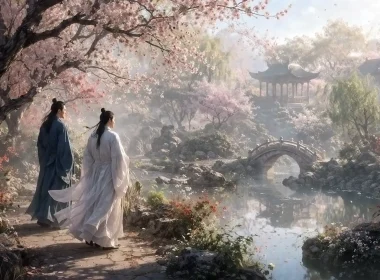
Although Zhang Xu's poetry is limited in quantity, its quality is exceptionally high. His poems primarily focus on landscapes and pastoral scenes, excelling at capturing subtle changes in natural scenery and creating profound, far-reaching conceptions through fresh, natural language.
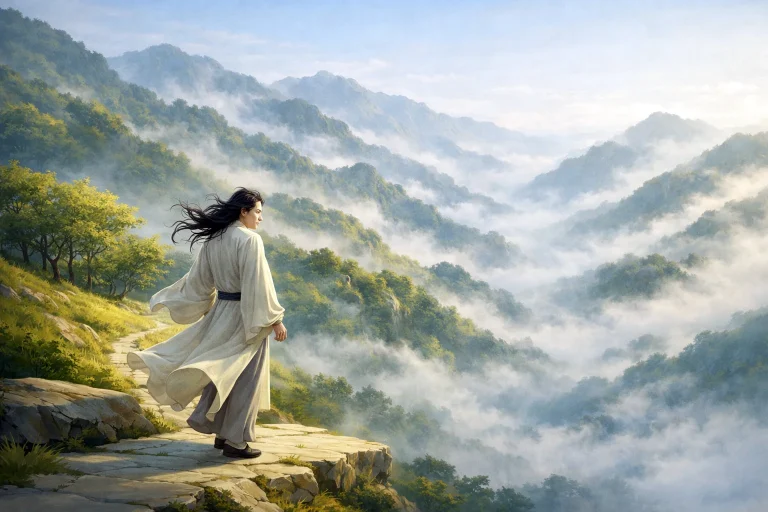
For example, in "Peach Blossom Stream" (桃花溪), the lines "桃花尽日随流水,洞在清溪何处边" use the image of peach blossoms floating on the stream to express a longing for the utopian Peach Blossom Spring. The language is concise, and the conception is ethereal. Similarly, in "Detaining a Guest in the Mountains" (山中留客), the line "纵使晴明无雨色,入云深处亦沾衣" uses the detail of clothing becoming damp even without rain to convey the depth and moisture of the mountains—subtle and evocative, inviting reflection.
His poetic style is similar to that of landscape and pastoral poets like Wang Wei and Meng Haoran, yet it has its own unique characteristics. Wang Wei's poetry infuses Chan (Zen) elements, creating an ethereal and distant quality; Meng Haoran's poetry is known for its fresh naturalness and simple sincerity; Zhang Xu's poetry lies somewhere between the two, combining Wang Wei's ethereality with Meng Haoran's freshness, while also incorporating the freedom and boldness of his calligraphic art.
Intrinsic Connection with Calligraphy
Zhang Xu's poetry has an intrinsic connection with his calligraphic art. His cursive script is famous for its wildness, but his poetry is known for its fresh elegance. This may seem contradictory, but in fact it is unified. Both reflect Zhang Xu's pursuit of "naturalness"—in calligraphy, he pursued "natural, uncontrived expression," and in poetry, he pursued "freshness and naturalness."
Du Fu, in his "Song of the Eight Immortals of the Wine Cup," described Zhang Xu's calligraphy as "挥毫落纸如云烟." This state of creative flow, where the brush moves with ease and the work emerges in one breath, is also reflected in his poetry. His poems are similarly unadorned and undecorated, using natural language to depict natural scenes, reading as smoothly as flowing clouds and water.
Literary Influence
Zhang Xu occupies an extremely important position in the history of Chinese culture. As both the "Sage of Cursive Script" and a poet, his influence spans the two realms of calligraphy and poetry.
Calligraphic Achievements and Influence as the "Sage of Cursive Script"
Zhang Xu is one of the greatest cursive calligraphers in Chinese history, venerated by later generations as the "Sage of Cursive Script." His cursive script, renowned for its wild, unrestrained power and sweeping momentum, pushed the lyrical and expressive qualities of cursive calligraphy to their utmost limits. He studied the styles of Zhang Zhi and the Two Wangs, yet developed his own unique "wild cursive" style.
His calligraphy had an extremely profound influence on later generations. Yan Zhenqing twice resigned from office to travel specifically to learn calligraphy from him, acquiring his brush techniques and becoming a master in his own right. Huaisu's wild cursive style was also deeply influenced by him; the two are often mentioned together as "颠张醉素." Great Song dynasty calligraphers such as Su Shi, Huang Tingjian, and Mi Fu all drew inspiration from Zhang Xu's cursive script. Even today, Zhang Xu's cursive works remain models for calligraphy enthusiasts to study.
Cultural Symbol of the "Eight Immortals of the Wine Cup"
Zhang Xu is one of the figures depicted in Du Fu's "Song of the Eight Immortals of the Wine Cup." His image—"脱帽露顶王公前,挥毫落纸如云烟"—has become a classic representation of the "eccentric scholar" in Chinese cultural history. His uninhibited drinking and unrestrained demeanor, shared with Li Bai, He Zhizhang, and others, came to symbolize the spirit of High Tang literati.
Literary Status as One of the "Four Scholars of Wu"
Zhang Xu, together with He Zhizhang, Bao Rong, and Zhang Ruoxu, was known as one of the "Four Scholars of Wu," enjoying great fame in the literary circles of Jiangnan. All four were renowned for their literary talent and shared a bold, uninhibited nature. Among them, Zhang Ruoxu became famous for his single masterpiece "春江花月夜," He Zhizhang is remembered for "咏柳" and "回乡偶书," and Zhang Xu is known for his quatrains such as "桃花溪" and "山中留客." Together, they represented the literary achievements of Jiangnan literati during the High Tang.
Classic Status of His Poetry
Although Zhang Xu's surviving poems are few, pieces such as "桃花溪" and "山中留客" are among the finest Tang quatrains, recited throughout the ages. "桃花溪," set against the backdrop of the Peach Blossom Spring, expresses a longing for an ideal world, with an ethereal conception and an enduring aftertaste. "山中留客," with its detail of clothing becoming damp, conveys the depth and moisture of the mountains—subtle and evocative, inviting reflection. These poems, like the landscape and pastoral works of Wang Wei and Meng Haoran, form an important part of High Tang poetry.
In summary, Zhang Xu was a renowned calligrapher and poet of the High Tang dynasty. His greatest achievement was in cursive script; he was venerated by later generations as the "Sage of Cursive Script." His wild cursive art had a profound influence on Yan Zhenqing, Huaisu, and subsequent calligraphers. Although only a few of his poems survive, pieces such as "桃花溪" and "山中留客" are among the finest Tang quatrains, celebrated for their freshness, naturalness, and profound, distant conception. He was the eccentric scholar in Du Fu's "Song of the Eight Immortals of the Wine Cup," whose brush flew like "挥毫落纸如云烟," and also one of the "Four Scholars of Wu," a man of dual genius in poetry and calligraphy. His character and his art, even after a thousand years, still allow us to imagine his uninhibited, bareheaded demeanor and the sublime artistic realm he achieved with his brush.